Free Vertical Addition (1 – 10) Printable Worksheets
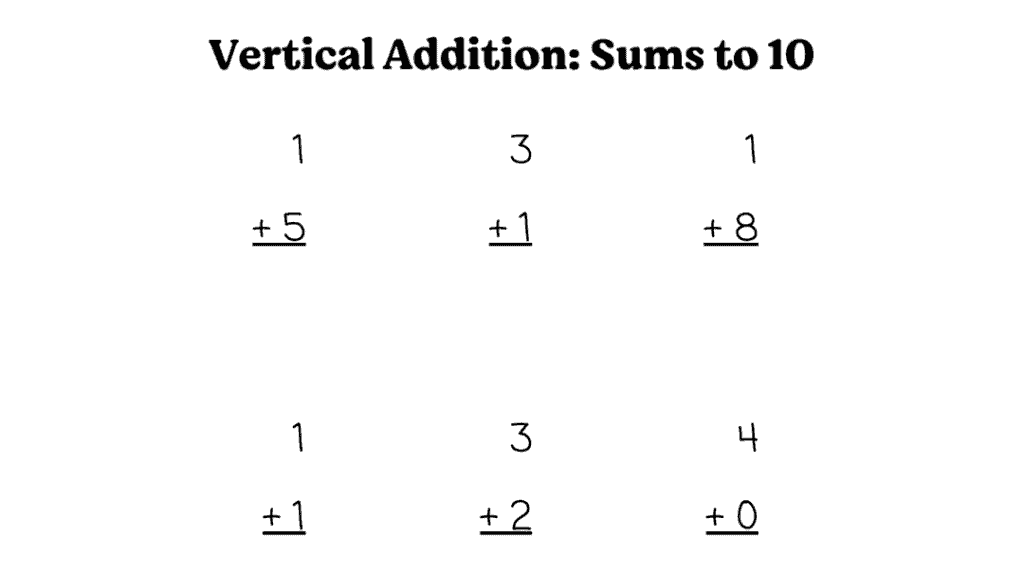
Free vertical addition worksheets for kindergarten. Practice column-style math that prepares your child for place value and multi-digit addition.

Free vertical addition worksheets for kindergarten. Practice column-style math that prepares your child for place value and multi-digit addition.
The posts you requested could not be found. Try changing your module settings or create some new posts.
Our kindergarten addition worksheets help young learners discover how numbers work together through simple, clear problems. With varied formats and visual support, children build a strong foundation in addition while developing confidence and problem-solving skills at their own pace.
Addition helps children understand how numbers relate to each other and connects math to everyday life. When kids learn to add, they build thinking skills that go far beyond memorizing facts. They learn to observe, question, and solve problems they encounter naturally, like figuring out how many toys they have altogether or how many crackers everyone needs at snack time.
These early experiences with numbers build curiosity about how things work and give children tools to make sense of the world around them.
Every child’s math journey looks different. Some kindergartners dive into addition early, while others need more time exploring counting and quantities. Your child might be ready if they can count objects to 10, recognize some written numbers, or show interest in combining groups of things during play.
That said, readiness is not a strict checklist. If your child is curious about numbers, that is enough to start exploring together, even if they are still developing other skills.
Start wherever feels natural for your child. Most kindergartners benefit from touching and moving real objects (toys, snacks, blocks) before working with numbers on paper. Physical materials make addition visible and concrete, helping children understand that addition means combining groups.
Worksheets work best as a next step once your child has explored addition through hands-on activities. Some children enjoy worksheets right away; others need more time with objects. Follow your child’s lead.
The best practice does not feel like practice at all. Weave addition into daily moments: count apple slices at snack time, add toy cars during play, or combine building blocks while constructing together. When your child asks questions like “How many do we have now?” you are naturally practicing addition.
Use worksheets for 5 to 10 minutes a few times a week if your child enjoys them, but do not push. Math learning happens through play, conversation, and everyday problem-solving just as much as through formal practice.
Confusion is part of learning, not a sign something is wrong. If your child struggles, step back to hands-on activities with objects they love. Some children need weeks or months of concrete practice before abstract number work makes sense.
Take breaks when frustration builds and return when your child is curious again. There is no rush. Kindergarten math is about exploration and building positive feelings about problem-solving, not mastering specific skills on a timeline.
Yes. Fingers are a smart, built-in tool that helps children visualize and solve problems. Using fingers shows mathematical thinking, your child is using a strategy to figure out an answer. Most children naturally move away from finger counting as number relationships become more familiar, but there’s no need to discourage this helpful approach.
Celebrate any method your child uses to solve problems. The goal is building number sense, not speed.
Follow your child’s interests. Turn problems into stories about their favorite characters, use colorful materials, act out equations with toys, or let them teach addition to a stuffed animal. Some children love worksheets; others prefer games, songs, or building with blocks.
Pay attention to what sparks your child’s curiosity and build from there. When learning connects to what they already love, math becomes something they want to explore rather than something they have to do.