Free Vertical Subtraction (1 – 10) Printable Worksheets
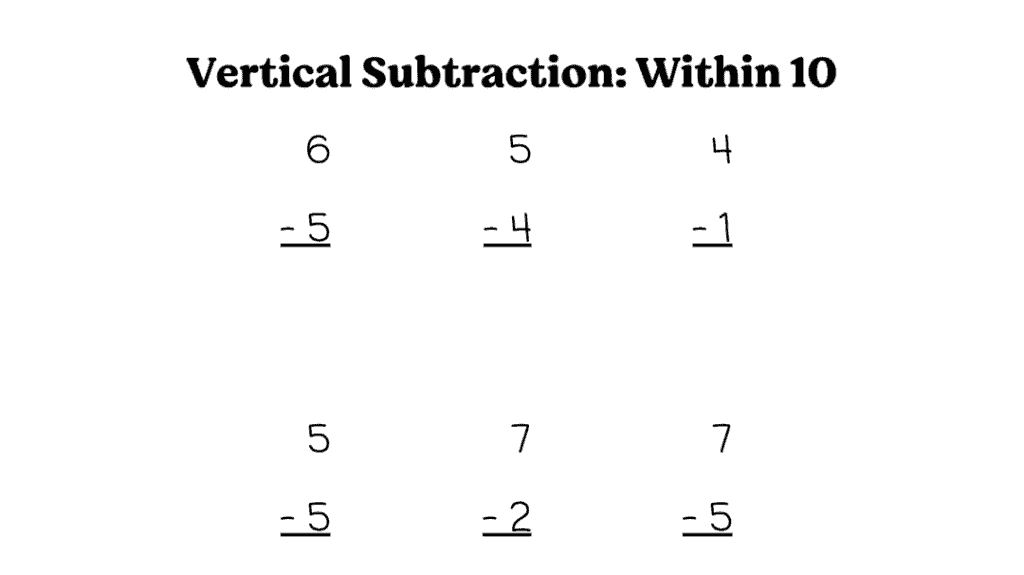
Free vertical subtraction worksheets for kindergarten. Help your child practice column-style "taking away" with organized, visual problems.

Free vertical subtraction worksheets for kindergarten. Help your child practice column-style "taking away" with organized, visual problems.
The posts you requested could not be found. Try changing your module settings or create some new posts.
Our kindergarten subtraction worksheets help young learners explore what happens when groups get smaller. With clear visuals and simple problems, children develop their understanding of subtraction while building problem-solving skills and mathematical confidence at their own pace.
Subtraction helps children understand that numbers can get smaller and that we can compare quantities to find differences. When kids learn to subtract, they develop thinking skills that connect to everyday situations, like figuring out how many cookies are left after eating some or how many more blocks they need to match a friend’s tower.
These experiences help children see math as a tool for understanding the world around them, not just abstract symbols on paper. Early subtraction work builds flexibility with numbers and deepens their overall number sense.
Most children are ready to explore subtraction after they are comfortable counting and have some experience with addition. Your child might be ready if they can count backwards from 10, understand the idea of “more” and “less,” or notice when groups of things get smaller during play.
That said, readiness is not rigid. If your child shows curiosity about what happens when you take things away, that is enough to start exploring together. Some children grasp subtraction quickly, while others need more time seeing it happen with real objects before working with numbers on paper.
The most effective practice happens naturally throughout the day. Point out subtraction during everyday moments: “You had five crackers, you ate two, now you have three left.” Let your child help with simple tasks like setting the table: “We need six plates, we have two out, how many more do we need?” When your child asks questions like “How many are left?” you’re practicing subtraction together.
Use worksheets for 5-10 minutes a few times a week if your child enjoys them, but prioritize playful, real-world problem-solving over formal practice.
That’s completely normal. Subtraction is often more challenging than addition because it’s less intuitive, and we naturally combine things more often than we separate them. If your child struggles, spend more time with concrete materials and real-life examples. Act out subtraction stories with toys or draw pictures together, crossing out items as you take them away.
Some children need to see subtraction as “taking away” before they understand it as a number operation. Be patient and keep the tone positive. There’s no timeline for mastering subtraction in kindergarten. The goal is building understanding and comfort, not speed.
Start with “taking away” since it’s the most concrete and easiest for young children to visualize. You can introduce “finding the difference” later, once taking away makes sense. For example, “You have three apples, your friend has five apples. How many more does your friend have?” Both concepts are subtraction, but taking away is more straightforward for beginners.
As your child gains confidence, you can show how subtraction helps us compare quantities too. Don’t worry about explaining all the ways subtraction works at once, let understanding build gradually.
Yes. Some children find it easier to count up from the smaller number to find the answer, and that is a smart strategy. For example, to solve 7 minus 5, they might start at 5 and count up: “six, seven, that is two!” This shows flexible thinking and good number sense. Over time, children naturally develop multiple strategies for subtraction.
The method matters less than whether your child understands what subtraction means and can solve problems accurately. Celebrate any approach that works for your child.
Connect subtraction to your child’s interests and daily life. Create story problems about their favorite toys, act out scenarios with stuffed animals, or play simple games where things disappear or get eaten. Some children enjoy worksheets with pictures they can cross out, while others prefer building with blocks and knocking some down.
Use language that feels playful: “Uh oh, three bears went home! How many are still here?” Pay attention to what captures your child’s attention and build practice around those moments. When subtraction feels relevant and fun, children stay curious and engaged rather than frustrated or bored.