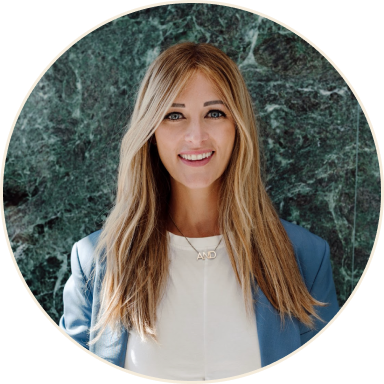
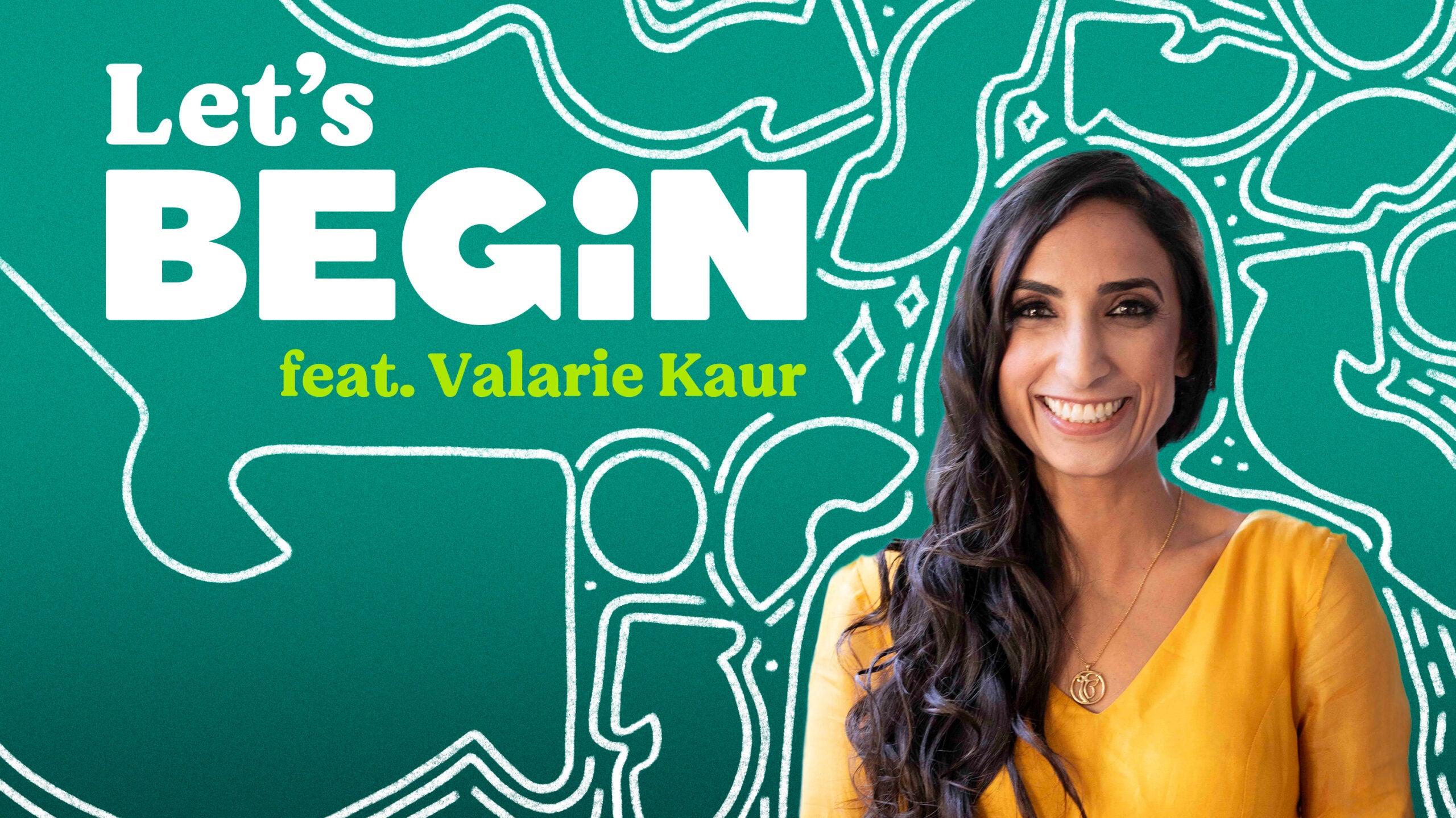
Valarie Kaur, renowned civil rights leader, lawyer, educator, and best selling author, joins Jenna for a timely conversation around processing the news with our children.
While these conversations and resulting questions from our kids can feel heavy and intimidating to navigate, they provide a valuable opportunity to instill the roots of empathy while teaching them how other people’s perspectives may differ from their own.
Listen anywhere:



Throughout this episode, listeners will hear insightful personal stories from Valarie and Jenna illustrating how they each approach challenging conversations with their own children, even when they aren’t quite sure how to process the headlines themselves.
To learn more about the importance of empathy and the Milestones that Matter visit beginlearning.com/milestones
Recap
Guest: Valarie Kaur (Civil Rights Activist, Lawyer, Filmmaker, & Author of World of Wonder) Host: Jenna Arnold
In a special and timely episode of Let’s Begin, host Jenna Arnold sits down with civil rights leader Valarie Kaur to tackle one of the most daunting tasks facing modern parents: how to talk to children about the news. Recorded just weeks before a major U.S. election, this conversation explores the anxiety parents feel about raising children in a polarized, often violent world.
Valarie offers a revolutionary framework for parenting through crisis: “Revolutionary Love.” She argues that we don’t need to teach children how to love or wonder—they are born with that capacity. Our job is to protect it. From practical scripts on how to explain violence without traumatizing kids, to the spiritual practice of “breathing and pushing,” this episode is a guide for raising resilient, compassionate children who can see humanity in their opponents.
The Problem: Parenting in the “News Cycle of Horror”
Parents today are overwhelmed. We are trying to protect our children’s innocence while simultaneously preparing them for a world full of division, war, and political unrest.
- The Reality: Children are “catching wind” of the news whether we tell them or not. They sense our stress, overhear conversations, and see the headlines. When we stay silent, they fill in the gaps with their own fears.
- The Reaction: Many parents default to either “shielding” (hiding everything) or “over-sharing” (dumping their own anxiety onto the child). Valarie suggests a third way: being an “emotional midwife” who helps children process the world without being consumed by it.
The Philosophy: “Revolutionary Love”
Valarie defines Revolutionary Love not as a soft, sentimental emotion, but as a muscular, active force. It is the choice to labor for others, for our opponents, and for ourselves.
Valarie’s Insight:
“I didn’t need to teach my children how to wonder. I just had to protect what they already knew… The root of love is to wonder about others, to wonder about ourselves.”
3 Key Strategies for Processing the News
The conversation offers specific, actionable ways to navigate difficult conversations with children.
1. The “Safe Container” for Rage
The Issue: When bad news hits (like the January 6th insurrection), parents often react with unfiltered rage or panic in front of their kids, which can be terrifying for a child.
The Solution: Process your own emotions first in a “safe container” (with a partner, therapist, or friend) before talking to your child. When you do talk to them, narrate what is happening calmly.
The Script: “I am feeling angry because I see people hurting others, and that is not okay. But I am safe, and you are safe.”
2. The “Wonder” Tool (Humanizing Opponents)
The Issue: We live in a culture of “us vs. them,” teaching children that people who disagree with us are monsters or enemies.
The Solution: Teach children to get curious rather than furious. When they see someone behaving badly, ask: “I wonder what happened to them that made them want to do that?”
The Lesson: “There are no such thing as monsters in this world, only human beings who are wounded… When we see their wound, they lose their power over us.”
3. The “Look for the Helpers” Refrain
The Issue: The news focuses on destruction, leaving children feeling hopeless and unsafe.
The Solution: Borrowing from Mr. Rogers, Valarie advises parents to point out the people helping in any crisis.
The Example: During the insurrection, Valarie showed her children that while people were breaking doors, her parents (their grandparents) were safe on the outside, and many people were working to stop the violence. Focus on the helpers to restore a sense of safety.
The Science: Emotional Regulation & Shared Humanity
Dr. Jody LeVos weighs in to explain the developmental science behind Valarie’s intuitive parenting.
- Emotional ABCs: Children cannot regulate emotions they cannot name. Parents must help children identify feelings (sadness, fear, rage) to manage them.
- The “Window and Mirror”: Media (like Sesame Street) and books (like Valarie’s World of Wonder) act as windows into other lives and mirrors for a child’s own experience, building the empathy needed to navigate a diverse world.
Final Thought: You Are The Midwife
Valarie closes with a powerful metaphor for this historical moment. We are not just in a time of darkness; we are in the darkness of the womb.
“What if this is not the darkness of the tomb, but the darkness of the womb? … We are birthing a new nation. And that requires us to breathe and then push.”
Episode Transcript
Valarie: We have to find a way to disagree with each other and still live together. And so to give our children the ability to see with new eyes, to wonder even about our opponents, and to discern for themselves: Is it safe enough? Am I safe enough to go over, knock over? Or maybe there’s another season. Maybe there’s another moment. Maybe there is a relationship, a potluck that happens in the future where we bond over our kids’ Little League game, and then we begin to talk about our stories.
Jenna: Hello everyone. We spent a lot of time considering how to have this conversation. An often avoided subject: processing the news with our children. There is a lot happening, and our kids are catching wind whether we like it or not.
What makes some of these conversations so hard to have with our children—I’m talking about the brass tacks news—is that we don’t always understand it ourselves, let alone how we as adults feel about it. Given the unique timing of this podcast—just weeks before the most consequential U.S. election in history (my claim, nobody else’s)—we feel there was no better time than now to tell you where we are.
We want our children to be aware, but not demoralized. We want them to feel empowered, and that withdrawal when it gets really hard. We want them to see complex social nuances earlier so harsh realities don’t come out of left field when they’re older, and we desperately want to protect their innocence.
We live in a culture, as we discussed in Episode 2 with Kristen Bell, that prioritizes the definitive, perfectly square answers over the confusion and discomfort of contradicting data and opinions. Coaching our children into constantly evolving national and global contexts require their understanding that others can have dramatically different life experiences, and therefore, dramatically different opinions.
Valarie Kaur, a mother of two, world-renowned thought leader, and author, was catapulted into activism after a Sikh family member was the first person murdered in hate violence in the aftermath of September 11th. For the past 20 years, she has focused on bridge building, even in the shadows of heartbreaking news that keeps hitting very close to home for her, as you’ll hear.
Valarie has two children, nine and five, and her new book, World of Wonder, reminds not just our kids but ourselves that when we don’t understand a person or an idea, it’s still a part of us that we don’t yet know. Publicly stumbling through these moments with courage, curiosity, and humility helps our little people follow suit. And thanks for stumbling with us. Let’s begin.
(Transition)
Jenna: Valarie and I have spent time in sacred places as we were finding our voices, etching our individual paths toward our contributions toward the collective freedom. We became mothers at similar times and we now face our most humbling task: trying to figure out what is actually going on.
[Laughter]
Valarie: That sums it up right there.
Jenna: Yes. Valarie, thank you so much for being here. I know you are moments away from getting on a 45-city bus tour around the country to go do the act of Revolutionary Love, and so giving us a few minutes to get ourselves ready is a real gift. Thank you.
Valarie: This is my breathe before the push. Thank you. Thank you for my deepest breath of the day.
Jenna: So, Valarie has a library of language and tools—and analogies, I should say—that have really helped me and so many other people put our arms around and stand sturdy and frankly feel hopeful for what is to come. And breathing through all of the intimidating, unclear variables that we see ahead of us is one of them.
So, Valarie, I am wondering: How you explain to your five and nine-year-old what “freedom” is?
Valarie: I don’t explain it. I invite them to feel it. In their bodies. We’ll be around the kitchen table, and we do our “Rose, Bud, Thorn” over every dinner conversation. And when they share their Rose—“Oh Mommy, my Rose was when I realized that my best friend and I were wearing the same color!” Or, “It’s when I kicked the ball and made the score in the recess game!”
I pause and say, “Oh, what did that feel like in your body?”
And they’ll pause and say, “Oh, it felt… it felt joy.”
“Where did joy feel like in your body?” And they’ll point to their chest or their belly. And I slow it down—I mean, I’ve finally learned how to slow it down for myself—but I’m slowing it down for them because I want them to know what freedom feels like in their body.
And if I can create a space inside of our home, and then hopefully spaces inside of their classroom as they go out into the world, where they know what it feels like to be loved, to belong, to celebrate, to feel worthy, to make the goal, to have a connection with their best friend, whatever it is… then that embodied knowledge is something that they will carry out into the world when they’re in hostile spaces. And they’ll know that the world doesn’t have to be that way. And they might think of what they can do or say or where they need to be in order to create that space again around them.
I keep thinking we have to practice the world we want in the spaces between us. And that begins with the space between us and our children, and with each other.
Jenna: Yeah, that’s beautiful. You know, when I… it’s so interesting because you and I have developed the musculature to be in allyship with and ask questions of other people’s stories that were less familiar with together. But even in hearing your definition of freedom, it’s so much more physical than mine. Whenever freedom comes up with my children, I often think of it in an ownership and territorial way, which I think is still in its infancy of evolution… but this idea of like territorial boundary ownership. And that really, where does freedom come? I often am using that when it comes to foreign policy… international headline type things. It feels easier to point over there even though there’s so much of it here too.
Valarie: My definition of freedom is when we are at home in our bodies and at home in the world. And so when I can draw myself and my children into that feeling in the body of being at home… you realize that we are born free.
And that being born free doesn’t mean being born isolated or having the things that we need owned by us. It’s being born into the arms of community. Where we are connected to each other, to family, to community, to the trees, and to the sky, all the way up to the stars, right? So much of the terror that I think is driving the crises of our time is disconnection. Disconnection from each other, from the earth, from ourselves. And so to invite people, and to invite our children, to remember what we are already born knowing—that we belong to one another—then any notion of ownership sort of… it doesn’t even apply. It just flies out the window. It evaporates on its own. You don’t even have to go at it directly.
Jenna: That’s right.
Valarie: It just kind of evaporates. Like, that’s not actually relevant when I think about what it means to be at home with you. At home together. Something very simple we’ve been doing because then the language does invade—“That’s MY pen! That’s MINE!” right? So like, “Oh, this is the pen that you are using.”
“This is the land that we are using.” “This is the bed I am using.” I have to remember it too. It’s like, “Oh, that’s Mommy’s book.” “This is the book that I am using.”
Jenna: Right. I like that active verb of using. That’s so great.
Valarie: And then you do return to what so many indigenous wisdoms have held across time and culture, which is: We are here to be stewards of the earth and of each other. For this brief time that we can use a thing, or be with someone, or do a thing. Right? Yeah.
Jenna: On your note about community… and I am entirely in alignment with you related to how one, I think people are desperate for community in ways that I don’t think they understand. I’m recording from Bucks County, Montgomery County in Pennsylvania, which are two very, um… we call those “swing counties” when it comes to the electoral conversations. And so you drive down any given street and there’s political signs up now. I know there’s some counties and some states in this country that don’t see that when you’re driving to school, driving to swimming practice.
And here, it’s very clear: people state who they are affiliated with. But my children see that. And then they suddenly wonder: Can I go and knock on that person’s door in an emergency? And so there’s this sudden boundary creation in our neighborhood around places that they may or may not want to go. I am of the belief that we actually all want to be together and we would all run into each other’s homes to save each other and help each other post-natural disaster or in any other circumstance. But there is this sudden visual boundary creation that my seven and nine-year-old are wrestling with. What are your thoughts?
Valarie: It reminds me the first time that my son heard a racial slur. He was four years old. And he was coming home from a concert in the summer in the park, sitting on the shoulders of my father. And he was literally just on top of the world. And they were waiting to board a ferry when someone was getting in an argument with the ferry conductor and my father, ever trying to be helpful, said, “Oh you could just, you go this way.”
She turned around, took one look at my father, and said, “Go back to your country.”
And my father is hard of hearing, so my son had to tell my father what the woman had said. When they came home, my parents were shaken. I was shaken because I’ve documented racial violence in this country for 20 years. Those are the words that precede an act of violence. I was so grateful that they came home safe, and then I was terrified.
I put my son to sleep and I had him feel: Where is the sadness in your body? Okay, I’m gonna kiss it. Where does it go? It changes color, it moves over here. So we began to learn how to relate to the different parts of ourselves. So I’m always like, “How do I do that with him?” But often times, sometimes, right? When we’re mamas, we’re doing it… we’re so focused on giving them the tools that I forget to do it with myself.
And so as we were falling asleep, my mind was racing. I was like, Where can we go? We have to move. We have to move. There’s no corner of the country we can move in. It’s like you’re saying, they’re visual… now there are visual boundaries every election season about who belongs to us and who is one of “them” and how do you cross those lines in a time when it’s in the air. It’s in the air.
So my mind is racing, racing. And suddenly my son puts his ear on my mouth. And he says, “Mommy, I not hear you breathing.”
He says, “You have to breathe to sleep, Mommy. Breathe and push, Mommy. Just breathe and push.”
And I thought, Jenna… I thought my son has become my midwife.
Jenna: Right.
Valarie: Often times we feel like we need to have all the answers for our children. And yet if we just defer to their wisdom… like in this moment we’re safe. In this moment we’re okay. In this moment we can gain the energy, the insight we might need to wonder about the woman who said the cruel thing.
And so when we are safe, when we are brave enough, we start to wonder about the people who hold that sign or say that cruel thing. Why? Why do they say that? Why do they believe that? Why do they do that?
We might be even safe enough to go and ask. To have a conversation. It might be really hard at first, under the slogans and the soundbites. It might just feel like daggers. But if you keep listening, you’re really wondering why. You begin to hear a person’s story. And you see their wound.
That woman was stressed out… tired… panicked. She turned around and she just grabbed the thing that was in the air, which is like, “You are against me and I’m just going to stab you back for even interfering with my drama.”
Just humanizing her turns her from a monster… And this is what I have learned after being in the trenches: There are no such thing as monsters in this world. Only human beings who are wounded. Who speak out of their fear or their insecurity or their rage. That does not make them any less dangerous. But when we see their wound, they lose their power over us. We become free. We begin to see that we’re all frail and wounded. Even the ones holding the signs and curling their lips.
And even just saying that or seeing that… that itself is revolutionary. To say there are actually no such thing as enemies, they’re just opponents. Opponents whose beliefs, ideas, actions oppose mine. And I get to decide how I relate to that opponent.
It could be that I need to stay with my rage. And I need to stay with my grief. And I need to keep my people safe. I need to keep my baby safe. We have to find a way to disagree with each other and still live together. And so to give our children the ability to see with new eyes, to wonder even about our opponents, and to discern for themselves: Is it safe enough? Am I safe enough to go over, knock over? Or maybe there’s another season. Maybe there’s another moment. Maybe there is a relationship, a potluck that happens in the future where we bond over our kids’ Little League game, and then we begin to talk about our stories.
Jenna: The Major League Baseball team, the Phillies, are going to end up in the World Series. The whole city… it’s a big sports city… so everyone’s like doubling down on that vibe and it’s like we thrive off of those moments with each other. But it will truly be one candidate, another… like back and forth, back and forth for the entire commercial segment.
The way that the political parties have evolved to convince folks to join their movement is so rooted in fear that they’re trying to scare whomever is watching said commercial. So the tone and the gritty and the filters and the like “The world is going to implode if you pick this particular person!”
Valarie: All we see around us is people villainizing each other. We call it a debate. We call it a choice. And yet we do not see any form of deep listening across difference modeled in our political culture or mainstream culture.
And so it is up to those of us—parents, educators—to create those spaces between us. Deep listening is an act of surrender. You risk being changed by what you hear. It’s vulnerable. It takes courage. And people might not be ready for it. Like when two people are listening to each other—really listening—a portal opens. A magical possibility, like truly, for people to be changed by each other. Broken open by each other. And it might not lead to agreement, but it might lead to beloved community.
Your role is to tend to your own wounds. To your grief, to your rage. To alchemize that into courageous action. To stand for what you believe. But even you just holding the possibility that you might knock on that door six months from now, or a year from now, will change how you show up. It means that you won’t fall into the trap of villainizing them. If you’re showing up with love for everybody. No one outside of our circle of care. Ultimately, that’s the only way that we rebirth this country.
Jenna: I love the way that you’re framing the inherited pattern of villainizing the other. And one of the ways that I found myself really role modeling this… It’s a little bit been like a secret excuse of mine when I do this. It’s a bit of like a… how can Mommy get out of a promise that she made? But it’s this idea of role modeling changing your mind. The compassion and the empathy with themselves to be able to say, “Ooh, shoot, I might have gotten that wrong.”
And particularly if they have been public about it or if they’ve demonstrated that to a neighbor or to a family member or on their social media feed… it feels like there’s this stake that gets put in the ground.
Valarie: I do think that what children want from us is not perfection, but presence. To be fully present. And so to be fully present to our own processes of our own evolution, our own mistakes, our own “ahas,” and share that with them gives them permission also not to be perfect. But to be present with themselves as they’re growing, as they’re evolving.
And there have been plenty of times when my children have like returned me to the thing that I forgot. Especially when it comes to loving and seeing one’s opponents.
I remember the day… it was the 2021 January 6th insurrection. We were watching images of people break down Capitol doors, trampling on people, White nationalist tattoos and Confederacy flags. And my brother-in-law was trapped in the building. So it was a very personal and terrifying day for us as a family. He’s a reporter for CNN.
And I was like, the children can’t see this. And so we put them in the room and put on Bluey or whatever. Locked the door. And we were watching and on the phone with him… will he get out? I mean, how many times have I seen people I love in the face of White nationalist violence and have been unable to protect them? It was terrifying. And it was so familiar.
And all I could feel was unbridled rage for the people who I was watching in real time stalking those halls looking for my brother-in-law. Someone like him. My brother-in-law gets out. He’s safe. We breathe. The newspaper lands on the kitchen table. And my son sees it. And at this point he’s five years old. And he says, “What’s this, Mommy?”
And I said… oh, so much for the… I will create a shelter of protection around you where you don’t see anything disturbing.
Jenna: Back to Bluey!
Valarie: Back to… Yeah. No, like… he’s seen it. You can’t unsee it. And I said, “Well, there’s some people who are upset with the results of the election—the choice of the new leader—and they were trying to stop the counting of the vote… or the passage of power.” I can’t remember what I said.
Jenna: The transition of power.
Valarie: The transition of power. I tried to say it in a very simple way so that a five-year-old could understand that they were trying to stop one leader from one to the next. So. He was looking at the images. And I said, “And they were upset.”
And he said, “Oh. They didn’t have a safe container for their rage?”
Jenna: Were you like: Check. My job is done. What would you like for lunch, dear?
Valarie: Mostly it was like… Oh… I couldn’t get there. I couldn’t get there. In myself I couldn’t get there. I was like hardening into hate, right?
Jenna: Right. You’re like, my rage is overflowing.
Valarie: Right. But he could see… and this is what we talk about in our family a lot. We talk about grief. It is one of the core practices of Revolutionary Love. Don’t suppress your rage. Don’t let your rage explode. Process your rage in safe containers where it doesn’t harm others or yourself. So my son will come up and like throw pillows on the ground because he knows that’s a safe container.
But for him to apply that in a moment when it was so hard for me to… It’s so hard for us to see the fullest humanity of our opponents, especially when we’re feeling existentially threatened by them. It maybe wasn’t my role in that moment to do it, because I just had to think about my brother-in-law and his safety. But there’s someone in our lives, if we’re all engaging in some role of the labor of Revolutionary Love, who can make that observation the way that my son did.
And that allows me… then my teammate called me and said, “Oh, Valarie, I’m so sorry.”
I said, “What? My parents were at the protest. Are they okay?”
“No, no, no. They were on the outside. They were the ones breaking down the doors.”
Here I saw my brother-in-law and I saw her parents… of my beloved teammate… and I realized like… It’s Dr. King’s words. That we’re inextricably bound together. And there’s no… there’s no ultimately leaving any of us behind.
And so knowing that… knowing that as wounded, as dangerous, as dark, as confusing… but knowing that there is shared humanity under all of it? And letting that guide what we do, what we say, how we respond? I mean imagine if everyone around us was operating from that place of deep wisdom inside of them instead of just their fear, just their trauma. What if we could teach our children to take a breath? Wonder about the person in front of them? Respond from that place of wisdom inside of them? I mean, it would be nothing less than… than revolution.
Jenna: I have been very, very, very detailed with my children. Because I believe that if they can learn those truths now… as it relates as much as it relates to joy and grief… they’re not going to have to learn it when I started learning it. In like 20, 25, 30 years old, 35 years old. And so many people who have come into really holding a magnifying glass over this large umbrella subject of social justice have been like, “Wait, I’ve been operating in the world with these kinds of assumptions.” And if I can spare my children of some of those assumptions and mistakes that I was making, they’ll develop that musculature to be more empathetic. And more compassionate. And more curious. Because they’ll understand so many of the nuances where my parents were so committed to protecting me and sheltering me from the complicated. And the complicated that was violent and bloody and caused harm. Because they wanted me to live in like a rosy, white picket fence suburban life. Which I did. And then when I got older… and I was like, “Wait a second. This isn’t what the world looks like for everybody.”
And so it’s how I ended up where I am professionally. But I’m curious to know: How much of the truths do you share with your children?
Valarie: It’s so fascinating to hear you speak because we as thoughtful parents… and sometimes we’re overly thoughtful…
Jenna: Take this all too seriously.
Valarie: Right. Because my mother, she’s like, “We didn’t think about any of this.” And that served her in a lot of ways. But other times, you know, it didn’t. Because she missed what I was experiencing as a child.
And and we often take that information into how we’re showing up for our children now. And when I hear you, I hear like you were sheltered and then discovered it all later and then now, right? You’re going to give it to your children right away.
What it felt like to be a small Brown girl growing up in the Central Valley of California was that my first racial slur was at six years old. And it felt like stinging under the skin and it felt like shame. And it felt, you know… they call it internalized oppression, but it was this voice in my head that said: You’re not good enough. You’re not strong enough. You’re not smart enough. You’re not fair enough. You’re not, you’re not, you’re not, you’re not.
And that happened over and over again in various ways around not being Christian, not being beautiful, not being White. And so it took so long for me to find a sense of freedom in my body, to be at home in my body. To undo all of what oppression heaps upon children that are that small.
And because I had that experience, my top priority for my children was like: You are beloved. You are beautiful. You are worthy. I’m not going to tell you about what Mama does out in the world just yet. You know? I’m instead, I’m going to make my home a container for what the whole world could feel like. So that—this is how we started the conversation, right?—so that you know what freedom feels like inside of you, because the world is not going to give it to you. So let let’s create a space here where we are brave with our grief, where we have safe containers for rage, where we listen across lines of difference, where we’re breathing, where we let joy in, where we wonder about each other. Let’s make this a practice space. And then when you go out there and you get hit with the slur—or worse—you know, you know that deep inside it doesn’t have to be that way. And it won’t take you as long as it did for me to hold on to your inherent worth and dignity and beauty.
That said, that was my priority, right? And now that my children are older… like my son is now nine and my daughter is now five… what I’ve discovered is as much as I wanted to hide what Mama was doing out in the world… life, you know, the world invades. The world comes for them. They see me doubled over on the bed after the latest massacre. “What’s wrong, Mama?”
And before I would not tell them. And now I realize like… I tell them. I just tell them the truth.
“What’s happening? What’s on the first front page of the newspaper?” I tell them the truth. “What is… kids were talking about Ukraine today and Russia and what is that?” I tell them the truth. “People are are are angry… they’re saying the words ‘I can’t breathe.’ What does that mean? What does it mean to say Black Lives Matter?”
I am at the point now where because the world is is always coming for us and our home is open, the conversations are happening… it’s happening in school, it’s happening here, it’s happening in the news… I’m now understanding that I just can follow their lead. And tell them as truthfully as I can what I know and what I don’t know. What I wonder about.
And and that way… I mean when I was little, anytime my parents sat down and lectured me about anything, it didn’t stick. It was watching them wrestle with questions. Watching them wrestle with the world. That gave me the tools to be able to do it ultimately inside of myself and outside. And so I think I follow… I follow their lead. And I’m responsive in so far as… they’re asking why.
Jenna: Their curiosity matches their development. And it is on us to meet their curiosity without being the bombardment that we as adults feel. Like we are literate, capable folks who are curious and concerned about the world, and we’re still like, “Oh my god, where’s the rock I can hide under?”
And so I do find that I have to pay attention in those conversations to where their natural boundaries are. So at one point I was driving down the road… this was last week… and my son said to me: “Mommy, is the Black and Blue American flag the same thing as the American flag?”
And I was like… well. And we were in the car. And I was like, Perfect timing. We have a five hour drive south. And I went back to…
[Laughter]
Valarie: I went back to probably like 1300. I went back to the Doctrine of Discovery. And like the Vatican’s interpretation of Deuteronomy. And who’s allowed to have and not and control people and who not.
And we were 17 minutes in. And my son said: “I’m not listening anymore.”
And so I did. I gave them a breather. And then the next day we saw another flag… with similar color palette. And I said to them, “Oh, there’s that flag again. What do you remember about our conversation yesterday?”
And my son said, “Are we there yet?”
And my daughter’s response was: “Ugh, Mom, it was so long. I’m telling you I got it but I just don’t feel like summarizing it for you.”
And I felt like… okay. It’s just going to be… there’s just going to have to be 17 more or 117 more conversations about this specific flag.
Valarie: Given that the world seems to be flowing with conflicting messages about where the country is headed… how are you centering love as the revolution?
Valarie: I am declaring to the world: Revolutionary Love is the call of our times. And I was thinking, how do I teach this to my children? How do I teach them Revolutionary Love?
Love is our birthright. We already know how to love. The root of love is to wonder. To wonder about others, to wonder about ourselves. To let that be the precondition for connection and care and action. And so I didn’t need to teach my children how to wonder. I just had to protect what they already knew.
So I began to sing a song to my daughter on our walks to the beach. And the verses started to unfurl in all directions. And now it is a children’s book! And it’s released with a learning hub that is free for parents and educators on how to practice Revolutionary Love with children.
The book is called World of Wonder. It just came out. You can go to OurWorldOfWonder.org for the book and for the music videos, which are also out and also available for free, as well as our learning resources.
Jenna: Valarie, we are blowing so much wind into your Revolutionary Love sails. We are going to make sure World of Wonder and Sage Warrior—which is the adult/children’s book… that is also now out… make it onto all of the fancy lists which I know are exhausting but they’re really helpful for activists and voices like yourself to continue to have the currency and resources they need to do the work that you’re doing.
And thank you for bringing two children in who know how to contain rage and put it in a safe place. Because we need more children like yours. So thank you so much for taking the time to be with us.
Valarie: And now we’re going to dive into the nuances of what this means for our children with our in-house Chief Learning Officer, Dr. Jody. Hi, Dr. Jody.
Dr. Jody: Thanks so much for being here.
Jenna: Thanks for having me, Jenna.
Jenna: So, what does this all mean in the context of where we are on this exact page in our history? When it comes to helping prepare children to have the ability to enter complex, sometimes contradicting situations with a gentle heart for themselves and other people?
Dr. Jody: I love that question, Jenna. And the conversation sometimes can feel a little bit heavy, right? So it’s great to pull back and remind ourselves that we’re really here to think about the learning outcomes that we want to instill in our kids.
And I think talking about developing the roots of empathy, and the ability to take other people’s perspective, is so important. And that really starts very, very early. Even infants show the ability to mirror the emotions that they see in others around them, whether that’s another baby crying next to them or the facial expression of their parents.
And by preschool, children are demonstrating the ability to actually name and regulate their own emotions, but also understand that they are distinct humans that may feel differently than the other kids around them. And that’s a really critical part of developing empathy: being able to see yourself and your experiences as something that are separate from others.
And as you were talking, it’s really important to model that for our kids. It’s important to have those conversations with our kids. But it’s also important for kids to work on those skills through play.
And one of the things that at Begin we’re really focused on is exposing kids to different cultures and perspectives from around the world. And we do that through playful experiences like Little Passports. And with the Little Passports kits, kids are introduced to countries from around the world, characters and experiences and music and food. And that’s a really important part of children’s ability to see their own experiences as something that is situated within a much bigger world.
Jenna: Dr. Jody, one of the running themes around these “Milestones That Matter” from previous episodes is that so many of our children’s talents and capacities are things that they already have baked within themselves. And our job isn’t necessarily to teach them, it’s to protect them.
Dr. Jody: I think that’s exactly right, Jenna. I was just reading a piece this morning in Psychology Today that “Empathy isn’t taught, it’s caught.” And I think that’s a great example of what you just said.
Jenna: Caught, not taught. Dr. Jody, with the simple mic drop. The state of the world offers us plenty of reasons to be concerned. And because we’re committed caregivers, we’re not going to pretend it is something other than it is. Helping our children and ourselves see those realities and our place in them is a gift we owe ourselves. And our little people.
Jenna: Please subscribe to Let’s Begin wherever you get your podcast and leave us a review. We appreciate your feedback. A summary of this episode can be found at BeginLearning.com/podcast. And you can follow me on Instagram @ItsJenna and Begin @BeginLearning.
Please note that opinions expressed on this podcast are solely those of the host and guest, not of Begin. Let’s Begin is produced by Begin in partnership with Pod People. Special thanks to our production team: Alexia Liberman, Beth Roe, Brian Rivers, Caitlin Ryan, Leah Weinstein, and Susanna Vasquez. Show cover art is designed by Eleanor Green.