Add up the fun with Dice Addition! Kids practice early addition by counting and combining the dots on pictures of dice—building number sense, subitizing skills, and confidence with foundational math.
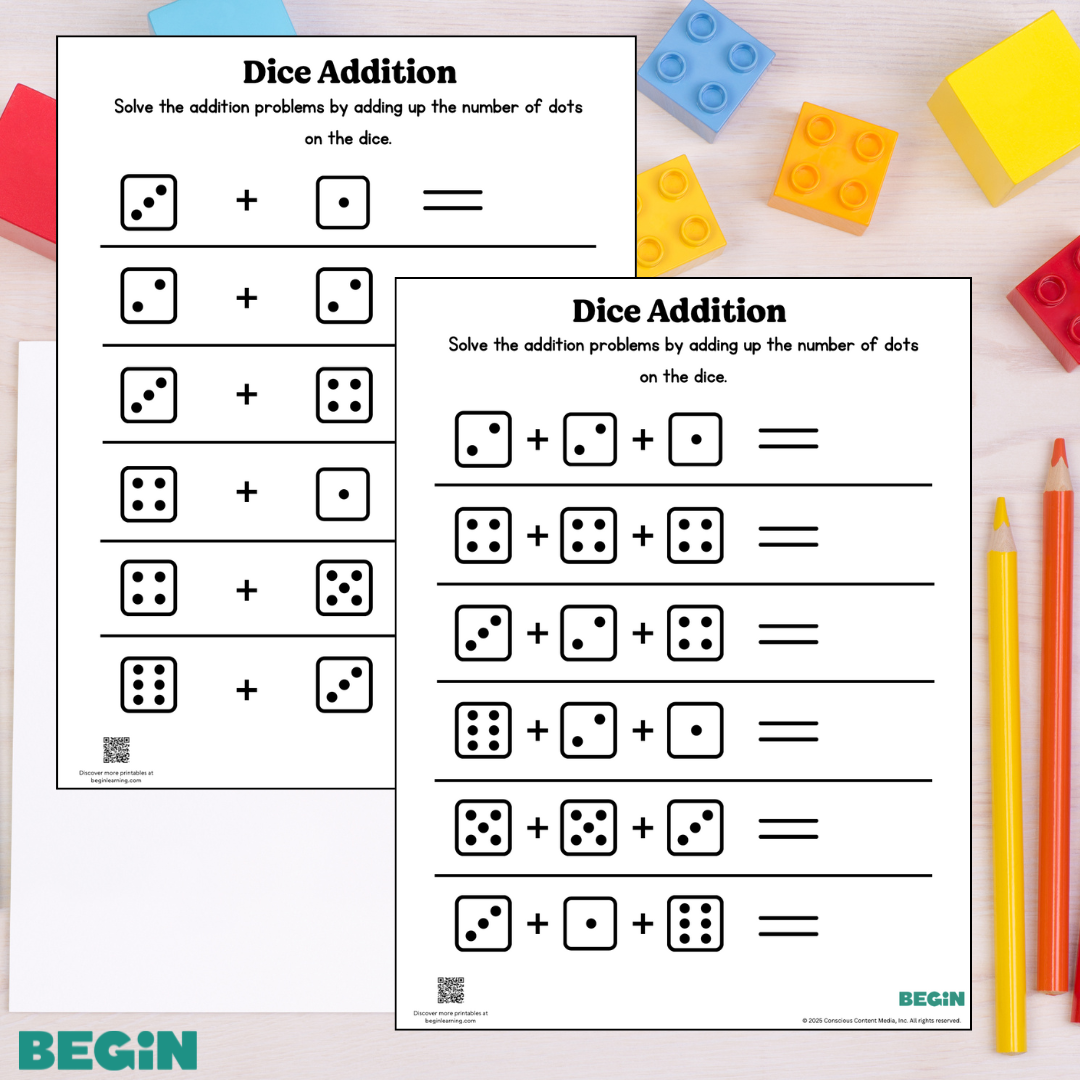
Materials Needed:
🖨️ Printed Dice Addition pages
✏️ Pencil for writing answers
🖍️ Crayons or markers (optional, for coloring the dice after solving)
⏱️ Time Needed: About 5-10 minutes per page
👩👧 Best As: A do-together activity for younger learners (ages 5–6) using the first two pages with two dice, and a guided-independent activity for older or more advanced children (ages 6–7) using the last two pages with three dice.
How to Use:
- Print the Dice Addition pages.
- If your child is an early math learner, start with the first two pages (two dice) to practice adding smaller quantities. If they are more advanced, you can start on the third page.
- Look at each set of dice and have your child count or “see” the dots, then write the total.
- Encourage your child to explain their thinking: Did they count each dots? Did they “see” and know immediately (e.g., they knew immediately that the die had two dots and didn’t need to count)? Did they see different groups of dots on the same die and then add them all together?
Build number sense, strengthen subitizing and addition skills, and help your child see the fun in math—one roll at a time!
Why Subitization Matters for Growing Minds
Working with dice images helps children build quantity recognition, counting fluency, and mental math—and strengthens a key early math skill called subitization. Subitization is the ability to recognize small groups of objects instantly without counting one by one (like knowing there are 5 dots on a die just by looking). This skill helps kids see patterns in numbers, understand that quantities can be grouped in different ways, and transition more easily to addition and subtraction. It also helps them begin to think about the different ways numbers and quantities can be constructed and deconstructed.
✨ Want to make it even more meaningful? Talk about what your child sees rather than what they count. Ask: “How did you know that was six?”, “Did you see three and three, or four and two?” This helps children describe their math thinking and builds flexible problem-solving skills.

Want to support your child’s early literacy, math skills, and creativity?
Try HOMER free for 30 days