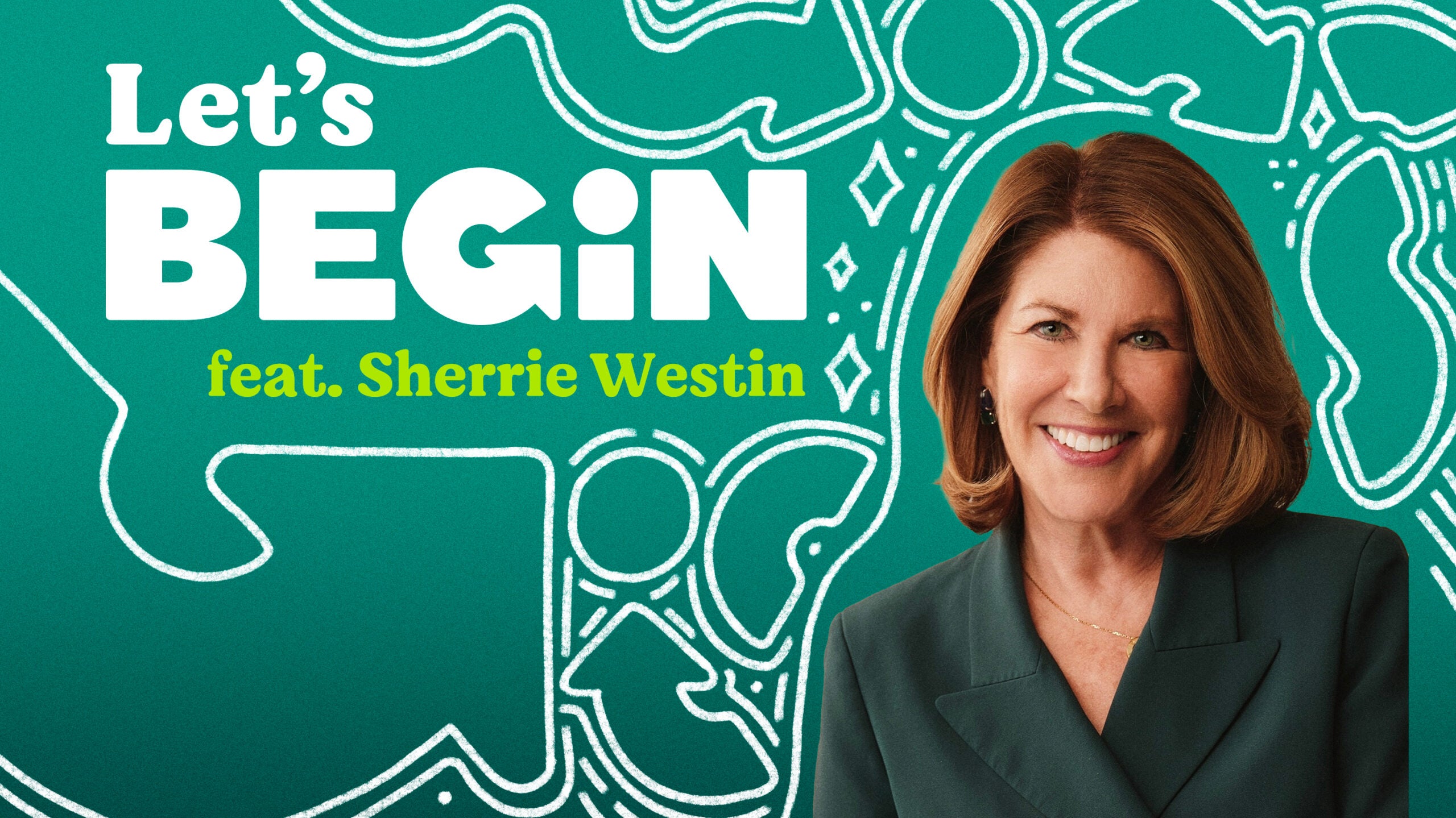
Let’s begin, at the beginning of Sesame Street. In today’s episode Jenna sits down with Sesame Workshop’s CEO, Sherrie Westin to discuss the origins of Sesame Street, their partnership with Begin, and why its mission is more vital than ever before.
Listen anywhere:



Since 1969, the characters of Sesame Street have reflected their audience, helping kids (and parents) see versions of themselves on screen. The cast of iconic muppets often model how to navigate the array of human emotions as they live together in community on Sesame Street.
Jenna and Sherrie discuss the significant impact of Sesame Street’s global reach, particularly with children in crisis, and how even in the show’s inception, it was designed for both kids and caregivers to enjoy together.
In partnership with Sesame Street, Begin offers an early learning program for kids ages 2 to 5 that captures the essence of the show. Through digital classes, engaging in-app activities, hands-on kits, and an expert-developed Grown-Up Guide, Learn with Sesame Street by Begin helps families navigate big feelings and supports social-emotional learning.
To learn more about Learn with Sesame Street by Begin, visit beginlearning.com/sesame
Recap
Guest: Sherrie Westin (CEO of Sesame Workshop) & Dr. Jody LeVos (Chief Learning Officer at Begin) Host: Jenna Arnold
In this heartwarming and critical episode of Let’s Begin, host Jenna Arnold sits down with Sherrie Westin, CEO of Sesame Workshop, to discuss the 55-year legacy of the “longest street in the world.”
Sherrie shares the origin story of Sesame Street, birthed during the Civil Rights movement and the War on Poverty as a radical experiment. The question was simple but revolutionary: Could television—the medium that taught kids beer jingles—be used to teach literacy and numeracy?. More than five decades later, the mission has expanded from ABCs and 123s to meeting children in the midst of complex global crises, whether that’s in a living room in the suburbs or a refugee camp in the Middle East.
They discuss the concept of “Emotional ABCs,” the power of representation (from the first multi-racial cast to Muppets with autism), and why the show’s secret sauce has always been engaging the adults alongside the children. Later, Dr. Jody LeVos explains the science behind Begin’s new partnership with Sesame Workshop, focusing on how “parasocial relationships” (the deep trust kids feel for characters like Elmo) can unlock social-emotional learning that parents sometimes struggle to teach alone.
The Problem: The “Emotional ABCs” Gap
While Sesame Street is famous for teaching letters and numbers, Sherrie identifies a critical gap in modern childhood: emotional regulation. Children cannot learn if they cannot regulate their emotions, and they cannot regulate emotions they cannot name.
- The Global Crisis: We are living in a time of profound instability, with 120 million displaced people globally (half of whom are children). Yet, less than 2% of humanitarian aid goes to early childhood education.
- The Result: We risk leaving the most vulnerable children behind, not just academically, but emotionally. Without the tools to identify feelings like frustration, sadness, and joy (the “Emotional ABCs”), children struggle to build the resilience needed to learn and connect.
The Philosophy: Smarter, Stronger, Kinder
Sherrie breaks down Sesame Street‘s “Whole Child Curriculum,” which goes far beyond academic drills. It is a framework designed to foster three core traits:
- Smarter: Cognitive skills like literacy, numeracy, and foundational learning.
- Stronger: Physical health, resilience, and coping mechanisms.
- Kinder: Empathy, respect for difference, and emotional intelligence.
Sherrie’s Insight:
“We don’t create a new character unless there’s a real reason… Big Bird is about kindness. Elmo is about love. Oscar was created to show that you could be friends with someone you totally disagreed with.”
3 Key Insights on Raising Resilient Kids
The conversation highlighted three specific ways Sesame Street (and parents) can support child development using media.
1. The “Window and Mirror” Effect
The Concept: Children need media that offers both a mirror (to see themselves and feel validated) and a window (to see a world of possibilities they hadn’t envisioned). The Application: Shonda Rhimes noted that Sesame Street was the first place she saw herself reflected. This is why the show introduced a multi-racial cast in 1969 and continues to introduce characters like Julia (a Muppet with autism) and Ameera (a Muppet who uses a wheelchair). It builds a sense of belonging and empathy simultaneously.
2. The Power of Co-Viewing (The Adult Secret Sauce)
The Concept: Founder Joan Ganz Cooney had a “hunch” that learning would be deeper if adults watched with their children. This is why the show includes humor, parodies, and celebrities—to keep the parents in the room. The Science: Research now proves that engagement with a caring adult is the most critical factor in healthy brain development. When parents watch with their kids, the media becomes a tool for connection rather than a babysitter. The Evidence: During the pandemic in Lebanon, a study found that facilitating engagement between parents and children via WhatsApp and phone calls led to learning outcomes in 11 weeks equivalent to a full year of in-person pre-K.
3. Leveraging “Parasocial Relationships”
The Concept: Dr. Jody LeVos explains that children develop deep, trust-based friendships with characters they see often. This is called a “parasocial relationship”. The Application: Because children trust Elmo, they learn faster from him. The Learn with Sesame program leverages this trust to teach difficult skills—like trying new foods, managing big feelings, or navigating conflict—that a parent might struggle to teach alone. If Elmo does it, the child is more likely to try it.
Final Thought: You Are Good Enough
The episode concludes with a message of grace for parents. In a culture that constantly tells us we aren’t doing enough, Sesame Street offers a different currency: Belonging.
“So much of what we tell ourselves is we are not good enough… That to me is the currency that Sesame offers the world… Everybody belongs.”
Episode Transcript
Sherrie: Joan Ganz Cooney, who created Sesame—the founder—she also just had a hunch that the learning would be deeper if an adult were watching with the child. She thought then the learning would carry on off-screen because the adult would talk to the child about it, etc. And that’s why she included celebrities and musicians and humor and parodies—you know, hired Jim Henson to create these Muppets. So I just think that is one of the most unique aspects of Sesame to your point: that we appeal to adults as well as children.
Jenna: Our guest today is on a mission to help children everywhere grow smarter, stronger, and most importantly, kinder. She was named a leading Global Thinker by Foreign Policy Magazine, one of Fast Company’s 100 Most Creative People in Business, and is a member of Forbes’ 50 Over 50 list. I’m thrilled to introduce you all to the CEO of Sesame Workshop, Sherrie Westin. Sherrie, thank you so much for being here.
Sherrie: Well, it’s such a pleasure, Jenna. Thank you for inviting me.
Jenna: Any opportunity to talk about Sesame Street is a moment that I certainly am happy to capitalize on. For context of our relationship, I sit on the Advisory Board of Sesame Street and showed up into the Sesame Street space initially thinking I was wearing my early childhood education hat, but quickly realized that my role in the Sesame Street family was that of a very enthusiastic community member, parent, and somebody who tries to consider themselves a global citizen because I had no idea about the reach of Sesame Street broadly.
At the heart of Sesame Street is its relentless commitment to showing children that they are seen and heard and valued no matter who they are or where they come from. Sesame Street has been teaching these critical life skills for 55 years—long before there was language for it. Sesame Street offers, I’d argue, the most fundamental life-affirming tool around dignity and self-worth. So Sherrie, how and why do you see the work of the show as critical to the social-emotional state of children around the world?
Sherrie: Well, I think you should just keep talking! You’re doing a better job than I could. I love that you’re such a wonderful champion of our work. But look, I will say that I think Sesame Street is really unique in the fact, as you mentioned, that it is 55 years old and has remained so true to its mission for all of these years and still so relevant today.
For those who may not know, Sesame was started in 1969. That’s when it debuted. And it was really an experiment because this was during the War on Poverty, the Civil Rights Movement, the Johnson Administration. There was so much research that showed that children in poverty, particularly children of color, were showing up without the skills needed to learn in kindergarten.
Joan Ganz Cooney, who created Sesame, had this innovative idea because television was the medium of the day. Children were learning beer commercials and Alka-Seltzer jingles—they were singing different little jingles that they heard and learned on television. So she thought: Why can’t we be teaching letters and numbers?
Sesame Street was this huge experiment: Could you use television to teach? Which may sound like no big deal today, but that was radical in 1968. And especially, could you use it to reach those children who may not have the same opportunities for quality early education? So launched in 1969, overnight success. She proved yes, indeed, you could use television media to reach children to teach children.
Jenna: I also think it’s really important to highlight that Sesame Street was birthed out of a social crack. There was the Vietnam War, there was the Civil Rights Movement, and we saw extreme poverty—not just in like Southeast Baltimore, but in different places around the world. And Joan Ganz Cooney had that insight to say, “Wait a second, we can take this medium that we’ve only ever been selling Marlboro cigarettes on,” but it really came out of a moment where adults—American adults—were questioning their identity and how they were raising their babies. And I love that because I feel like we’re sort of there right now too.
Sherrie: You raise such good points. I want to add one: that it was the first place that so many children of color saw themselves reflected on TV—the very first children’s show with a multi-racial cast. Secondly, you mentioned sort of all over the world, but one of my favorite stories is Joan often says she thought she was creating the quintessential American show. It was on a stoop in Harlem with a multi-racial cast. What she never anticipated was that within a year, Brazil, Mexico, Germany all came forward saying, “We want our local versions of Sesame Street.” And that’s what led to our local adaptations. It’s not just exporting the US version of the show; in many countries, there is Sesamstrasse, Plaza Sesamo—local productions of Sesame Street with characters designed to meet the needs of children reflecting their language and their culture.
And the other thing I would want to add, which I think shows what a visionary Joan is… she brought together Harvard educators, creative producers, and researchers to create this show. That’s still our model today, wherever we are—whether that’s in Jordan or South Africa or here in the US with every single season. But she also just had a hunch that the learning would be deeper if an adult were watching with the child. She thought then the learning would carry on off-screen because the adult would talk to the child about it. And that’s why she included celebrities and musicians and humor and parodies—hired Jim Henson to create these Muppets.
So I think that is one of the most unique aspects of Sesame: that we appeal to adults as well as children. And now if you fast forward, there’s all the neuroscience—you know this so well—to prove that Joan’s hunch was absolutely spot on. We now know that the way children learn is through engagement with a caring adult. We also know that for children who’ve experienced adversity or prolonged exposure to stress, that it can be debilitating for their healthy brain development—and the most important thing to help mitigate that is more engagement with a caring adult. That’s why I think Sesame has such deep impact particularly for marginalized children and in crisis contexts, because this content is designed to be not only a tool for that child but a catalyst for more engagement between adult and child.
Jenna: As I’ve gotten increasingly more familiar with the brand over the years, I’ve been relieved that the target demographic in the room has not just been the four-year-old, but the 42-year-old who is folding laundry in the back of the room. And it’s been a relief for me because I’m that 42-year-old who’s confused—maybe more than ever.
We are now in a time when many parents are grappling with the discomfort and fear regarding their children’s mental health as well as their own well-being. Sesame’s characters—like Elmo, who we just saw break Twitter when asking how everybody was doing—are clearly seeking some level of comfort that the brand and its characters seem to be the only ones delivering. When I look at the portfolio of other content that exists out there today, they really only have one focus: keeping the kids entertained. Most parents are putting it on and running out of the room. That’s what feels so different about Sesame and its objective.
I’m curious about what some of the red flags are that Sesame is observing in parents that are indicating the need for additional support and guidance around what it means to be a caretaker today.
Sherrie: I’ll start with the beginning of your point about when you reference Takalani and anecdotal information. There’s also qualitative research, right? And I can share qualitative research in so many places. When we were in Afghanistan for 10 years, or WASH work that Gates funded in Nigeria, Bangladesh, India—there are so many instances where we have research that shows we’re not only reaching those young children, but we’re changing attitudes. We’re changing behaviors of adults, of caregivers as well as children. Whether that’s attitudes around allowing children to go to school, particularly girls; whether that’s attitude around health issues like HIV and AIDS in South Africa, or around water, sanitation, and hygiene. Often the child becomes a catalyst for the adult. But also, my theory is that when that adult or that caregiver or even that father is watching, it’s not as threatening as me saying, “You should send your daughter to school.” So we’re able to model behaviors. It’s a children’s show. It’s very non-threatening. But that appeal to adults as well as children really has a powerful impact on opening hearts and minds as well as teaching.
When you talk about Elmo and the viral moment, I think again this comes back to the fact that Sesame appeals to generations. When Elmo is tweeting, that’s obviously for adults and fans, not for young children. But it allowed us to talk about, “How is everyone doing?” We have tackled the mental health issue through the lens of young children. Often people think of issues as being adult-only and they’re not looking at it in terms of the impact on young children. So for Elmo to be able to tweet that—360 million people responded. But what I also love is that it allowed us to create more of a national conversation and then talk about it from the lens of a child. 17,000 people downloaded our resources to give parents tools to address emotional well-being for young children.
Creating a Muppet with autism came out of years of research and a program designed to give families with children with autism tools and resources. But we realized there was so much more we could do by helping other children have a greater understanding and empathy for those with autism. That’s why we created Julia. So not only for children with autism to see themselves, but for others to have a greater understanding.
And lastly, parents feeling struggling… we do see that. Particularly because children are growing up in a de facto digital world, like it or not. I think parents are nervous about digital technology and all the media children are exposed to; they feel guilty. We see that a lot in our studies. The point is to help enlighten parents: How can we create content and use technologies in a way that increases engagement between adult and child? How can we help parents understand the importance of building a foundation for digital well-being at a young age, as opposed to waiting until they’re teenagers to address this?
We know the power of media to reach children—that’s exactly what Joan set out to do in 1969. Today the need has never been greater—more children displaced, more disruptions to education—but there have never been so many different opportunities to reach them in different ways and on different platforms than before either.
Jenna: I can’t stop thinking about why folks gravitate to your characters so much—adults and children obviously. But I wonder if it’s because they’re willing to be so vulnerable and put their shame and their embarrassment and their confusion out so quickly? Whereas no matter where you are in the world, you’re raised to believe that you’re supposed to get things very sorted the older you get.
Do you think it’s because Sesame Street, particularly in some of the characters like Big Bird, seems to be willing to be insecure in a way that really speaks to who we all are inside, behind the facade that we show up with?
Sherrie: You know, Sesame has a curriculum for whatever we’re creating. We don’t create a new character unless there’s a real reason for that character. Even the original characters were created with certain agendas. Big Bird is about showing kindness and helping one another; that will always be true to his character. Elmo is all about love, and he’s three and a half and he’s always going to be written as a three-and-a-half-year-old. I think it’s one of the reasons that children gravitate to Elmo first or early, because they relate to him. Oscar was created to show that you could be friends with someone that you totally disagreed with, who had a different view of the world.
When I look at our international productions, we create new characters when there’s a specific reason. So in the Middle East, where we’re reaching like 29 million children with Ahlan Simsim (Welcome Sesame), it was created to help all those children who were displaced after the Syrian crisis. So two of the new Muppets are Basma and Jad. Jad has to leave his home. He becomes best friends with Basma. We don’t say Jad is the “refugee Muppet”—we would never say that. But it allows us to model storylines that will help children cope with the fact that they had to leave, that they become best friends with others. It allows us to create characters children identify with because they can identify with that story.
There’s a reason a character is created, and we stay true to that character. That’s why I think there is this ability to resonate with children—and often with adults—because they’re created for a purpose, not just trying to think of an entertaining character.
You mentioned social-emotional learning. From the outset, Sesame was created with what was called a “whole child curriculum.” I think a lot of people think of Sesame as ABCs and 123s—certainly they do in the States. That was sort of the foundational learning. But it was also the social-emotional skills we know children need to thrive that is as important in arriving at school ready to learn. Our mission sounds like a very clever tagline: We help children grow smarter, stronger, and kinder. But it’s so much more than that. It is absolutely what’s baked into everything we do: Smarter (literacy, numeracy, foundational skills), Stronger (resilience, health), and Kinder (empathy, understanding, respect for differences).
Jenna: It’s shocking, it’s daunting frankly, Sherrie, for me to think that Sesame is more critical today than it’s ever been. Coming at Sesame with a foreign policy lens, having been at the United Nations for years and being deeply involved with international organizations that are delivering urgent food and medical care… I believe that Sesame Street is as critical to get into these places as any of those other basic human needs are, because of how Sesame sends the message to its audience that they are worthy of something beyond their circumstance.
Sherrie: That’s such an important point. Especially for children in crisis contexts. There are 120 million people displaced today, almost half of whom are children. What could be more traumatic than having to leave your home or being in a conflict region, leaving everything behind?
In Lebanon during the pandemic, all of a sudden we couldn’t have that home visitor in the home or the child wasn’t going to the learning center. How could we reach them when they had no access to formal learning? So we put Ahlan Simsim on WhatsApp. Groups of parents had access to the content on their WhatsApp, and then those teachers and home visitors were trained to call them three times a week to facilitate engagement with the Sesame content. NYU did a randomized control trial and found that the learning outcomes—both literacy and numeracy and social-emotional skills—in 11 weeks was the equivalent to a full year of in-person pre-K. Because the content is that good, but more than that, it was guaranteeing there was more engagement between adult and child.
Your point about this being so essential… in humanitarian response, less than 2% of humanitarian aid goes to early education or early childhood development. Because of course people think that what you need is security and safety and food. And of course you do. But the point is, it’s actually as essential that you’re reaching the youngest children with early childhood development… because they are the most vulnerable in those first five years. They have the most to lose and the most to gain if we can reach them with proven outcomes, but they receive the least.
Jenna: There’s no need to compare or to rank what’s more critical in crisis moments. The mental stability, the ability to emotionally regulate and begin to identify, name, compartmentalize your experience and your emotions is actually the foundation of what safe societies look like.
One of the things that Sesame does so beautifully is it says everybody belongs. So much of what we tell ourselves is we are not good enough. Not good enough for what? Not good enough to speak our mind, or to write the book, or join the PTA, or say to our kids “I actually might have handled that incorrectly yesterday”? That to me is the currency that Sesame offers the world.
Sherrie: Your point about emotional well-being—we actually call it the “Emotional ABCs”—is so important because children have to be able to regulate their emotions in order to learn. And they can’t regulate emotions if they can’t identify them.
You also talk about their sense of belonging. One of the things we believe is children learn best when they see themselves reflected in media in a positive light. I love what Shonda Rhimes said recently—she said that she saw in Sesame both a window and a mirror. It gave her a window onto the world and a world of possibilities she had not envisioned, but also a mirror to see herself reflected. Helping children see themselves, helping them see a sense of possibility, but also helping them understand that they’re not alone.
Jenna: I love Oscar and Oscar’s creation because he’s the side of us that we all secretly have—the like, “I don’t want to be friends with you” or “Today’s a terrible day.” Just the permission to know that that side of us still exists. And we also have to welcome that part of us.
Sherrie: We still have grouches in our community, yes.
Jenna: [Laughs] But I do love that the belonging and becoming is the foundation of Sesame.
In honor of a podcast that is laser-focused on helping parents and caretakers feel better about who they are in this challenging moment of raising children… I want to plug Sesame Street. It is a 501(c)(3). It is not a for-profit company. It is constantly in need of money. So if you have a blank check and you’re wondering what to do with it, I certainly have some ideas.
Sherrie, with that, I want to thank you again for modeling kindness and generosity, for showing up in this moment, for picking up a massive torch. Thank you so much for making me and my role as a parent and the world better.
Sherrie: Thank you for your passion, your enthusiasm, and for your plug because it’s true—Sesame needs support and people don’t often realize that. Thank you for being a champion.
Jenna: To help us learn more about the unique partnership between Begin and Sesame Street, Dr. Jody, thank you so much for being here. I’m curious about why Begin said yes to a partnership with Sesame Street on this phenomenal “Learn with Sesame” product. Why this collaboration? Why is it key right now?
Dr. Jody: We really wanted to address social-emotional learning and we could not think of a better partner than Sesame Workshop. They have over 50 years of experience supporting kids and families, but really such an outsized impact in terms of emotional well-being.
When you think about the characters that the kids are so familiar with… we know from research that when children recognize characters like Elmo, they develop that parasocial relationship and they learn from those characters more than they learn from characters they don’t have that relationship with.
Jenna: “Parasocial”—I feel like that is a big word. What does that mean?
Dr. Jody: It’s really when kids are developing a familiar, almost like a friendship with a character because they’ve seen them so many times.
Jenna: I have a parasocial relationship with Oprah and Taylor Swift.
Dr. Jody: Exactly. You trust them, right? You trust their advice. Kids are no different. When kids are learning from characters that they have that relationship with, they trust that character and research shows that they’ll learn faster. It was really important for us to leverage these characters that kids are so familiar with.
This program is all about bringing multiple ways of learning through play together in one program: digital interactive content, classes for kids, classes for grown-ups, and tangible kits with games and activities that parents and kids can do together.
Jenna: One of the things that I appreciate so much about the collaboration is that while you’re a for-profit company, you started out creating literacy apps and coding apps—of which my daughter learned to read on Homer. You merged technical expertise with the requirement to be literate today. Begin saw the writing on the wall and went to a company like Sesame Street that has that trusted relationship across generations.
I also want to call out and be honest with the audience here that Begin is a partner and we are looking to support both the brand on Sesame Street through this work, but our objective is reaching families.
Dr. Jody: Absolutely. One of the things that was critical to this partnership was this framework of something for the child, something for the parent, and something for the parent and child together. We know through research that not only are parents actually looking for those kinds of co-play experiences, but the learning outcomes are enhanced when there is co-play and co-viewing. It’s really a win-win situation.
Jenna: One of the things that I love about the “Learn with Sesame” product is that it’s not another homework assignment for parents, which feels exactly what is so daunting about the landscape of child rearing today. It is a guilt-free product that you can give kids.
Dr. Jody: Exactly. The last thing we want to do is add more pressure to parents. We really want to enhance joy and simplify the process.
Before we started designing the product, we spent a lot of time understanding what were the most critical skills to teach. In broad strokes, we wanted to help children learn to:
- Recognize and name emotions in themselves and others.
- Manage big feelings: Strategies and tools for self-regulating.
- Operate in social spaces: How do we initiate play? How do we make friendships? How do we navigate conflict?
Within that, we heard from parents things like: “I need help getting my kids trying new food,” or “I need help with bedtime routines.” So we made sure we were designing to support those very specific need states into the product as well.
Jenna: I hope you are as obsessed with Sesame Street as I am. For more information about the “Learn with Sesame Street” program, which includes hands-on activity kits that make for a well-rounded gift for the holiday season, visit the show notes.