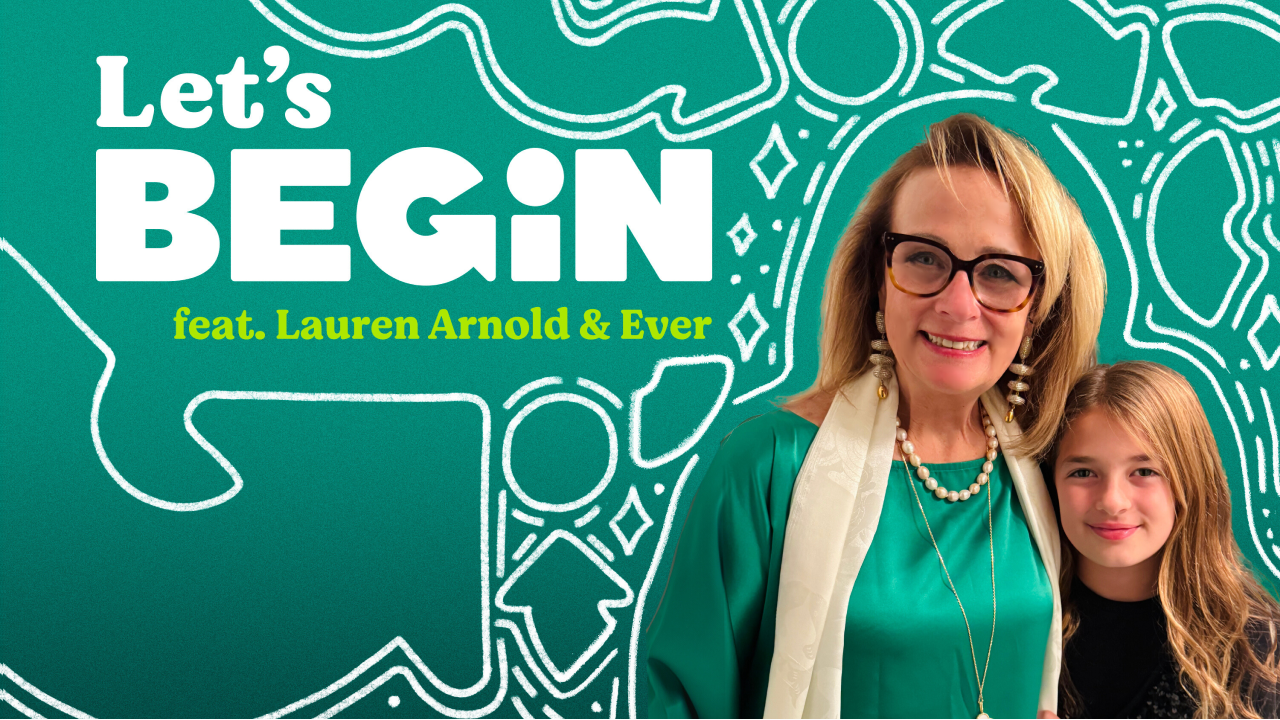
Have you ever wished you could have a candid, honest, yet loving conversation with your mother AND your child about how you’re doing as a parent? We recognize what a privilege it is to have a conversation like this, and today Jenna is here to give it a try.
In a multi-generational conversation with Jenna’s own mother, Lauren, and daughter, Ever, today’s episode explores the landscape of parenting in the past, present, and future.
Listen anywhere:



This episode offers a tender reflection on the evolving roles of parents, the uniqueness of each generation, and the deep connection between mother and daughter, all while exploring the vital importance of showing up for children in a way that nurtures their emotional needs and individual growth.
Lauren reflects on the challenges she faced as a mother in a rapidly changing world, offering wisdom about the cyclical nature of parenting and societal shifts—proving that while the world may change, the struggle to get kids to eat their vegetables stays the same. Ever, at just nine years old, offers a refreshing perspective on the experience of being a child in today’s world. She candidly shares her thoughts on the challenges parents face in keeping up with the individuality of their children, while also revealing her desire for something more from her mother.
To learn more about Begin’s expert-designed digital and hands-on learning product to enjoy with the whole family visit beginlearning.com
Recap
Guests: Laura Bush (Former First Lady & Education Advocate) & Ever Hager (Student & “The Moderator”) Host: Jenna Bush Hager
In a special season finale, host Jenna Bush Hager invites the two most important women in her life—her mother, former First Lady Laura Bush, and her nine-year-old daughter, Ever—to audit her parenting. We often hear from experts, but rarely do we sit down with the generation that came before us and the generation we are raising to ask: “How am I doing?”
In this episode, three generations discuss the “trailblazing assignment” of modern parenting, the timeless struggle to balance structure with joy, and why the secret to a happy home might just be taking yourself a little less seriously.
The Problem: The “Seriousness” Trap
According to 9-year-old Ever, the biggest issue with modern parents isn’t that they are strict, but that they are often “too serious.” Between work emails and color-coded to-do lists, parents often forget to transition from “manager” to “playmate.”
- The Stat: Ever hyperbolically notes that parents seem to be on their phones “5,000% of the time,” while she just wants them to play tea or engage in the chaos of childhood.
- The Result: We prioritize the “To-Do List” as a monument to our success, missing the “rainbow of emotions” and fun happening right in front of us.
The Philosophy: The Guide, Not The Creator
Laura Bush shares a liberating philosophy she adopted when she first held Jenna: the realization that she was not the “creator” of her child’s outcome, but merely a guide. She suggests that parents today put too much stock in the “scoreboard” of their children’s achievements, thinking a child’s success is a reflection of the parent’s identity.
Laura’s advice:
“Your job is to walk alongside them… I always felt that if you needed 100%, I was only about 20%. And that other 80% would fill in with school, with peers, with mentors, and with what you reached out to find.”
3 Insights on Parenting: Past, Present, and Ever
The conversation revealed three distinct areas where modern parents can learn to let go, using the wisdom of a grandmother’s hindsight and a daughter’s honesty.
1. The “Less Serious” Rule (Joy vs. Productivity)
The Issue: Parents are often bogged down by the logistics of life—homework, teeth brushing, and schedules—turning the home environment into a workplace. The Solution: Laura wishes she had “laughed more” and been less serious about the small stuff. Ever’s prescription for her mom is simple: “Laugh, laugh, laugh. Play, play, play.” The Lesson: While the “big stuff” (safety, values) matters, the “little stuff” (a missed ballet season or a messy room) is not worth sacrificing the joy of the present moment.
2. The Benefit of Hindsight (Anxiety vs. Trust)
The Issue: Parents constantly worry if they are making the right decisions at every fork in the road (schools, sports, friends), fearing that one wrong move will ruin their child’s future. The Solution: Laura reflects that when Jenna was 10, she couldn’t see the future, so she worried. But having the “benefit of hindsight,” she sees that Jenna turned out happy and self-sufficient. The Lesson: Anxiety is often unnecessary. As Ever asked in her “wisest question of the season,” sometimes you just have to “keep calm” and trust that it will turn out right.
3. The Multi-Generational Village (Support)
The Issue: The “nuclear family” experiment has left many parents feeling isolated, trying to be everything to their children at all times. The Solution: Acknowledging that different generations fill different roles. As Laura notes, she has more free time than Jenna, so she can be the one to play while Jenna works. The Lesson: You don’t have to do it alone. A parent is just one part of the equation; the “tribe” fills in the rest.
Final Thought: You Are Doing Okay
The episode concludes with a rare moment of validation from the most honest critics a mother can have. Ever’s closing statement reminds us that even when parents are busy, distracted, or imperfect, the love is felt.
“You’re all doing better than you probably realize… We love you back, no matter what.”
Episode Transcript
Ever: Mommy, if you could take a glimpse into my future and you saw something that wasn’t good, would you try your hardest to make it better again? Or would you just keep calm and maybe it would turn out right?
Jenna: Oh my god. That is just the wisest question of the entire podcast season. Hello, everybody. The conversation today is going to look a little bit different. We’ve previously had experts and activists helping us think through the ways we raise our kids and ourselves today. But I’ve asked my 70-year-old mother, Laura, and my nine-year-old daughter, Ever, to weigh in on what my parenting looks like—how I’m doing, and how I can be better.
I specifically wanted to hear from the previous generations—people who have walked the path that I am now trying to follow in their footsteps, and in some cases, do dramatically differently. We don’t prioritize multi-generational conversations, or at least we don’t hold them sacred the way that we might need to moving forward. Truth be told, my mom, Ever, and I wouldn’t be having this conversation about my parenting if it weren’t for this podcast.
I recognize that all families look different. I certainly bring in the complicated nature of being raised by my parents, just like Ever is already making clear the challenges she’s having with being my daughter. As you’ll hear from my mom—who we lovingly reference as “Yeye”—she reminds us that even though we might feel lost in the forest of angst and worry, there is another side to it. And Ever reminds us that all of the experts so far have been right: hanging out with our kids, staying off the phone, and playing is what means the most to them.
As I offer myself in the public square to my greatest critics… let’s begin.
Jenna: What are you nervous about?
Ever: I don’t know!
Jenna: Welcome to the rest of your life. Mom, what makes you a little bit nervous about this conversation?
Laura: It’s not what makes me nervous; it’s what I’d like to do, and I hope I can do it effectively. I would like to answer your questions in a way that helps others. I’ve spent the last couple of days listening to all your episodes, and I just love the way you’re able to get the jewels, the gems, the bits that your guests have had to offer parents. I wish that I had this when I was raising you.
Jenna: Okay, Mom. Well, since you said you want to be of service to others, what is it that you would love to say to the current generation of parents? How would you want to help them differently?
Laura: That’s a really good question. I look at you, your generation, and others—and of course, you’re not just one monolithic generation, you’re many. What’s remarkable about your situation right now is that you are in the middle of facing massive societal change. That is requiring you to be present in new ways that have never been tested before. So, you don’t have role models, really, to face what’s in the future. Your kids are going to be living lives that are completely unfamiliar to you, as well as to my generation.
But then I step back and I think: Wow, they have a lot to do. And then I remember, that’s what I faced. That’s what my grandmother faced. That’s what my great-grandmother faced. Every generation has their trailblazing assignment. I grew up in the hippie era. We were shattering norms. We were showing up with long hair and protesting the Vietnam War, and our parents didn’t like it. Then we became parents, and we were going to do it very differently than our parents.
That’s what you all are doing as well. You’ll be doing it very differently than my generation did, and you’ll be facing your own transitions and knocking down norms to make way for a new society. Recognize that these are cycles of change that keep repeating themselves.
Jenna: But don’t you think this one is harder?
Laura: It’s always hard. Think about the parents who raised their kids during World War II.
Jenna: I know, you’re right.
Laura: And I do think what’s really remarkable about what you’re going through is the fast-paced emergence of technology, and in particular, Artificial Intelligence, and how that’s changing everything about the human brain.
Jenna: Ever, do you think it’s hard to be a parent?
Ever: Yeah. We’re hard.
Jenna: Who is hard? The parents or the kids?
Ever: The kids.
Jenna: What do you think is the hardest thing about being a parent?
Ever: It’s that you have to keep up with us because sometimes we can be a lot of crazy! And it’s like we have our own personality, and nobody really matches that point. So, it’s hard to keep up with something that is so energetic.
Jenna: Do you think we have the same personality or different personalities?
Ever: Well, nobody has the same personality. There are things that we have that are kind of the same—like you and me both love bracelets, and we both love canvassing and stuff like that. But there are other things where nobody is the same, so it’s hard to keep up with someone like that.
Jenna: Sometimes you say things like, “You don’t understand me.” I used to think that Yeye didn’t know or get me, or understand what I was feeling. Do you feel that way sometimes?
Ever: Sometimes.
Jenna: How can I better show up for you in the parts that are different?
Ever: I don’t know. Spend a little more time playing with me and my brother. Or, if you do something, maybe you could tell me if you felt you did it wrong? Before I would have to [say it].
Jenna: Do you think that I can admit when I do something wrong? Or maybe a little bit not the way that I wanted to? Should I say that more to you?
Ever: If you feel it was wrong, maybe I could tell you too. But like… I want to ask you a question.
Jenna: Go for it.
Ever: Is there something that you learned from Yeye that you did or taught me and [my brother]?
Jenna: Oh, so many things. But the one thing that’s coming to mind right now is that you’re not mine. Meaning, you’re my baby—you’re always my baby—but my job is to walk alongside you. Not tell you exactly what to do. Now, when it comes to table manners, I’m still going to be on top of it!
Ever: I’ll try harder.
Jenna: So will I! Sometimes Yeye has pointed out other families and said things like, “See that Daddy over there? That Daddy thinks that that little kid is supposed to be his homework assignment.” Or, “See that other parent over there? They want their kid to be perfect in this kind of way.”
Yeye kept telling me: I am not your creator. I am not in charge of who you become. I am here to help show you the way. And the other thing that she said that was so, so important to me is that she said: “I’m only going to be able to help raise you halfway. The rest of the world is responsible for making you, You.” She thought it was her job to make sure that I went to the right classes, or hung out with the right adults, or tried the different kinds of activities.
Laura: Or that you had the right mentors and the right love around you. And you were great at finding those folks.
Jenna: Mom, you always used to say—and I think this is actually a shout-out to Hillary Rodham Clinton in her book It Takes a Village—how did you know you weren’t going to be able to fill in all the blanks for me?
Laura: Really good question. Ever, you’re doing a great job moderating, thank you so much! Your questions are really terrific.
When I held you, Jenna, the first time in my arms, I felt the power of a new human being entering this sphere. I felt an overwhelming sense of responsibility to make sure that I was the kind of mother that you needed. And every being comes in with a different set of needs. Dad and I brought you home, we put you on the bed, you cried, we cried harder. And we looked at each other and said, “Now what?”
And I said, “I don’t know.” And it’s been an “I don’t know” ever since! It’s an act of learning and growing together. Raising a child involves raising myself. Your father engaged in the same kind of activities so that we could be the parents that you needed. And every parent, I think, shows up differently because their child comes in with different needs and a different purpose.
So for you and your brother, I always knew that I would be your guide, but not responsible for who you were and how you turned out. I would be one factor in that.
Jenna: The most important factor, probably, right?
Laura: Parenting certainly is one of the most important factors in school and community and everything else. But I always felt that if you needed 100%, I was only about 20%—less than half. And that other 80% would fill in with school, with peers, with other mentors, with what you reached out to find.
Jenna: Do you think parents today take too much credit or put too much stock in the scoreboard of their child?
Laura: I think so.
Jenna: Is that more today than it was before?
Laura: No. We all drove around our cars with decals in the windows proclaiming what schools our kids got into. Some people still do that. I haven’t seen it in a long time though. People think that their children give them their identity. It’s always been clear to me that you came into my world with a purpose that I had to help you achieve. But guess what? I also have my own life. And my own purpose. So we achieved together as a family.
I think it’s important in a family unit that a mother or a parent is supported in what they need to do as well as what the children need to do. There’s a lot of sacrificing on behalf of the children and sublimating our own desires to that child’s purpose. I think that is not helpful to either the parent or the child.
Jenna: So my Mom was raised in the Mad Men generation where her parents were going out to the country club and cocktailing. Mom was the eldest of four. You were really tasked to be the caretaker for all of them—as in, just keep them alive while we go have fun! But they certainly weren’t like, “What is Laura’s purpose? How can I facilitate that?”
Laura: No, it’s very true. Her purpose is to be a babysitter! That’s a joke. That’s actually not true. My mother and my father both were very supportive of me and my career. They didn’t quite understand the degree to which I pursued degrees, but however, they were very proud of it.
But I think what I want to say is, it’s not necessarily about how much we achieve, but about respecting ourselves as parents for who we are and what we are, while we also are raising these little ones and respecting them and their needs. Sometimes I look around and I see women all over the world working to pay school fees. It’s a global phenomenon. And I look at them and I think: You’re working so hard to simply pay school fees. And then those kids will graduate and they’re going to work hard to pay school fees. Where does the individual show up?
Jenna: Ever, can I ask a question that I’m going to ask Yeye too? If you could change one thing about parents… what is one thing you could go back and change?
Ever: I don’t think there’s much to change. But I think maybe… it would be easier if parents could go back in time and remember when they were kids, and remember how hard it was for them sometimes. And then take all those things from when they were a kid… and realize it. I think that would give them maybe some more advice.
Jenna: Do you think sometimes Mommy tries to fix your problems for you? And I should just give you extra cuddles and ask more questions?
Ever: Do you hate when Mommy tells you to eat your cauliflower and brush your teeth and clean your room?
Jenna: I thought the cauliflower was very good last night!
Ever: You don’t have to tell me to eat my cauliflower, but you sometimes do have to tell me to brush my teeth more than once. And clean my room. Which I understand—sometimes we can’t do things on the first command. It’s hard. It’s not easy!
Jenna: I love you. Okay, Mom. What is one thing you wish you knew about parenting when you were younger that’s changed for you over time?
Laura: I wish that I knew that it was okay to be less serious.
Jenna: Ooh.
Laura: If I could go back, I would laugh a lot more.
Jenna: Laugh at what? Like the not brushing the teeth?
Laura: All of it! Is your homework done on time? Did you get 10 out of 10? Are you in the right school? Are these relationships working for you? In the moment, everyone seems so big and so serious. What do you think, Jenna, about not taking things so seriously as a parent?
Jenna: I don’t know. Because when I look back, there are so many significant forks in the road in anyone’s life. The obvious ones like school, job, partner—those kinds of things feel ginormous. And they are. But I am a big believer in “It’s a big important decision, but if you need to change it, you can.” This idea of “Calm down, we don’t have to live within the same rule set that we have in the past”… I hear you on stopping taking it so seriously.
But I still, as a mom, think: We didn’t do ballet this season. Which, for all the right reasons… but I’m like, Oh shoot, we just missed a whole season of dance and movement. Is she going to be able to get caught back up? Kids at 7, 8, 9 are specializing in baseball and soccer and lacrosse. And I understand the reason why they do it, and the socioeconomic opportunities that exist with scholarships… but it does feel big, Mom. Do we stay at the school or not stay at the school? Is this going to impact her intellectual capacity? Am I going to end up serving her the best that I can?
Ever: Mommy, do you think if you tried to be less serious, you would [laugh] a lot?
Jenna: I don’t know if I know how to! When Yeye just said she wishes she was less serious, I started laughing because I’m like… What does that even mean? Yeye being less serious? Have you seen her get dinner ready?
Laura: And that’s what I’m saying. It’s not the major moments—of course you’re going to be strategic and serious and thoughtful and do your research. What I meant to say was, I wish I had been able to infuse more fun in life.
Jenna: Yeah, but Mom, you were financially stressed. You had a daughter with a significant learning disability, who then turned into having a significant autoimmune deficiency. I feel like we are like: “The next thing, the next thing, the next thing.” It feels like a march, for sure.
Laura: During those times as a parent, that’s when I believe it’s important to step back and say: Where can I find some lightness in these moments? And how can I dial back my intensity?
Jenna: So, is that like finding more fun? And I do think I’ve seen that in the past decade from you. Just being a little bit more like, “Woo-hoo!”
Laura: Yes, exactly. Like, it’s okay. It doesn’t matter. Half of that doesn’t matter. The big stuff matters, but the little stuff doesn’t, and we can let it go. What do you think of that, Ever? Do you agree?
Ever: Yeah. I feel like we’re having a lot of fun, but sometimes I wish we could have more fun. The morning is always fun, getting to school, but then at the end of the day, it’s always work, work, work. So… I feel like we could have more fun.
Jenna: What does less serious look like again?
Ever: Laugh, laugh, laugh. Play, play, play.
Jenna: So interesting. In all of the other episodes, Dr. Jody continues to emphasize play. So, Ever, when we played tea yesterday, was that fun? You want to do that more?
Ever: Yeah.
Jenna: Do you feel like sometimes Mommy and Daddy are looking at their phones a lot? Brace yourself, people.
Ever: 5,000% of the time they are looking at their phone. 1% of the time… eh, 2% of the time, I’ll give you that… they play tea with me. But Daddy never does that. Mommy does. So… yeah.
Jenna: That felt awesome.
Laura: And how about Yeye? Do you feel that I’m looking at my phone?
Ever: Yeye? 50% on her phone. Like another few thousand percent she plays and goes to do her nails while I’m with her.
Laura: Ooh. Because I have more free time! That’s why multi-generational parenting is amazing. We have to fill in for each other. Whether it’s familial, on a friendship basis, or a community basis—it goes back to the tribe.
Jenna: Yes, the nuclear family experiment has failed. I have some questions for you, Jenna. Do you feel that I equipped you with the tools that you need to be a parent?
Jenna: Yeah. Is that a question that you’re scared to hear the answer to?
Laura: No, no, I want to hear it.
Jenna: There was nothing about the way that you parented that I’m like, “Ooh, I don’t want to be like that.” I think there were moments that you actually said that to me. I do remember a conversation between us about how you and Dad felt a little neglected by your parents, and so that’s why you all showed up at the Little League field and were just so hands-on and so aggressive—because you were products of the generation of parents who were “out to lunch.” Martinis.
Your presence felt constant. Except when I got to high school, and I would have appreciated a couple of Saturday nights where you and Dad took some trips somewhere! But I think it was wise that you did not go.
Probably the one thing I want to do for Ever… that I don’t know if I needed, but I don’t know if I have the training for… is be slower. And be more present. Because I think Ever has a rainbow of big and beautiful emotions that I either was trained not to let be so heavy on me, or it’s just part of the ways that we’re different. And I think I’m going to have to show up for her differently.
Laura: I watch you support Ever’s emotional development and it’s so beautiful. Her rainbow of emotions is appreciated, loved, and supported. Unlike in the past—my generation was not about that. There wasn’t an awareness. Mental health was just emerging. Our insights into the human psyche were just at the starting point. And I do think that your generation is equipped with some of the knowledge that we didn’t have.
Jenna: But we have to break some cycles on it too.
Laura: Yes. And let’s dive into that. Breaking the cycles of the past is a really important job, I believe, for each generation of parents. So back to that moment when I held you in my hands and I said, “Oh my gosh, now what?” I also knew that I had to really embark on a lifetime of learning and self-development so that I could be the kind of parent that you needed. And so many parents now appreciate that and get that and are doing that.
And that includes personal development. It also includes pursuing your own path. And having the trust that that won’t negatively influence your children. How many times when I was commuting from Philadelphia to DC on that train… was I so fearful that I was leaving a horrible mark on you by not being there every single day? And guess what? It’s okay. You’re okay. You’re just fine now. And I think modeling the kind of behavior that it’s okay to have a professional environment in addition to a parenting environment is good.
Jenna: I feel like what I’m watching with some of my friends… I feel like the 90s “Mommy Wars” have sailed a bit away. They look differently today. But it’s just the obsession with the To-Do list. That the To-Do list becomes the life. And my To-Do list is my monument! It is my home base. It is color-coded. I love it. And I could spend years doing my To-Do list and then pick up my head and be like, “Wait, what the hell did I do?”
And so I just want to say that there were moments throughout my childhood, certainly, where Mom was like: “You are going to have a career before you start a family. And you’re going to have a career that you want to go back to after you have your first child.” And that made me very much who I am today. But also, I think there are ways that I might reframe that with Ever. I don’t know what that is yet, but I think there is a little bit of a reframing and less of a competitive edge to it that feels like we can keep those conversations in the 90s where they belong.
Ever: Question for you. Yeye, do you think, looking at her now, are there things you would do differently?
Ever: She asks the best questions.
Jenna: She’s the best moderator!
Laura: So, Ever, you know what’s really interesting? I now have the benefit of hindsight. You know what that means? I know how it turned out. I’m looking at your mom. She’s self-sufficient. She’s happy. She’s a great mom. She’s in a good relationship. She’s in a good place. And she’s having an impact.
When she was 10? I couldn’t see the future. So the grades mattered. The social environment mattered. The school she went to mattered. And every decision point I was making… I didn’t know how it was going to turn out. I’m so grateful for where she is now. I think she’s terrific. So I guess I’d say I do nothing different because she turned out differently perhaps. Or, it doesn’t matter what I did. She was going to turn out the way she is anyway.
Ever: Mommy, if you could take a glimpse of my future, and you saw something that wasn’t good… would you try your hardest to make it better again? Or would you just keep calm and maybe it would turn out right?
Jenna: Oh my god. That is just the wisest question of the whole entire podcast season. I want you to be You entirely. And I don’t care what that looks like. And I also want to keep you safe. No matter what. So the answer to that question depends a little bit. If it’s a dangerous thing? I’m going to change it. Anything else? I’m probably going to let it go.
Ever: Thanks, Mom. I love you.
Jenna: I love you.
Ever: Thank you, Mom. I love you.
Laura: I love you.
Jenna: And now, some closing remarks from our moderator, Ever.
Ever: You’re all doing better than you probably realize. And we know that it is really hard and scary. We came out loving you, and we always will, no matter what. We also know, even if we don’t like it, that sometimes you were too busy to play with us. That’s okay. We know that it is also for us. On behalf of all the kids, I just want you to know: We love you back, no matter what.
Thank you for listening. Goodbye. And go on your phone if you really want that thing! You’re on your own!