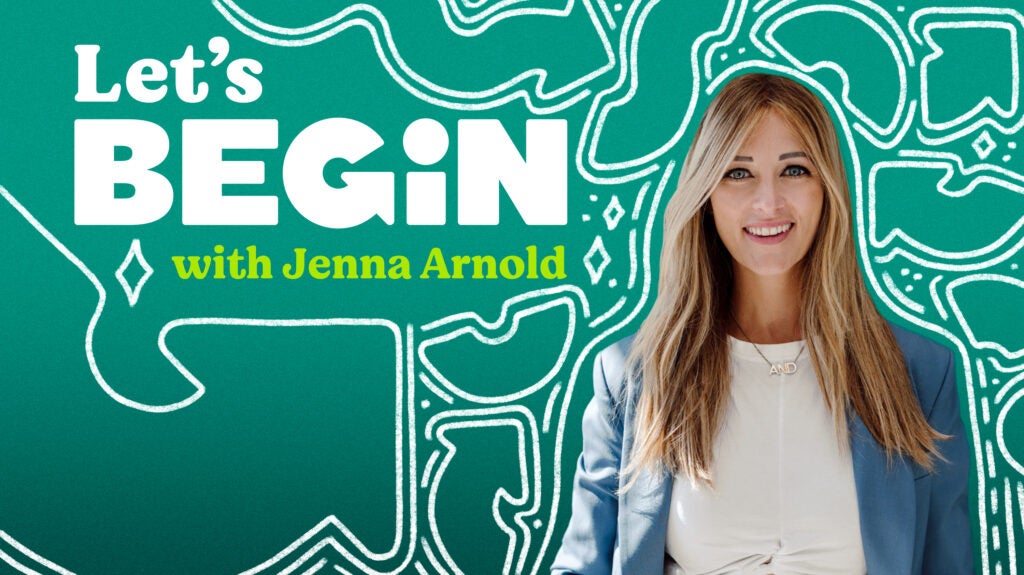
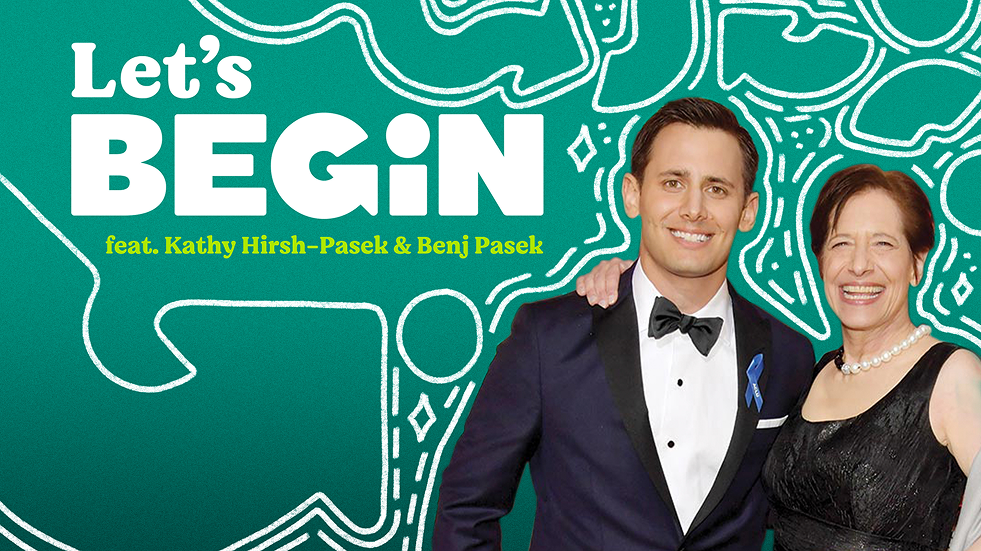
In a world where parents are drowning in expectations and kids are buried under extracurriculars, how do we step back, loosen up, and actually enjoy the ride? Jenna sits down with Dr. Kathy Hirsh-Pasek, a leading expert in child development, and her son, EGOT winning Composer and Lyricist, Benj Pasek, for a playful yet profound conversation on raising curious, creative kids.
Listen anywhere:



Benj shares how he learned to add play into his life early on and how his parents created a safe space for him and his brothers to learn and follow their own individual interests. Dr. Kathy Hirsh-Pasek not only created a playful and nurturing home for her kids to grow and learn about themselves, she also made sure it was fun for her and she thinks you can too.
To start infusing more play into your family’s learning journey with Begin visit beginlearning.com
Recap
Guests: Dr. Kathy Hirsh-Pasek (Child Development Expert) & Benj Pasek (EGOT-winning Composer/Lyricist) Host: Jenna Arnold
In a world where parents feel pressured to optimize every minute of their child’s life, “parenting panic” has become the norm. We multitask, we hover, and we worry. But according to Dr. Kathy Hirsh-Pasek and her son, renowned composer Benj Pasek, the secret to raising successful, creative children isn’t about doing more—it’s about doing different.
In this episode, we explore how to move from panic to play, with practical (and hilarious) anecdotes from a household that produced a child development expert and a Broadway star.
The Problem: The Myth of Multitasking
Dr. Kathy points out a hard truth: parenting has stopped being fun because we are trying to do too much. We see parents at the park on their phones, pushing a swing with one hand and ordering groceries with the other.
- The Stat: We all think we are good multitaskers, but research shows only 2% of the population can actually multitask effectively.
- The Result: We are physically present but mentally absent, competing for our children’s attention against our own devices.
The Philosophy: Be a Coach, Not a Director
Benj Pasek notes that as an adult creative, his job is often “unlearning” the rigid rules of adulthood to get back to the pure, shame-free creativity of childhood. He credits his parents for not imposing a specific “image” on him.
Dr. Kathy’s advice:
“Your job is to let your kid be your kid… You get the opportunity not to be a CEO parent and have the child in your image, but maybe to help a child be in his or her own image.”
4 “Parenting Hacks” from the Pasek Household
The most valuable part of this conversation was the specific, unconventional rules Kathy used to teach boundaries, self-regulation, and negotiation.
1. The “7:15” Rule (Boundaries & Freedom)
The Issue: The kids were picking their noses constantly. It was gross. The Solution: Kathy didn’t ban it entirely. She instituted “7:15.” At 7:15 PM, for exactly one minute, the kids were allowed to pick their noses as much as they wanted. The Lesson: It gave the kids an outlet (“I have the freedom to do this!”) but placed a strict, socially appropriate boundary around it (“I can’t do it at 7:16”).
2. The Dairy Queen Rule (Self-Regulation)
The Issue: The family loved Dairy Queen, but too much sugar is bad. The Solution: On road trips, the rule was they had to stop at every single Dairy Queen they passed and order something. The Outcome: By the third or fourth stop, the kids were begging not to eat ice cream or ordering the smallest possible item (like a single piece of broccoli if they could!). The Lesson: Instead of the parent being the “bad guy” saying no, the kids learned the natural consequence of excess (feeling sick) and learned to regulate their own intake.
3. “Make Your Best Argument” (Critical Thinking)
The Issue: Kids arguing over dinner choices (pizza vs. chicken). The Solution: Kathy created a game called “Make Your Best Argument.” The kids had to logically present why their choice was superior using facts (e.g., “Pizza has grain and dairy!”). The Lesson: This teaches negotiation and rhetoric rather than screaming. It respects the child’s intellect and turns conflict into a skill-building exercise.
4. Mandatory Family Meetings (Civil Discourse)
The Issue: General family grievances. The Solution: Anyone could call a “Family Meeting” at any time, and every member—parents included—had to attend. The Lesson: It created a platform where everyone had a voice, teaching the kids that problems are solved through discussion and negotiation, not authoritarian decrees.
The Science: The 6 Cs
Dr. Jody LeVos weighs in to explain the framework behind Kathy’s intuitive parenting: The 6 Cs. These are the skills kids actually need to thrive in an AI-driven future:
- Collaboration: Learning to work with others.
- Communication: Speaking, writing, and listening.
- Content: Traditional learning (the “what”).
- Critical Thinking: analyzing and evaluating.
- Creative Innovation: Making something new.
- Confidence: The grit to take risks.
Final Thought: Reclaiming Awe
The episode concludes with a reminder to embrace the mundane. As Kathy says, if you can look at a puddle or steam in the shower and see a world of imagination, you are teaching your child to find joy everywhere.
“We have to be people who are good citizens… Social relationships are at the core of everything.” — Dr. Kathy Hirsh-Pasek
Transcript
Jenna Arnold: Today, we have two very accomplished guests, another parent-child duo. I think I asked them on to test my BS meter. Like, we have an expert in parenting who has also launched three well-accomplished children into the world.
Dr. Kathy Hirsh-Pasek is a renowned psychology and child development expert, a senior fellow at the Brookings Institute, and Temple University psychology professor. She is also a dear friend of the Begin Learning team through her decades of research and her “6 C” learning framework, which we’ll talk about with Dr. Jody at the end of the episode.
Benj Pasek is one of her three sons. The only one without a PhD, but he is an EGOT winner. He has an Emmy, a Grammy, an Oscar, and a Tony for his extraordinary work on Broadway and in Hollywood. I know him because we both have a love for Krispy Kreme donuts, we love to geek out on foreign policy, and I find great enjoyment in playing his matchmaker.
Today we’re diving into the secret sauce behind Kathy’s parenting approach. Are we going to find out that you have to be a brilliant, professional, and child-raising expert to produce prodigies? Or was it in her moments of insecurity, where she fell back into her instincts and joyful approach, that was the key to her success?
Jenna Arnold: Kathy, do you know the first time that I met Benj, he came to my house for like Shabbat or something, and he brought a box of Krispy Kreme donuts? And I just kept thinking: One, I’m in love with a man who shows up with Krispy Kreme donuts, but oh my god, he went to like the bowels of Penn Station to get Krispy Kreme donuts.
Dr. Kathy Hirsh-Pasek: That’s what you do, Jenna. That’s what you do.
Benj Pasek: This morning during my workout I said that… for some reason I was craving an Auntie Anne’s pretzel.
Dr. Kathy Hirsh-Pasek: Oh, yes, they are good.
Jenna Arnold: Right back to Penn Station for you, Benj. Kathy is on her way to Australia to either entirely relocate or come back with very detailed notes about parenting in Australia because I am in the business of judging and comparing, and I would like to know if they have it more together than we do here.
Dr. Kathy Hirsh-Pasek: It’s very, very likely. Very likely.
Jenna Arnold: Of course it is.
Dr. Kathy Hirsh-Pasek: They’re more chill.
Jenna Arnold: Kathy, on that point of being chill, you have a number of degrees, decades of experience of being a parent, and a series of products—and I will just point to your sons as evidence that you know what you’re doing. One of the things I continue to hear from you is your concern around the level of unnecessary stress parents put on themselves. And this “chill variable” being something that I certainly aspire to. I don’t know if I have it. But what are some of the things that you’ve noticed over the past couple of decades that has gotten you to the observation that parents and caretakers are really on edge today?
Dr. Kathy Hirsh-Pasek: Well, you don’t have to go any further than just go walk in the park. And you see parents trying to multitask. They’re on their phone, they’re ordering something, they’re pushing the kid—one kid’s tagging them, you know, and trying to pull their coat. It’s really not fun anymore to be a parent. And it should be fun to be a parent.
Now, parenting is really hard work. But it’s also something where you should get a lot of enjoyment. We’ve had a lot of stuff competing for our attention. And I think now our kids are just one of the things in the mix competing for our attention. And the sad news for humans—it’s really sad—is that we all think we’re multitaskers, but only 2% of us are really good multitaskers.
Jenna Arnold: Kathy, you know every single person who is listening is like, “Well, I fall in that 2%.”
Dr. Kathy Hirsh-Pasek: (Laughs) So I think that’s part of what’s creating the craziness, is too many things are vying for our attention.
Jenna Arnold: This real conundrum, Dr. Kathy… It’s easy to hear from you that, “Oh, people need to chill.” But aren’t you like on the other side of a number of stress decades with three sons—two who are doctors and one that has accomplished a lot in their own field? I’m a little bit like, “I’m not sure my kid’s going to be able to like take the SAT,” or “She’s about to get her heart broken, she’s too much of a people pleaser,” or “My son is rude.” How am I going to kick that out of him and make sure he understands consent? Like, I got a long way to go before I can look at a kid like Benj and be like, “Phew. Did it.”
Dr. Kathy Hirsh-Pasek: Well, you know, now that you’re in it, you know that there’s some great moments and there’s some really rushed moments. And your job is really to let your kid be your kid. In the sense that they’re going to grow up to be something that you may not imagine right now. And you get the opportunity not to be a CEO parent and have the child in your image, but maybe to help a child be in his or her own image. How great would that be? And let me tell you, the adventure is incredible if you follow their lead a little bit.
So my advice is: Step back a little. You don’t need to be on it every minute. But you do need to give your children choices. Because how are they supposed to pick what they really want to be if they don’t know what soccer is? If they don’t know what playing the flute could be like? You know, that’s our job: is to expose people to things so they say, “Wow, I was excited by that. But I wasn’t excited by that.” And if we give kids choices—I’m not saying to let them run the roost because I do think that’s a mistake and we’ve gone too far in that direction—but I am saying expose them, let them taste, have fun while you’re going and tasting. And then let them become who they’re going to be. Not your image.
Jenna Arnold: Benj, I want to thank you on behalf of eager parents in the world who are just desperate to make sure that there’s high quality content. You’ve contributed so much already. Thank you. But one of the things that is clear to me, and I am familiar enough with your body of work—but like probably only like six of the sixty hundred songs that I know by heart—but it seems like there’s this sense of wonder and curiosity that you hold quite sacred. I feel like—and we’ve done a lot about the power of creativity and curiosity in this season; Kristen Bell and I were on for far longer than we needed to be being like, “How do we preserve kids’ natural curiosity?”—but it sounds like your mom held that sacrosanct in your home too. Has that translated into your career or how you produce the things for the world, particularly for kids?
Benj Pasek: Yeah. I mean, that’s such a good question and such a, I think, a great observation on behalf of, you know, me loving my mom and the way that she operates in the world. One of the things that I think the older that I get as an adult is that our jobs as adults are to basically unlearn all of the things that corrupt us from our most childlike versions of ourselves.
You know, we have this really pure artistic, creative instinct, and then the world kind of dogpiles on and tells us that we’re not allowed to do that, and we build up these defense mechanisms and these fear-based ways of going throughout the world. And so much of the work that I feel like I’ve done as an adult is to try to unlearn things that the world has imposed to tell me that I’m not supposed to be like my most, you know, authentic nine-year-old self.
And I feel like I have such an advantage in doing that because I wasn’t, for the most part, given that mandate by my own parents. It was really a desire to, yeah, maintain looking at things with wonder and beauty and from a place of creativity and from a place of “let’s make something.”
Another thing that I think is really true for the way that my mom always approached things with us was: How do you motivate people out of joy instead of fear? And I think that that makes a more creative, more engaged person. Whether it’s honestly like… I just was working out and I was working out with a group of six friends because for me, to work out is really not pleasant. But to hang out with my friends while we’re working out becomes a joyful act. And so, how do you kind of “life hack” so many of the things that could be really not fun and make them into joyful, playful moments?
I think, yeah, in terms of the things that I want to write about or the things that I try to create with my collaborator… it feels like it’s trying to hold on to the essence of joy and wonder. But I think that that comes from a place of actually really trying to approach life from that same vantage point. Which is: How do you motivate yourself because you love something or you’re curious about something? Motivated through curiosity and joy as opposed to feeling like it’s all dutiful.
And as my mom was saying, when you give people options to follow the thing that they naturally like, what their natural instinct is of what they follow… then work can feel like play. And when you orient yourself, I think, with a playful attitude, I think you’re just… you’re much more self-motivated. And I think that I feel very lucky that I haven’t had to unlearn so much in adulthood because so much of my early childhood was oriented towards that way of thinking.
Jenna Arnold: So all that sounds great. While you have done a brilliant job of delivering a product to the world that I think fully encompasses what you just described… are you like that with yourself? And if the only thing I want is for my kid to be kind enough to themselves… because I am far too hard on myself.
Benj Pasek: I find that the voice in my head that is shameful or the voice in my head that is self-critical is mostly inherited from other people in my life, not my parents. And I think then the work of undoing that in my adulthood has been a lot easier because it hasn’t been my parental voices.
So like: Are there teachers? Are there friends? Are there embarrassing moments? Are there exes? Are there ways that, you know, even people that I work with, how their families have treated them and how that then plays into how they treat me, that plays into how I view myself? Of course. You know what I mean? Growing up queer in a world that’s inhospitable to queer people… there are so many things that are self-critical. So there’s a lot of work to undo.
But I don’t have the self-critical voice of like screaming at myself when I fail, you know what I mean? Or believing that I’m worthless or… all of these things that I think could be inherited from a parent, I don’t have that element of it because for the most part, it was done with love and joy. Now, on the flip side, like, do I wish that I had better time management skills? Do I wish that I were more self-regulated in certain ways? Of course. And who knows what the perfect balance of anything is, right? Like, I don’t know… is it two pinches of sugar or three pinches of sugar? Did we over-correct?
But I do think that it’s been easier for me to learn how to implement structure for myself than it has been if I were going the other way, which was trying to really unpack and unlearn a deep, deep-seated sense of self-hatred and criticism and shame. And so many of my friends—speaking through a creative lens, I think—are so afraid to even pursue… And when I say creative, I don’t mean a life where you’re a professional songwriter. I just mean like following any kind of creative impulse, which I think is closest to who we are as kids. Like, we are creative beings. They’re so afraid to even let themselves try or be creative or make something or risk something because that voice is so loud internally that’s telling them that they can’t, that they shouldn’t, that it’s bad, that it’s not good enough. And that becomes inherited and then that becomes part of you. And I’m really grateful for that element of it.
Jenna Arnold: There’s nothing else I deliver to my kid is that in 30 years from now he’s like, “You didn’t make me feel like an asshole. Thanks, Mom.”
Dr. Kathy Hirsh-Pasek: Well, you know, I think part of it though Jenna is also giving yourself a break. You know, we talked about that. And Benj and you have both raised two important points. What we’re not saying is: kids have the roost, go out and do whatever you want and we’ll just follow along. Also saying: Don’t be a dictator and don’t have a child in your image, try to let a child grow up in his or her image. So how do you do that is really a tough balancing act. Because kids need boundaries. They really do. And the laissez-faire parents… we’ve looked at it in psychology, oh my god, for decades. And it doesn’t work so well for the kids. Like if you want to guarantee a kid’ll have problems, just assume that you can tell them everything in your life and it becomes their burden and they can go out and charge it for themselves. They’re not old enough to do that. It’s a super complex world.
And one of the places where I hear that the most, especially with teens, is: “Well, they figure out what they want to be on. I don’t know what they’re doing. But they’re on their phones like tons.” And you know, kids will do that. Kids will watch whatever we put in front of them. Even little kids. You know, we really are coaches. That’s who we are as parents. We’re not directors. But we’re also not absent.
Jenna Arnold: You and I are both in agreement. I was a first-grade teacher in LA, a fifth-grade teacher in Miami. And I ran a really tight ship in my classroom. You and I are both of the same school of thought that “No” is a complete conversation. And I do see around me—this is something that I don’t think I’ve said yet on this season, but I’m going to say it—is so many of my friends… One, believe our kids’ frontal cortex is developed.
Dr. Kathy Hirsh-Pasek: You’re right. Our kids don’t have all the stuff they need in executive function in the frontal lobe for attention and self-regulation. One of the reasons we started school at age seven was that the kids could sit. You know? And before that, we’re asking them to sit for long periods of time and it isn’t quite working. And a lot of people are looking at this. We just recently looked in kindergarten classrooms and these kids are supposed to sit for like 55% of the school day. Sit. I mean, no. That’s not what little people do. You know, little people are curious explorers. They’re like the discoverers of the world that they happen to be in. They need to tinker, they need to get dirty. And you’re right, if they fail at something, that’s okay. They learn from the failure. And what do they learn? Persistence. So that they keep going. They learn not to run back to Mommy. They learn to try it again and see if they can build the tallest tower. And that’s what you’re going to need in the workplace of now, let alone the workplace of the future.
So I guess what we really need to do is: not give full rein, but as you said, boundaries. And boundary pushing’s fine, but you can’t even boundary push if you don’t know what the boundaries are. So we have to give ourselves a break and say, “This is kind of what I expect. I need to let you know what my expectations are. I need to let you know what’ll happen if you violate that. And let’s be civil to each other.” And make sure that as you go on, you’re creating human beings, not just products, as you’ve said.
Jenna Arnold: Kathy is… has carried the torch that there’s no one size fits all. And if she showed up this same way for each one of your brothers, they wouldn’t have become fully themselves. Do you feel like you saw that?
Benj Pasek: My experience was essentially like giving us a lot of opportunity to have a lot of exposure to things. And then following the things that we naturally liked. I never really felt that forced to pursue something that I absolutely hated. Now that doesn’t mean like you shouldn’t learn how to have some sort of grit or work hard at something and hard things have value at working hard at. But I think that the orientation towards doing things out of joy meant that I was doing work without me really knowing that I was doing work.
You have to learn the letters to be able to read. Yeah, and learning letters is hard. But like at the end of the day, if you’re telling stories that you love, then you want to learn the letters. And if you’re reading stories that you don’t want to read, then you don’t want to learn letters. So orienting things towards like, “How do you do it with a joyful approach?” I think was right.
My older brother was super academic. I was more theatrical. My little brother is a social psychologist and really into the observation of people. And I think that she and my dad really tried to just orient our lives around the things that we had natural proclivity to.
One other thing I wanted to say because based on the last thing you were talking about which I think is an interesting example of that balance. This is sort of sidebar but earlier question… was like that balance of giving kids borders but also finding joy. So just like two quick anecdotes that I think you might enjoy, Jenna. I’ll bring my mom back to her parenting youth. Which was: She would allow leniency but also give us borders. Here’s three examples that I can think of.
Two were: There was a time in our house called 7:15. I remember this forever. She’s laughing right now. 7:15. We had an entire minute where we had to, we were mandated to pick our nose. And why were we mandated to pick our nose? Because we were picking our nose all the time throughout the day, probably eating our boogers, I don’t know what we were doing. But we were disgusting. So we would pick our nose all the time. And at 7:15, we couldn’t pick our nose at any other time. But at 7:15 we had to pick our nose and we went at it.
Dr. Kathy Hirsh-Pasek: Like, go at it!
Benj Pasek: This is so good, Kathy. It’s so good. So we would, I mean, every… but like if at 7:16, you gotta shut up. At 7:14, it’s not time yet. And so like it gives the kid an outlet. It gave me the thing of like, “Oh, I can do that. I have the freedom to [pick my nose], but I’m not going to do it in an inappropriate time.” It’s giving a boundary while also giving freedom.
The other one that I’ll think of… and I don’t know Mom if you have other ones… She wanted to create, I think, like a sense of adventure and a sense of, like, fun. The same way that I brought Krispy Kremes to your Shabbat. We had this thing where our family was obsessed with Dairy Queen. So every time, every single time that we would pass by a Dairy Queen, we would have to stop at the Dairy Queen and order something at minimum. Now that was all fun and games when it was just like driving around local suburbs.
Jenna Arnold: Wait, what happens when you were late?
Benj Pasek: No, no, no. What happens when we were on a road trip is the real question, Jenna. Because by the time that you’re on a road trip and you pass by four Dairy Queens and you have to order something at the Dairy Queen on the fourth time?
Jenna Arnold: Wait. Everyone? Everyone’s getting—?
Benj Pasek: Everyone has to order something at the Dairy Queen and eat it. Which means that… you don’t know where your day’s gonna go. You don’t know if you’re gonna pass that Dairy Queen again. So what do you learn as a kid? You’re like, at first you’re like, “I’m living the life. I’m eating that vanilla with butterscotch dipping and my Blizzards and the Snickers.” But then, oh my god, if you pass by a Dairy Queen and then you pass by it again… when you’re a kid, you don’t know how the world works or what directions are. You’re scared! You’re like, “Okay, I’m gonna order a smaller portion the next time.” Or “I’m not gonna go as crazy as I did the first time because I need to understand portion control or self-regulation.”
Jenna Arnold: Kathy, did anybody throw up? Too much Dairy Queen?
Dr. Kathy Hirsh-Pasek: No, but there were times you said, “Do we really have to eat it? Please? I really, I can’t handle it.”
Benj Pasek: And I was like, “Please, the broccoli!”
Dr. Kathy Hirsh-Pasek: Exactly.
Benj Pasek: Yep. By the third time, by the fourth time, I was like, “I don’t want Dairy Queen.” She was like, “You have to order the Dairy Queen.” So then in my head, I learned like: Okay, what does it not look like to be too self-indulgent? And like that was the lesson. What does it not look like to have excess or gluttony? Because like you never, you know, if your parents give you the ability to eat ice cream, but you don’t want to eat ice cream all the time… And you know, it’s a little bit Matilda. It’s the little bit of the chocolate cake. You know, and she forces the kid to keep eating the chocolate cake. And like we, we sort of hoisted ourselves by our own petard. And like that was the lesson. So like I think there are these ways… and I could probably think of more, but those are the ones that just came off the top of my head… where we got to be playful and fun and like do the subversive thing or do the thing that felt like it was an adult act… with like real parameters and real borders and boundaries around it. And I feel like that’s an example that I look at and I’m like, “Wow, that was pretty smart. Good job, Mom.”
Dr. Kathy Hirsh-Pasek: Oh, thank you, thank you. I’ll just give you two more that come to mind. You know, when you have, when you have three kids, like nobody, nobody wants to eat the same dinner. I mean it can really be bad. So one wants, you know, a hamburger. The other one will only eat stuff that’s white… which is one of my kids. If it wasn’t like a bagel or chicken, we wouldn’t eat it. The other would eat almost anything. And every night… getting to dinner…
Jenna Arnold: Wait, sorry. I just need to know which one was Benj? Was Benj the bagel?
Benj Pasek: No, no, I wasn’t. That was my little brother. He only ate like white, white foods. Yeah, it was very weird.
Dr. Kathy Hirsh-Pasek: So I invented this game called “Make Your Best Argument.” And you had to figure out, you know, which food you wanted to eat that night. A lot of times I did it around a cheap restaurant, you know. But “Make Your Best Argument” about where you want to go eat. So Mikey of course mastered this whole thing because he would eat pizza or bagels or chicken. Like that was pretty much his entire repertoire. And he would say, “Well, you know, pizza has a grain, and pizza has milk product, and pizza has…”
So meanwhile he gets to fourth grade and they teach him the five-paragraph essay. And I remember he came home and he says, “Well, everybody in school was really having trouble with the five-paragraph essay.” And I said, “Yeah? And you weren’t?” He goes, “No, it’s just Make Your Best Argument.” And so he knew where to take it from.
But the other thing is that, you know, you build into all this stuff respect for your kid. So um, another thing that I thought was really brilliant that my husband came up with was family meeting times. So look, we all… if you have more than one kid, you know that the kids are going to argue over something. You know, there will be arguments till they figure it out. But how do you create an environment where people learn how to negotiate as opposed to just screaming at each other? So whenever you had a problem—hopefully it wasn’t like every minute—we had Family Meeting. And anyone in the family could create Family Meeting and everyone else in the family had to attend.
Jenna Arnold: Sorry. At any time?
Dr. Kathy Hirsh-Pasek: At any time. And then you gave what your complaint was and everybody else gave their rationale for doing what they wanted, and then we worked it out. And then we went on with our life in a more civil way.
Jenna Arnold: We are aligned. We are not doing CEO Parenting. But it does sound a little bit like you’re running a business. In that it was like: there’s HR, there’s community building, there’s… But one of the things that I love about the “7:15 nose-picking cursing”… of which I love how Benj is like, “When we were nine and we learned all the curses…” My kids at three were using slimming curses like they were, you know, Shakespearean level.
But there is something really silly about it. And one, I had my mom and my daughter—my seven-year-old mom and my nine-year-old daughter—on an episode. And that was really important because obviously I had my own mom stuff to work out and I was hearing how I was doing as a mom from my kid. My mom was reminiscing that she wishes she was more silly and more joyful.
And last night I was… my kids, I couldn’t get my kids in and out of the shower fast enough. I was just like, “Come on! Please! You know the next step!” And I heard her in the back of my head being like: “Calm down. We know you have to get dinner on the table. We know you have a hundred emails you have to do. We know it feels like the world’s falling apart and you want to at least bear witness to something.”
And what the nose-picking and the “Have To Eat Dairy Queen”—because I am, I’m gonna come up with that rule, I have to figure out what the destination is and it actually might be Dairy Queen because that does feel so perfect—I didn’t think anybody threw up… But it feels like a little bit silly. Like it feels like Kathy you’re like, “Well, we’re gonna figure this out together. What happens on our third ice cream?” And that respect that you say that you were trying to offer the boys. Which one, I think parents today are both afraid of their kids but they’re also like just largely frustrated ’cause it’s not as easy as they thought it was going to be. But I imagine, Benj, you felt like you had some power and control when you were like at the ice cream or when you had to call the family meetings or when you were able to say the curse words. Like, you must have felt emboldened to stand on your own two feet or something in those moments.
Benj Pasek: Yeah, I mean… Obviously I, you know, I’m in therapy.
Jenna Arnold: We all are. That’s what this is.
Benj Pasek: And again, like I’m not trying to paint an overly rosy picture of everything, but like in general when I think about it, I felt like I could like voice my concerns or I could talk about things. And that doesn’t mean that like we were in charge. Like, it wasn’t that. It just was like I was listened to or considered. And as a result, I didn’t feel the need to like rebel against something so much because I wasn’t like having to… there wasn’t like this built-up anger of having my feelings or voice repressed all the time, so I didn’t have to retaliate.
Jenna Arnold: While there’s so many systematic things that we uh, are in the process of reconsidering… I also keep harping on the idea that one of the most important ways to at least for me make the world a little bit better is standing on some sort of soapbox suggesting that we have to raise our boys differently. If we’re just so concerned about boys… and maybe it’s just me… but if I see all the boys that are in leadership, they’re not… their eyes aren’t as big and their horizons aren’t as broad. I certainly don’t see how they are centering wonder. What do we do?
Dr. Kathy Hirsh-Pasek: I don’t know what we do, to be honest. You know, what we’re dealing with now is a kind of, you know, tribalism everywhere. And and reasons to not like anybody who’s “other.” So I think part of what we have to do is help our boys and our girls be sensitive people who are good citizens. I just think to the extent that people can see from multiple perspectives, then we will all be better leaders. And I think we owe that to every kid who grows up in our home: How do we help them see other perspectives?
In our house, we had the real fortune because of the kind of job that I’m in to be able to travel a lot. And there’s a lot in going to other cultures and seeing what a supermarket looks like in another culture, you know? Or figuring out “What in the world should I order on the menu? Like what do they eat here?” These are little examples but you can do them even by going to different ethnic restaurants in a city. Do you know what I mean? Figure out how other people are thinking… what are other people doing?
And I would say number one on the list is to create kindness. I think sometimes the world has given up on kindness, not just on curiosity. And as Benj said earlier, to also help our kids maintain awe.
Jenna Arnold: Benj, the patriarchy?
Benj Pasek: Oh God. I mean… I think about it a lot. I think I think men are really suffering right now in particular. And it’s a really tough time to be a guy. Uh, you know, and that’s like such an uncool thing to say. I feel like I have a little bit of cover being a gay man to be like: I actually feel really, really bad for most straight men. I think a lot of straight men suffer with maybe not having as acute social skills as as, you know, groups of women or queer people. And like: How do we make them feel like they can be in conversation with us? And a lot of that has to do with addressing the loneliness epidemic more than anything else.
I’d be curious to throw it back to like my mom or you: Like, how when you have these sort of these lonely boys who like don’t have social skills? Because that’s a thing that I observe especially with like the young boys. And then it turns into a habit of these boys like not being in community. I mean so many men that I know now are like… the more evolved men are like flocking to men’s groups and like getting to talk about masculinity for the first time ever because they’ve been… I just feel like most men don’t have friends. You know? And it’s really crazy. They just sort of inherit their wife’s friends but they’re told that they’re not really allowed to have friends. They just don’t know how. They don’t have that emotional intelligence. Yeah. What are the steps that you take to help a boy who like doesn’t engage in the world in that way? I’m actually really curious. Ask my mom that.
Dr. Kathy Hirsh-Pasek: Part of what what I think we all have to do is reckon with the society we live in today, which is very very different Benj than when you grew up. But you know, we’re seeing massive amounts of time on screen. You know? And um, what is called “social media” isn’t really social. Uh we just put out a task force report with the American Psychological Association on this very topic. Like what are we going to do? You’re talking about… just to give you a sense of it… by the time you’re nine or ten, you are on your screen for 10 hours a day. Now I just want… just you know take that and extrapolate out. It means that you’re working a 70-hour week, right? By being on screens. So no wonder people aren’t social. Right? They don’t have the time to look in another person’s eyes. And when you add to that the fact that like the human brain is a fundamentally social thing… that’s how we’re built to learn with others, to be with others. And we’re retreating from that… it’s a really dangerous situation.
But for little guys, I mean part of it is forcing that um navigation. You have to be in environments where you have to navigate the scene. It’s something by the way that you really do get out of like preschool. That’s a biggie. I know it’s not the reading and math outcomes everyone talks about, but these social outcomes are critical and they pave the way for what you’re going to learn throughout the rest of preschool, throughout the rest of formal school, all the way up through life. So: How do we help kids be in more social situations where they have to navigate the social situation? And social skills, social relationships… this may be the most important thing I’ll tell you today from the science… social relationships are at the core of everything.
Benj Pasek: I remember sitting in a parking lot outside of a Rite Aid with my mom and my older brother and we would play a game where we would have to imagine when people passed by what they did for a living, what their dog’s name was, where they were from, where they were coming, where they were going. Now to me as like a five-year-old, I just thought this was like a fun game, right? Like you look at someone and you’re like, “Oh like her name is, you know, Petunia and like she has a dog…” You know and like you’re picking up… But what I didn’t realize that I was being aided in doing was picking up certain social cues. Like: Is she sad? Okay, why is she sad? Is she coming out with a lot of bags? Okay, what is she buying? What would she need to be buying them for? Like all of a sudden through the gamification of something I was like learning a lesson that was about empathy and putting myself in the shoes of other people and creating narratives and and wondering about the narrative of someone else and getting myself out of my own body and thinking about someone else’s position in the world. But to me as a five-year-old it was like: Oh my god this is silly. This is fun. This is weird because it’s like the background of of of it is is is a Holocaust movie, but I think of the movie Life is Beautiful where it’s like the genius of that entire story is how do you imbue the darkest things in the world with a sense of play and joy? And if we don’t have like the worst most horrible tragedy to be the baseline and we just have our lives which we think are tough enough you know… What does it look like if we apply that filter onto it? And like how can we create gamification and joy and fun and play into everyday things that then have secret nuggets of developmental lessons? And I feel like that’s the thing when I walk away from like looking at my childhood… there were so many things like that that I just thought we were having fun. I was literally eating Dairy Queen.
Jenna Arnold: And picking your nose.
Benj Pasek: And cursing for an entire minute straight.
Dr. Kathy Hirsh-Pasek: You know, there’s just one other thing I’ll say. First of all, I was not a perfect parent and I just want to be super clear about that.
Benj Pasek: I would always tell her though by the way that I was ready to ruin her career. Any moment she pissed me off I’d be like, “Watch me. I’ll take you down. I’ll take you down. I’ll burn the house down and your, you know, it’ll be over for you.”
Dr. Kathy Hirsh-Pasek: No, you know, I wish I wish there were some sort of map for the whole thing for parenting. There really isn’t. It just isn’t easy. But right now it’s harder. Right now it’s harder than it’s ever been. It’s like at a wedding. You plan the whole wedding and you’ve done everything perfect for this wedding. And then of course something goes wrong. Like somebody doesn’t show up or the dress gets a tear in it, whatever it is. And those are the moments you remember. You don’t remember the perfection all the time.
So I think if we can, you know, it’s not about constantly gamifying—life is what life is. But if we can make it just a little bit easier… and part of that is putting on your four-year-old head. And I mean that so seriously. When you’re walking in the rain, you know, and you see a puddle… don’t you sometimes just wish that you could jump in it? Your kid does. You know? And and when you see something like I don’t know, even a roll of toilet paper… and when it comes down too fast, don’t you just wish you could wrap it up and make something? A four-year-old would. Or when you go in the shower, you know how the shower steams up? And when it steams up guess what? You can draw where the steam comes. And then it steams up again. And then you can draw a whole new picture. We call it “Shower Art” in our family. But my point is that everything offers those opportunities if you put your four-year-old hat on and your four-year-old head. And then go out and do something you have not done for the longest time. When’s the last time you skipped? My point is that if we could all give ourselves a break and we could all just reinvent that sense of awe and curiosity in ourselves, we’d probably get more of it from our kids.
Jenna Arnold: Benj and Kathy, thank you so much for offering Benj shockingly concrete things for us to do.
Benj Pasek: Boom!
Jenna Arnold: And Kathy for being the tip of the spear on probably frankly stating the obvious for the industry but also like really holding it down for us.
Benj Pasek: Thanks for letting us be part of the mess. And it’s very, you know, honestly it’s really cool to get to have the conversation with my own mom and like remember things. Getting to thank your mom in real time or process it in real time is really a gift. Then when we’re off the podcast I’ll tell her all the terrible things she did too. Don’t worry.
Dr. Kathy Hirsh-Pasek: Oh I’m sure there’s a litany. Believe me guys.
Jenna Arnold: Yeah yeah. She’ll just add you to the spreadsheet. To the Google Spreadsheet Kathy.
Benj Pasek: Exactly. Straight to the therapist.
Jenna Arnold: Dr. Jody, I know you are such a big fan of this conversation primarily because you are such a big fan of Dr. Kathy. Tell us about how you have been fangirling her throughout your career.
Dr. Jody LeVos: Thank you Jenna. Yes, this is so exciting for me personally and professionally because Kathy really has had a major impact on both my career as a learning designer and as a learning expert at toy and media companies as well as a mom of two kids. And so what I mean by that is through Kathy’s research, it’s really opened my eyes to the importance of these “6 C” core competencies that she talks about in terms of making sure that kids are ready not just for school but also for an ever-changing world around them.
And more than that is also just sort of the “how.” And Kathy’s research has really talked about the importance of what she refers to as “guided play.” You know, we all know about “free play” where kids sort of invite themselves into a situation, create a narrative in their heads, and really drive the entire experience. And that type of free play is so important for things like storytelling, self-expression, and problem solving. But there’s also a lot of rich research that Kathy’s lab has brought to the table around the benefits of guided play. And guided play is really where kids are, you know, driving an experience, but there are intentional grown-up moments that scaffold specific learning outcomes.
And that can look like something as simple as: If your child’s on the floor playing with some blocks and some toy cars, as an adult, as a parent, you can get down on the floor and you can ask something of the child really intentionally to get them to either maybe count the cars or think about which block that their car is driving over is bigger than another one. So really evoking in kids these learning outcomes through the play experience itself. And so as a learning designer, building in guided play experiences has been a big part of my work, but also as a mom.
Jenna Arnold: This is why we have to have you at the end of the episode because you use the term “guided play”—which I’m sure she coined like 30, 40 years ago—and we just listened to Benj stumble through language like “gamification” and “joy-filled activities.” And yes, guided play is exactly what Kathy was referencing when she says “You’re the coach not the director.” And I loved the examples that Benj was offering around when they were observing people out in the wild. That they were crafting stories about the people that were walking by. And I had in my mind as I was thinking about this like, gosh, this is probably like the initial source of Benj’s character development, knowing that he’s such an extraordinary artist on that front, that it came, I’m sure, some of those guided play moments were sourced there.
I think one of my concerns that Kathy alluded to as well is that it’s harder to be a parent today than arguably it ever has… even though in previous episodes there’s people like my mom who would be like, “Calm down, it’s always been difficult.” …is the level of competition that parents feel like they are up against within themselves. But I just think parents have more ideas than they probably give themselves credit for.
Dr. Jody LeVos: I think that’s exactly right, Jenna. I think there’s this intuitive part of us that we just need to tap into. When your child is having a play experience, your job isn’t necessarily to know exactly what you should be asking them, exactly what they’re capable of at that age and stage that they’re in, but really just to trust your gut and to create a connection with them in that moment. And if they’re playing with a doll, you could ask them the name of that doll. You could ask them how they came up with the name of that doll. You don’t need to interject, you don’t need to drive the experience or take that experience away from the child. But it’s really trusting your gut and creating that connection and evoking something that either the child maybe wasn’t doing already—like storytelling or solving a problem or coming up with a name—or getting your child to verbalize what they were already doing.
And so I don’t think you need a PhD in child development. I don’t think you need to, you know, read a ton of books or feel stressed about how to support guided play. I think it’s really tapping into your intuition. It’s meeting your kids where they are at in that moment and making sure that that experience feels joyful. If you’ve turned it into a lesson, it’s no longer play.
Jenna Arnold: And I know we talked about this probably in almost every episode at this point. That there is no way to do this. And reverting to our inner child in a way is probably a safe stance to take.
Dr. Jody LeVos: Yeah, I don’t think you can go wrong. And I think silliness… I think Kristen Bell talked about this as well in the episode around curiosity. But silliness helps to minimize the fear of failure. It helps to reduce those expectations. It allows for freedom of expression and exploration. And you’re right, I think we all still have that inner child that we can and should tap into. And it benefits our kids when they see us doing that.
Jenna Arnold: And Dr. Jody, I know Kathy is a huge fan of Begin, particularly what you are focusing on with your learning team. I am as well. But tell me a little bit more about what the collaboration between the two of you is ultimately going to look like and what caretakers can get excited for.
Dr. Jody LeVos: Yeah, we’re we’re leaning even more directly into Kathy’s foundational work. And what you’ll see from Begin moving forward, even more so whether it’s how we’re communicating with parents about what their kids are learning with our products and what the experiences themselves are intended to support and teach… it’s really around Kathy’s “6 Cs” or the core competencies that she knows from research are so critical for success. And those include Collaboration, Communication, Content (which is a lot of sort of the traditional school skills), Creativity and Curiosity (which of course we’re incredibly excited about and I know that really came to life in the conversation earlier with Kathy and Benj), Critical Thinking, and Confidence. And so we’re really excited to help bring those to life across everything we do at Begin and we’re really delighted to, you know, really benefit from the work that Kathy’s been doing.
Jenna Arnold: Thank you all so much for joining us for the inaugural season of Let’s Begin. I can say that there are some concrete takeaways. I probably have some more questions than I do answers at this point. But what I do know is that I’m probably doing a good enough job, and what I know for certain is: You are too.
Please subscribe to Let’s Begin wherever you get your podcasts and leave us a review. We appreciate your feedback. A summary of this episode can be found at BeginLearning.com/podcast and you can follow me on Instagram @itsjenna and Begin @beginlearning. Please note that opinions expressed on this podcast are solely those of the host and guest, not of Begin.
Let’s Begin is produced by Begin in partnership with Pod People. Special thanks to our production team: Alexia Liberman, Beth Roe, Brian Rivers, Caitlyn Ryan, Leah Weinstein, and Susana Vasquez. Show cover art is designed by Eleanor Green.