
With the abundance of information out there, it can seem like there are no clear answers about how to teach a child to read. Discussions over reading models can get heated and be hard to follow. As a busy parent, you may not have time to wade through all of the conflicting opinions. We’re here to help!
Kids with strong reading skills do better in school, and reading unlocks the rest of the learning world. Once they can read, kids can turn to books (and the internet) to find new passions, experience unforgettable stories, explore new places, and engage with the world in new ways.
We’ve rounded up 15 effective tips for teaching kids to read, to help you boost your child’s reading skills and confidence.
These tips are simple, easy to fit into your lifestyle, and help kids build foundational reading skills while having fun!
Key Takeaways
- The most effective ways to teach a child to read focus on phonics, can be done every day, and are fun for the child.
- Parents can help by teaching letter sounds, helping kids sound out words, practicing reading skills regularly, and talking and reading with kids frequently.
- Taking reading “off the page” is another effective way to help your child learn to read. This can look like reading a recipe while cooking or reading a seed packet while planting flowers.
- Ways to make learning to read fun include making scrapbooks, playing games, and labeling things in your home.o your lifestyle, and help kids build foundational reading skills while having fun!
Tips for How to Teach a Child to Read
1) Focus on Letter Sounds over Letter Names
We used to learn that “B stands for ball.” But when you say the word ball, it sounds different than saying the letter B on its own. That can be a strange concept for a young child to wrap their head around!
Instead of focusing on letter names, we recommend teaching them the sounds associated with each letter of the alphabet. For example, you could explain that B makes the /b/ sound (pronounced just like it sounds when you say the word ball aloud).
Once they firmly establish a link between a handful of letters and their sounds, children can begin to sound out short words. Knowing the sounds for B, T, and A allows a child to sound out both bat and tab.
As the number of links between letters and sounds grows, so will the number of words your child can sound out!
Now, does this mean that if your child began learning by matching formal alphabet letter names with words, they won’t learn to match sounds and letters or learn how to read? Of course not!
We simply recommend this process as a learning method that can help some kids with the jump from letter sounds to words.
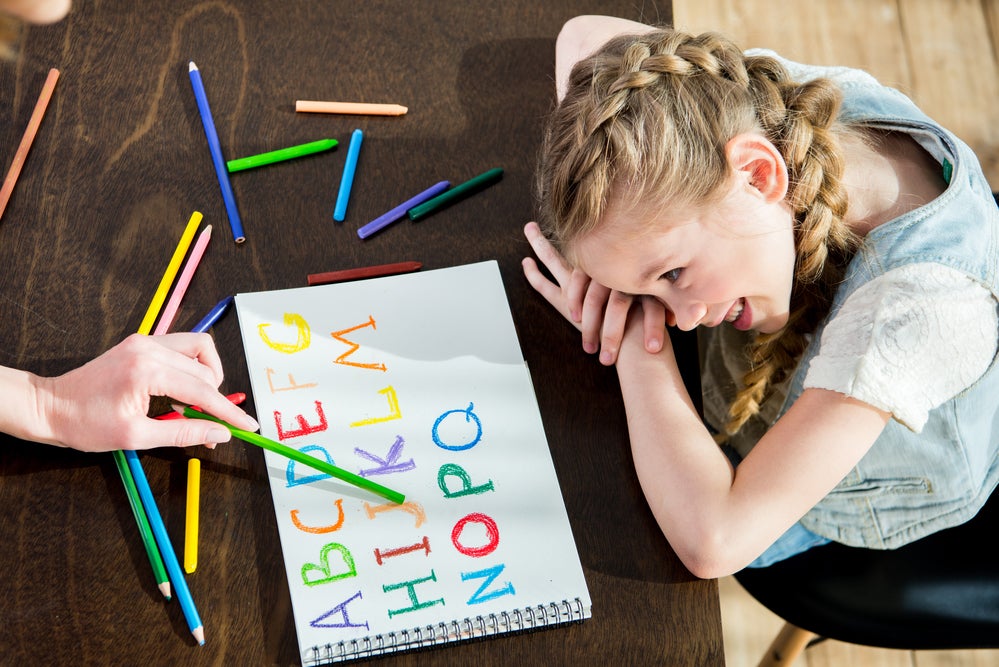
2) Begin with Uppercase Letters
Practicing how to make letters is way easier when they all look unique! This is why we teach uppercase letters to children who aren’t in formal schooling yet.
Even though lowercase letters are the most common format for letters (if you open a book to any page, the majority of the letters will be lowercase), uppercase letters are easier to distinguish from one another and, therefore, easier to identify.
Think about it—b and d look an awful lot alike! But B and D are much easier to distinguish. Starting with uppercase letters will help your child grasp the basics of letter identification and, subsequently, reading.
To help your child learn letters, we find that engaging their sense of physical touch can be especially useful. If you want to try this, you might consider buying textured paper, like sandpaper, and cutting out the shapes of uppercase letters.
Ask your child to put their hands behind their back, and then place the letter in their hands. They can use their sense of touch to guess what letter they’re holding! You can play the same game with magnetic letters.
3) Incorporate Phonics
Research has demonstrated that kids with a strong background in phonics (the relationship between sounds and symbols) tend to become stronger readers in the long run.
A phonetic approach to reading shows a child how to go letter by letter (sound by sound), blending the sounds as they go in order to read words that the child has not yet memorized.
Once kids develop a level of automatization, they can sound out words almost instantly and only need to employ decoding with longer words. Phonics is best taught explicitly, sequentially, and systematically, which is the method we use in the HOMER app.
If you’re looking for support in helping your child learn phonics, our HOMER app might be exactly what you need. Just 15 minutes of HOMER a day improves early reading scores by 74%!
4) Balance Phonics and Sight Words
Sight words are also an important part of teaching your child how to read. These are common words that are usually not spelled the way they sound and can’t be decoded (sounded out).
Because we don’t want to undo the work your child has done to learn phonics, sight words should be memorized. But keep in mind that learning sight words can be challenging for many young children.
So if you want to give your child a good start on their reading journey, it’s best to spend the majority of your time on phonics, developing and reinforcing the information and skills needed to sound out words.
5) Explore Language Sounds
Kids love to play with language. Lean into that fun by encouraging your child to explore a variety of words and the sounds they make. Using made-up words, games, poems, songs, and a big dose of imagination, explore:
- Rhymes (cat and hat)
- Alliteration (The cat crept curiously toward the cougar)
- Tongue twisters (Sally sells seashells by the seashore)
- Matching sounds (How many words begin with the letter C?)
These activities work well as transitions between events, like when you’re driving home from school or when you’re busy cooking dinner.
6) Follow Your Child’s Interests
Read books that tap into your child’s curiosity. For example, if they have a fascination with tigers, see if you can find books, both fiction and non-fiction, about tigers. You can also bring their activities into the reading space. If they play baseball, read books about baseball.
See if you can follow your child’s interests on the fly, too! Some of the most engaging reading sessions will come when you incorporate their tangents.
For example, if your child interrupts you while you’re reading to ask a question, take the time to answer it, and even ask one in return. Or if they have a new plot idea for the story, urge them to share it. The more active your child is in the reading process, the more they learn.
You can go beyond subject matter, too. What book style captures your child’s attention the most? Do they like non-fiction? Wordless books? Rhyming books? Books that are interactive? Giving your child more of what truly engages them will instill that love of reading you’re after.

7) Talk a Lot
Even though talking is usually thought of as a speech-only skill, that’s not true. Your child is like a sponge. They’re absorbing everything, all the time, including the words you say (and the ones you wish they hadn’t heard)!
Talking with your child frequently and engaging their listening and storytelling skills can increase their vocabulary.
It can also help them form sentences, become familiar with new words and how they are used, and learn how to use context clues when someone is speaking about something they may not know a lot about.
All of these skills are extremely helpful for your child on their reading journey, and talking gives you both an opportunity to share and create moments you’ll treasure forever!
8) Keep It Light
Reading is about having fun and exploring the world (real and imaginary) through text, pictures, and illustrations. When it comes to reading, your child should be relaxed and focused on what they’re learning rather than squeezing in a stressful session after a long day.
We want to give a gentle reminder that your child shouldn’t feel any pressure when it comes to reading. And neither should you!
Although consistency is always helpful, we recommend focusing on quality over quantity. Again, 15 minutes a day of HOMER’s reading pathway can increase early reading scores by 74%!
It may also take some time to find out exactly what will keep your child interested and engaged in learning. That’s OK! If it’s not fun, lighthearted, and enjoyable for you and your child, then shake it off and try something new.
9) Try Being Silly
If you’re having fun while you read to your child, it’s going to be easier for them to have fun, too! Read in a silly voice. Create distinctive characters, so you sound like you’re performing a play. And if you want to get your whole body involved, act out the story on your feet.
Being silly while you’re reading can help your child relax, which can make learning easier. Your child is more likely to retain information like the pronunciation of words or the sequence of events in the story. And you’ll both have a good time doing it!
10) Practice Shared Reading
While you read with your child, consider asking them to repeat words or sentences back to you now and then while you follow along with your finger.
There’s no need to stop your reading time completely if your child struggles with a particular word. An encouraging reminder of what the word means or how it’s pronounced is plenty!
Another option is to split reading aloud time with your child. For emerging readers, you can read one line and then ask them to read the next. For older children, reading one page and letting them read the next page is beneficial.
Doing this helps your child feel capable and confident, which is important for encouraging them to read well and consistently!
This technique also gets your child more acquainted with the natural flow of reading. While they look at the pictures and listen happily to the story, they’ll begin to focus on the words they are reading and engage more with the book in front of them.
Rereading books can also be helpful. It allows children to develop a deeper understanding of the words in a text, make familiar words into “known” words that are then incorporated into their vocabulary, and form a connection with the story.
We wholeheartedly recommend rereading!

11) Label Household Items
Incorporate reading into every part of your home by labeling objects that your child interacts with regularly. For instance, write the word door on an index card and tape it onto the bathroom door. Do this with furniture, toy bins, and anything else central to your child’s life.
Your child will accidentally read all day long. Without even thinking about it, they will connect the spelling of a word, the way it sounds, and its meaning. You can even secretly label some objects, like snacks in your child’s lunchbox or clothes in their closet, to make reading a game!
12) Play Word Games
Getting your child involved in reading doesn’t have to be just about books. Word games can be a great way to engage your child’s skills without reading a whole story at once.
One of our favorite reading games only requires a stack of Post-It notes and a bunched-up sock. For this activity, write sight words or words your child can sound out onto separate Post-It notes. Then stick the notes to the wall.
Your child can then stand in front of the Post-Its with the bunched-up sock in their hands. You say one of the words, and your child throws the sock-ball at the Post-It note that matches!
13) Read with Unconventional Materials
In the same way that word games can help your child learn how to read, so can encouraging your child to read without actually using books!
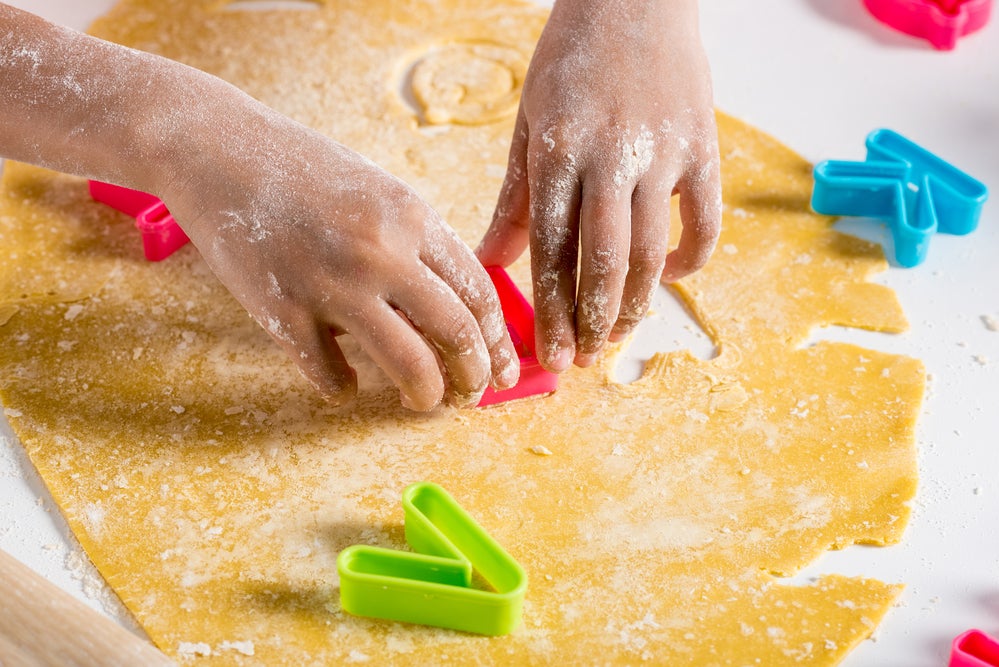
If you’re interested in doing this, consider using play-dough, clay, paint, or indoor-safe sand to form and shape letters or words.
Another option is to fill a large pot with magnetic letters. For emerging learners, suggest that they pull a letter from the pot and try to name the sound it makes.
For slightly older learners, see if they can name a word that begins with the same sound, or grab a collection of letters that come together to form a word.
As your child becomes more proficient, you can scale these activities to make them a little more advanced. And remember to have fun with it!
14) Take Action with Informational Texts
Incorporating an activity into your child’s reading experience can strengthen their vocabulary and comprehension skills. You might do something like plant a flower garden together. As you dig holes, place seeds, and water the soil together, you can also read the seed packets.
Using the process of reading to accomplish a physical task is immediately gratifying. And when your child can connect an object (watering can) or an action (planting flowers) to a word, they’re much more likely to both remember and understand it.
Another way to think about this is to ask the question, “What can reading be used for?” Some answers include:
- Finding the answer to a question
- Learning how to do something you’ve always wanted to do
- Staying connected to someone you love (a relative who lives far away)
- Comparing the book to the movie
- Making something (like a recipe) or building something (like a model airplane)
15) Create Autobiographical Books
Books can be doors (helping us explore different cultures, worlds, and people), but they can also be mirrors (teaching us about ourselves). A powerful way to ignite a love of reading in your child is to create books based on their routines, lists of favorite things, and memories.
They don’t need to be fancy. Just a few pieces of paper stapled together can become a keepsake that your child will go back to again and again.
Think of these books as scrapbooks. Add a few photos of your child, the places they often visit, and the people and animals they love. Write a few words describing the photos on each page. Or ask your child to draw pictures and then dictate to you what they’re about.
Then read the book with your child. Encourage them to share what they remember from the photos or improvise what they imagine is happening in their drawings. Ask questions. Often, these books become treasures that your child will keep close by and open up often.
The Ritual of Reading
Above all else, you want your child to establish a reading routine. Whether they read for 15 minutes in the morning or 50 minutes at night, the daily ritual of reading supports and grows your child’s cognitive, social, and emotional skills. Studies show that 15 minutes a day does it!
How can you help your child make reading an essential part of their everyday life? Some ideas include:
- Read bedtime books
- Take book breaks in the afternoon
- Use books during transitions (like waiting at the doctor’s office or in the car on the way to soccer practice)
- Create screen-free, quiet reading time for your whole family
You can also use your village! Help your child participate in reading experiences outside of your home. Some ideas that involve your community include:
- Getting a library card for your child
- Joining reading challenges (at the library or camps, for example)
- Going to story hours and author talks at libraries and bookstores
- Starting a book club with your child’s friends and their caregivers
- Creating a book swap in your neighborhood

Reading Comes with Time and Practice
Overall, we want to leave you with this: there is no single answer to how to teach a child to read. What works for your neighbor’s child may not work for yours. And that’s perfectly OK!
Patience, practicing a little every day, and emphasizing activities that let your child enjoy reading are the things we encourage most. Reading is about fun, exploration, and learning!
And if you ever need a bit of support, Begin is here for you!
Our age- and stage-matched learning membership helps kids learn the skills they need most to thrive in school and life, including how to read. Or you can download our award-winning HOMER app. Just 15 minutes a day has been proven to improve early reading scores by 74%!
Frequently Asked Questions
What should I do if my child gets frustrated while trying to read?
One of the first things to do if your child loses steam when they read is to validate their emotions. Reading is challenging to learn. If your child is frustrated, they’re probably feeling something underneath the frustration: a lack of confidence or low self-esteem.
They might be reading a book that’s above their reading skills, in which case, finding a new book may make all the difference. You can also try the tips we’ve offered here, focusing on the fun of reading and hopefully letting go of some of the frustration.
Another idea is to read together, with you reading most of the text and your child reading the parts they can. This may boost their confidence. Keep reading sessions short, make sure the content of the book is enticing, and urge your child to be patient.
Is it OK if my child reverses letters (like b and d) sometimes?
Reversing letters is normal for young children. Also called mirror writing, it happens because kids are developing their visual processing skills at the same time they’re learning to read. They may not understand yet that the position of the shapes of a letter makes a big difference.
So they might see a d and know that a b has the same shapes, only in reverse, and they’ll decide it’s a b. Most kids outgrow this by the time they reach second grade.
Why can’t my child reread a word in a sentence they just sounded out?
This can happen when a child is concentrating so hard on decoding a word that they can’t remember and comprehend the sentence. So when they go back to read it again, they end up needing to go through the same decoding process.
This might be an indication that a book is too challenging for a child. If you find a book that’s “just right” for a child, they should be able to decode words correctly the first or second time around. And once decoding is automatic, they can comprehend what they’re reading.
Should I correct all of the words my child mispronounces when they’re reading aloud?
Your number one goal when you’re reading with your child is to make sure they’re having a good time! If your correcting their mispronunciation makes them feel hesitant or frustrated about reading aloud, they won’t like it and probably won’t want to do it.
When the word is important for context in the story, though, you may decide to correct that particular word. But try to do it in a way that doesn’t break your child’s flow. So, instead of saying, “You got that word wrong. It’s forest not frost,” you might just say forest.
But again, the most important thing is that your child is developing a love of reading!