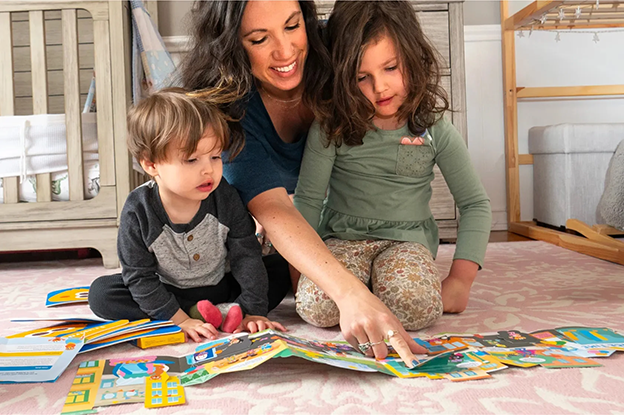
Helping your child develop kindergarten reading comprehension is one of the best things you can do to support their learning adventure.
Improving vocabulary and comprehension skills lays the foundation for all the reading to come, while also helping your child learn how to apply new knowledge to what they already know.
In this article, we discuss strategies you can use to build your child’s reading comprehension for a lifetime of reading fun!
Key Takeaways
- Kindergarten reading comprehension is part of communication and content, two of the research-based 6Cs* that inspires the Begin Approach to helping kids thrive in school and life.
- Strategies for building kindergarten reading comprehension include reading aloud, modeling reading, doing reading comprehension activities, focusing on the illustrations, doing a five-finger retell, putting on a show, reading about the real world, and connecting reading with what they see around them.
- Tips for improving kindergarten reading comprehension include keeping things light and lively, creating character voices, encouraging independent reading, choosing a variety of topics, telling family stories, prompting your child to tell stories, connecting new and existing knowledge, and hanging out at the library.
Strategies for Building Kindergarten Reading Comprehension
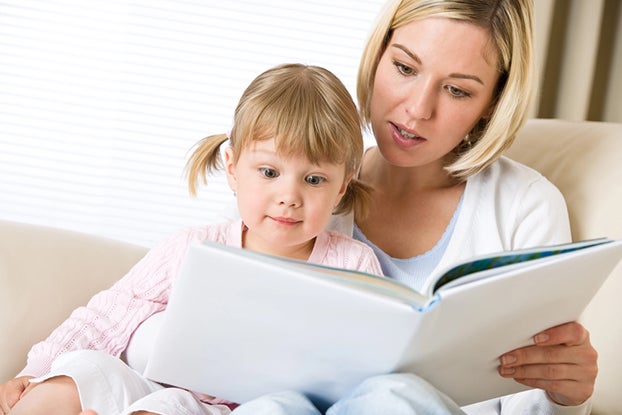
Read Aloud Together Every Day
One of the best things you can do to build your child’s kindergarten reading comprehension is to read aloud together every day. Sit on the couch or in your favorite chair with your young reader and spend 15 to 20 minutes reading a variety of books.
Doing this:
- Builds background knowledge: Hearing stories exposes children to new ideas, settings, and experiences that strengthen their understanding of the world.
- Expands vocabulary: Read-alouds introduce rich and varied words in context, making it easier for children to grasp meaning and remember new terms.
- Models fluent reading: Listening to an adult read demonstrates tone, pacing, and expression, which helps children learn how sentences flow and meaning is conveyed.
- Encourages discussion and connection: Talking about the story—asking questions, predicting what will happen, or connecting it to real life—deepens comprehension and critical thinking.
Reading aloud is also a great way to share some quality one-on-one cuddle time with your child before they get too big for your lap!
Practice Kindergarten Reading Comprehension Habits
As your child grows and their reading level improves, they’ll read for longer uninterrupted stretches at a time. In the early stages, however, it’s good to practice kindergarten reading comprehension activities as you read.
Some of the most effective habits are:
- Thinking aloud
- Asking questions
- Making predictions
- Visualizing
Thinking aloud: As you read, let your child know what you’re thinking and feeling.
For example, if a character loses their favorite toy, tell your child, “She must feel sad that she lost her toy. I wonder what would make her feel better.”
Asking questions: As part of thinking aloud, ask lots of questions—those that don’t require an answer and those that do.
For example, you may say, “Oh, my! I wonder how she feels?” and not expect a response. Or you could say, ““How would you feel if that happened to you?”” and wait for an answer.
When asking questions that you want an answer to, remember to give your child plenty of time to answer. It may take them a minute to process. Be patient and remind them to be patient, too. Thinking in silence is perfectly OK! If they have trouble, you can model your thought process.
Making predictions: As you read the story, take a few moments to make predictions about what’s going to happen next. Then ask your child what they think will happen next.
Keep in mind that there’s no right or wrong answer, and the response you get from your child may be completely outside the framework of the story. With time and practice, they’ll learn to anticipate the outcome based on the text they’re reading.
Visualizing: Encourage your child to create a mental image of the story as they read.
Ask them what they think the character looks like in a situation other than the story (maybe even have them draw a picture). Ask them what the weather feels like. Ask them what scents they might smell if they were the main character. Ask them what they think the character is feeling.
Building a mental image like this can help your young reader engage with the text and find joy in the reading process.
Review After Reading
Once you’ve finished the story, spend a few minutes talking about what happened. Reviewing reinforces comprehension and memory. You might say, “Let’s go back and think about the beginning, middle, and end.”
Encourage your child to retell the story in their own words, or use simple prompts like, “What was your favorite part?” or “Which part surprised you the most?”
Literal Questions
For preschool and early elementary readers, help them understand story elements by asking them literal questions, or questions they can find the answer to in the text.
You can even use a graphic organizer or a sheet of paper where you and/or your child draws quick sketches or makes notes:
- Who were the characters? (Draw faces or stick figures.)
- What was the setting? (Draw the house, park, or school.)
- What was the problem? (Quick sketch of the challenge.)
- How was it solved? (Draw what happened at the end.)
You could also do a “Five Finger Retell.” When you finish reading the book, retell the story with your child by having each finger on one hand represent a story element:
- Thumb is the characters
- Pointer finger is the setting
- The middle finger is the beginning
- The ring finger is the middle
- Pinkie is the end
These visual approaches help children organize their thinking and recall key details.
Inferential Questions
As children get older, encourage inferential questions, or questions that require them to “read in between the lines” to encourage deeper comprehension and critical connections. Examples include:
- Cause and effect: “Why did the character make that choice? What happened because of it?”
- Connections: “Does this remind you of another story we’ve read? Or something that happened in real life?”
- Author’s purpose: “Why do you think the author wanted to tell this story? What lesson might they want us to learn?”
- Perspective-taking: “What might the story look like if it were told from another character’s point of view?”
These types of questions move children beyond remembering details and help them analyze, interpret, and apply what they’ve read.
Don’t Forget about the Illustrations
If you’re reading a picture book or illustrated chapter book with your child, remember that focusing on the art can be a great way to reinforce reading comprehension.
Before you read the book, take a picture walk. First, look at the cover art and ask your child to predict what the story is about. Then check out the illustrations, page by page, without reading yet. Ask your child if their prediction has changed.
Don’t forget to explore the jacket flaps, too. They provide more clues about the story you’re about to read.
Then, as you read, become story detectives. Often, illustrations add a totally new layer or twist to the book. Ask your child to tell you what’s happening in the pictures. See if they can tie what they see to what they’re reading.
Put On a Show
If your child is a kinesthetic learner, allow them to act out the book. Maybe they choose a favorite scene or recreate the story arc of their favorite character. Connecting physical movement to the story will help your child better understand it.
Read About the Real World
While it’s great to read make-believe stories with your child, read about the real world as well.
Find age-appropriate non-fiction books that discuss things your child is interested in (e.g., space, dinosaurs, animals, trains, the list goes on and on) as well as new topics that might spark their imagination.
The more children know about a wide range of topics—animals, history, science, different cultures, and everyday life—the easier it will be for them to understand what they read.
Stories often build on prior knowledge, so each new word, idea, or experience your child has adds to a mental “toolbox” that makes comprehension smoother and deeper.
Connect Reading with What They See
Find opportunities to connect reading with what they see in the world around them. For example, if you read a book about bunnies and you see a bunny in the wild while running errands, point out the animal and bring up the book.
This helps your child make personal connections between what they read, what they know, and the real world.
Keep Things Light and Lively
The main goal of reading with your child is to stimulate their curiosity and cultivate a desire to learn about new things and explore the world around them.
To that end, keep things as light and lively as possible, and try to make everything you do with reading fun and enjoyable.
Conversations and activities about books shouldn’t turn into quizzes and long lists of questions. There should be a back-and-forth between you and your child about what you both enjoyed in the book, how it made you feel, and the lessons you learned.
So, as you try the strategies and tips in this article, don’t make it about performance, facts, or knowledge. Focus, instead, on the fun you and they can have with a really good book.
Create Character Voices
One “light and lively” technique that’s usually a hit is turning the book you’re reading into a play! Give the characters in the story unique voices. Ask your child to help you match their traits with the kind of voice you choose.
Is the character young or old? Are they running from something or fighting a dragon? Picking voices with your child helps them differentiate between characters and better understand the story.
If you want to get the whole family involved, each of you can be a character from the book.
Choose a Variety of Topics
To boost your child’s reading comprehension, choose topics that they’re already interested in. Use these books as a way to motivate your child to get in the habit of reading every day, which will develop their comprehension skills.
For example, if your child is fascinated by space, find age-appropriate fiction books set in space or nonfiction books with lots of pictures that discuss the planets, the stars, and other things your child might see in the night sky.
Share Family Stories
Building kindergarten reading comprehension doesn’t have to happen only during your scheduled reading times. It can happen any time!
When you’re stuck in traffic or waiting in line, share a family story with your child. Maybe it’s the time you got to see the Grand Canyon or visit the seashore.
Whatever the story might be, don’t just relate the facts; use vivid language and make the story as exciting as possible. Don’t be surprised if your child has questions when you’re done, and take the opportunity to keep the discussion going.
Then, if there’s time, ask your child to tell you their favorite family story.
Prompt Your Child to Tell Stories
If you can persuade your child to tell stories, too, you’re giving them a whole new way to learn story structure and logical sequencing.
Here are a few ways to inspire them to try:
- Start with something small and familiar. Ask your child to tell you a story about their day.
- Ask them to “read” a wordless picture book or tell you a story about a piece of art on your wall.
- See if your child can tell you the sequence of one of your routines. Ask them questions if they get stuck, and encourage them to include details. (For instance, if they’re telling you their bedtime routine, ask them to tell you the color of their toothbrush or their favorite bedtime book.)
- Go on a walk and ask your child to tell you a story about what they see (or hear or smell).
Connect New and Existing Knowledge
It’s never too early to encourage your child to connect the knowledge they’re learning with the knowledge that they already have. This is often called applying and transferring.
For example, if your child is resistant to trying a new food, talk about a character in a story who might have felt the same way. What did they do? How did they feel? Then you can transfer that same lesson to trying other new things and how your child might enjoy those, too.
You can also do this in reverse. The more experiences your child has, the more meaning they can take from the books they read. Going on a hike can help your child connect with books about nature. Watching a local baseball game can help them connect with books about sports.
With a little prompting from you, the books-and-experiences loop is a powerful way to integrate reading comprehension into your child’s learning process.
Make Reading Fun with HOMER by Begin
When it comes to kindergarten reading comprehension, fun is the secret to success. Make up games, incorporate hands-on activities, show them how much you enjoy reading, and harness the power of existing tools and programs, like those offered by Begin.
Our learning products—including the HOMER app—and parent resources are designed to inspire your young reader to build a solid foundation of reading comprehension for kindergarten, 1st grade, 2nd grade, and beyond.
HOMER’s four-step approach (Introduce, Practice, Apply, Transfer) goes beyond rote memorization to build confidence, make connections with other subjects, and foster a life-long love for reading.
For more information on everything we offer and why families love learning with Begin, visit BeginLearning.com today.
*The 6Cs Skills Framework is a science-backed framework designed by acclaimed developmental psychologists and learning scientists Dr. Kathy Hirsh-Pasek and Dr. Roberta Michnick Golinkoff (Becoming Brilliant, 2016).
Frequently Asked Questions
What reading skills should a kindergartener have?
By the end of kindergarten, most children are developing the foundational skills that prepare them to become confident readers. While children grow at different rates, many kindergarteners are able to:
- Recognize letters and sounds: Identify uppercase and lowercase letters and know the sounds they make.
- Understand print concepts: Show that they know how books work (front to back, left to right) and that words on a page carry meaning.
- Recognize sight words: Read common words by sight (e.g., the, and, is, my).
- Use phonics skills: Begin to blend sounds to read simple words (like cat, hop, sun, kite, stick).
- Build vocabulary: Understand and use many new words learned through conversation and being read to.
- Comprehend stories: Retell familiar stories in their own words and answer basic questions about characters, settings, and events.
- Develop early writing: Write their first and last name, add labels to drawings, and compose simple sentences using phonetic spelling and early invented spelling.
Remember: every child develops on their own timeline. Some may be reading short books by the end of kindergarten, while others are still piecing sounds together—both paths are normal as long as progress is steady.
What is the five-finger rule?
The five-finger rule is a technique to find a “just right” reading book. Your child picks a book and then opens it to the first page. As they read the page, they hold up a finger every time they come across a word they don’t know or can’t pronounce.
If, by the end of the page, they’re holding up 0-1 fingers, the book is too easy for them. If they’re holding up 2-3 fingers, it’s just right. And if they’ve got 4-5 fingers up, it’s above their reading level (but perfect to read with a partner!).
What is the PEER method of reading comprehension?
The PEER method of reading comprehension is a structured way to have an interactive reading experience with your child. While you probably incorporate a lot of pieces of it in your read-alouds anyway, you can reference them below.
P: Prompt your child with a question about the story. For example, you might point to an illustration and ask, “What do you see on this page?”
E: Evaluate your child’s response. For example, your child answers, “Bear.” You respond, “Yes, that’s right, it’s a bear.”
E: Expand on what your child said. You could say, “It’s a big brown bear walking in the grass.”
R: Repeat the question you began with, encouraging your child to add the new information you provided. You might ask, “Can you say, ‘A big brown bear is walking in the grass’?”
What is paired reading?
Paired reading is exactly as it sounds: when two people read together. You and your child can do it or, if you have more than one child, your kids can do it. (A very effective way to inspire reading comprehension is to have an older sibling read with a younger one.)
Instead of the child struggling alone, both readers read aloud in unison.
- The adult sets the pace and models fluent reading.
- The child follows along, joining in at the same time.
- If the child hesitates or makes an error, the adult continues reading smoothly, so the child can keep going without frustration.
As the child gains confidence, they can gradually take over more of the reading, while the adult provides support when needed.