
Learning multiplication is an important milestone for kids. And memorizing the multiplication tables is a foundational skill that unlocks the door to more advanced math concepts down the road.
This guide provides a comprehensive overview of how to make the memorization process easier and more effective.
We’ll define some key terms, explore the numerous benefits of memorization, and share some easy-to-implement tips to help your child learn the multiplication tables.
Key Takeaways
- Use these terms as you start to teach your child to memorize multiplication tables: fact, multiplication, times, product, and factor.
- Memorizing the multiplication tables lays a strong foundation for learning more advanced math later. It also helps improve mental math so kids can focus on other aspects of the problem.
- To help your child get a good start memorizing the multiplication tables, first address “easy” series such as the 0s, 1s, 2s, and 5s, highlight patterns and relationships between numbers, and use songs and stories.
Table of Contents
- Defining the Terms
- The Benefits of Memorization
- How to Learn Multiplication Tables Step-by-Step
- Smart Tips for Memorizing Multiplication Tables
Defining the Terms
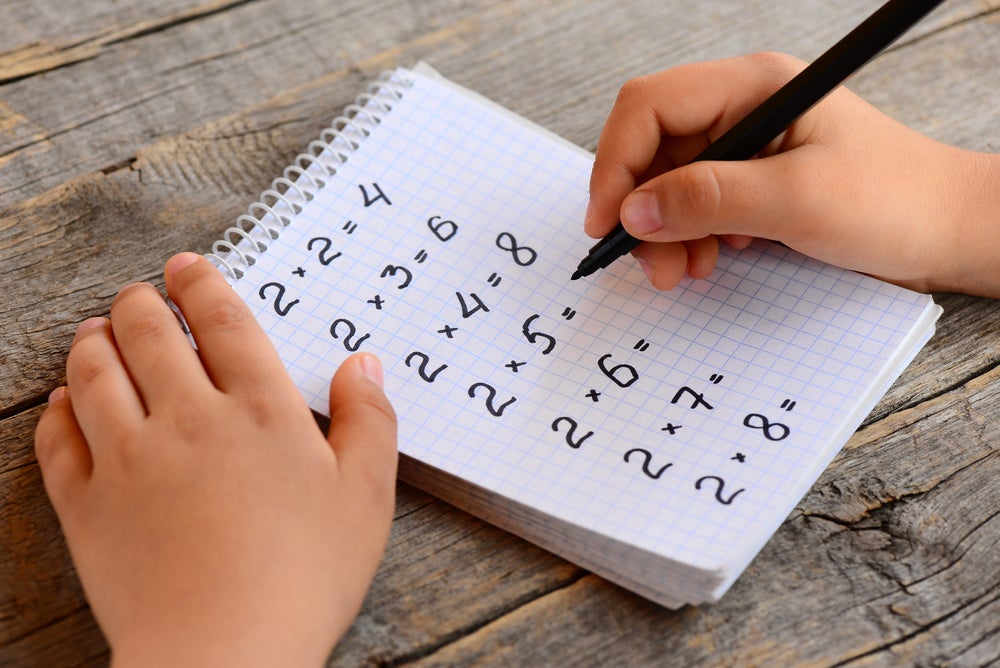
Learning to multiply comes with a new set of vocabulary that your child might not be familiar with. Here are some of the more common terms to get them started:
- Fact: A basic calculation that is permanently true and involves single-digit numbers (e.g., 2 + 2 = 4 or 3 x 3 = 9)
- Multiplication: The mathematical operation of repeated addition
- Times: A common word used to indicate multiplication
- Factor: A general term for any of the numbers being multiplied together (e.g., in the equation 3 x 4 = 12, three and four are the factors)
- Product: The answer or result of multiplication
- Multiplication tables: A grid or list showing all the products of two numbers (typically one through 10)
- Times tables: The same thing as multiplication tables
Begin using these terms when you talk about multiplication to help your child understand what’s going on as they begin to memorize their times tables.
The Benefits of Memorization
Strong Foundation for Learning
Multiplication is essential for building a strong foundation for learning more advanced math (e.g., division, fractions, geometry, and beyond).
Think of multiplication like a support pillar in a building. Without quick recall of the multiplication tables, the whole structure on top of that pillar becomes unstable.
Improved Mental Math
Mastering times tables boosts mental math (performing calculations in their head), giving your child an advantage when solving problems.
When your child doesn’t have to pause and count to find a fact, it frees up their brain to focus on the more advanced aspects of a math problem. This is known as reducing their cognitive load.
Instead of using energy to figure out 7 x 6, they can direct their energy and focus into the strategy for solving the larger problem.
Real-World Applications
Memorizing the multiplication tables is extremely valuable in a wide variety of real-world situations. Most of the time, we’re using multiplication in our lives without even realizing it.
Here are some examples to share with your child of how multiplication comes in handy in everyday situations.
Shopping: You need to buy three bags of apples at the lowest price. Brand A costs $4 a bag while Brand B costs $5 a bag. Multiplication quickly tells you that three bags of Brand A apples will cost you $12, while three bags of Brand B apples will cost you $15.
Cooking: A cake recipe serves eight people and requires 2 cups of flour, 1 cup of sugar, and 4 eggs. You need to make enough cake to serve 24 people. Quick multiplication tells you that you need to triple the recipe (3 x 8 = 24), so you’ll need 6 cups of flour, 3 cups of sugar, and 12 eggs.
Budgeting: Your average weekly grocery bill is $200 and you need to budget for two months (8 weeks). Multiplication tells you that you’ll need to save $1600 to cover two-months’ worth of food for your family.
How to Learn Multiplication Tables Step-by-Step
The first step in helping your child learn their multiplication tables is to say both the problem and the answer out loud from the beginning in order. For example, 1 x 1 = 1, 1 x 2 = 2, 1 x 3 = 3, and so on, as high as your child can go.
Next, have your child write both the problem and the answer in order instead of just saying it out loud. Once your child knows their times tables in order, it’s time to practice them out of order.
You can quiz them yourself with out-of-order facts like, “What is six times six? What is three times four? What is eight times five?”
Flashcards also work really well here, and your child can even run through them on their own. Just remember to keep practice time fun with games or activities!
Smart Tips for Memorizing Multiplication Tables

Start with the “Easy” Ones
To help your child make progress at the beginning, start with an “easy” series of numbers, such as the 0s, 1s, 2s, 5s, and 10s tables. This helps them build confidence in their abilities before they get to more “difficult” series, such as the 6s, 7s, 8s, and 9s.
Highlight Patterns and Relationships
Explain to your child that the commutative property means that 3 x 7 is the same as 7 x 3. If they can remember one, they know the answer to the other and can cut the number of facts they’ll have to learn in half.
Or after they’ve multiplied 3 x 7 and then 7 x 3 and gotten the answer, ask them what they notice.
Another pattern you can use to help your child learn is the 9s finger trick. To do it, hold both hands up with your palms facing you. Number your fingers one through 10 from left to right (your left thumb is one, your left pointer finger is two, and so on).
For a multiplication problem like 9 x 6, count six fingers over from your thumb (the one you named “1”) and bend that finger down. The number of fingers to the left of the bent finger is the tens digit (in this case, 5), and the number of fingers to the right is the ones digit (in this case, 4), giving you an answer of 54.
In the early stage of learning the multiplication tables, you can also encourage your child to use the addition they already know to find a fact they haven’t yet memorized. For example, they’ve memorized 6 x 6 = 36, but they can’t remember 6 x 7. Have them recite 6 x 6 = 36 and then add another 6 (even using their fingers) to reach 6 x 7 = 42.
Eventually, you want them to be able to remember the product of 6 x 7 without using their fingers or adding on top of a simpler fact, but this will get them started until it sinks in.
Use Songs and Rhymes
Music and rhymes help the brain remember things, so take advantage of this by introducing them into the memorization process.You’ll find many online.
Here are some fun rhymes to try:
- Two and four want to celebrate. They’re turning eight! (2 x 4 = 8)
- Six and seven live in a shoe. It must be size forty-two. (6 x 7 = 42)
- When multiplying by one, don’t forget: The other number is what you get! (1 x # = #)
Make Math Fun with Begin!

Learning to multiply is an essential skill that gives your child a solid foundation for more advanced math later on in life. Memorizing the multiplication tables is one of the major building blocks in that process.
Begin is here to support you and your child throughout all of their math journey. Our HOMER app delivers fun, playful learning in math and other core subjects.
Try the HOMER app and watch your child soar!
Frequently Asked Questions
How long does it take to memorize multiplication tables?
The time it takes to memorize multiplication tables varies from child to child. Retention depends on factors such as age, previous math skills, and the amount of time they spend practicing.
For some, it might take a few weeks. For others, it might take a few months. The key is to be consistent and practice regularly, even if it’s only for a few minutes a day.
At what age do kids usually learn multiplication?
According to Common Core Standards, the U.S. education system typically introduces multiplication to children between the ages of seven and nine, which corresponds to 2nd and 3rd grade in elementary school.
The early stages of multiplication revolve around helping kids understand what multiplication is before memorizing facts, and includes concepts such as repeated addition (e.g., 3 + 3 + 3 is the same as 3 x 3) and skip counting (e.g., counting by 5s).
Once the child has a basic understanding of the theory, the focus shifts to the formal instruction of multiplication equations and the memorization of the times tables for numbers zero to 10.
In later grades (e.g., 4th grade and beyond), instruction moves on to applying the multiplication tables to more complex problems, such as fractions and geometry. At this level, instant recall of the basic times tables is expected.
Is it OK for my child to use their fingers when learning to multiply?
Yes, it is OK for your child to use their fingers when learning to multiply, especially in the early stages.
Their fingers serve as a “concrete manipulative” (a physical object a learner can touch and move to learn mathematical concepts) and help build strong connections in their brain.
They can also pair their fingers with other learning strategies to help them learn and memorize the facts quicker. Of course, the goal is to move away from using their fingers into rote memorization of the facts.