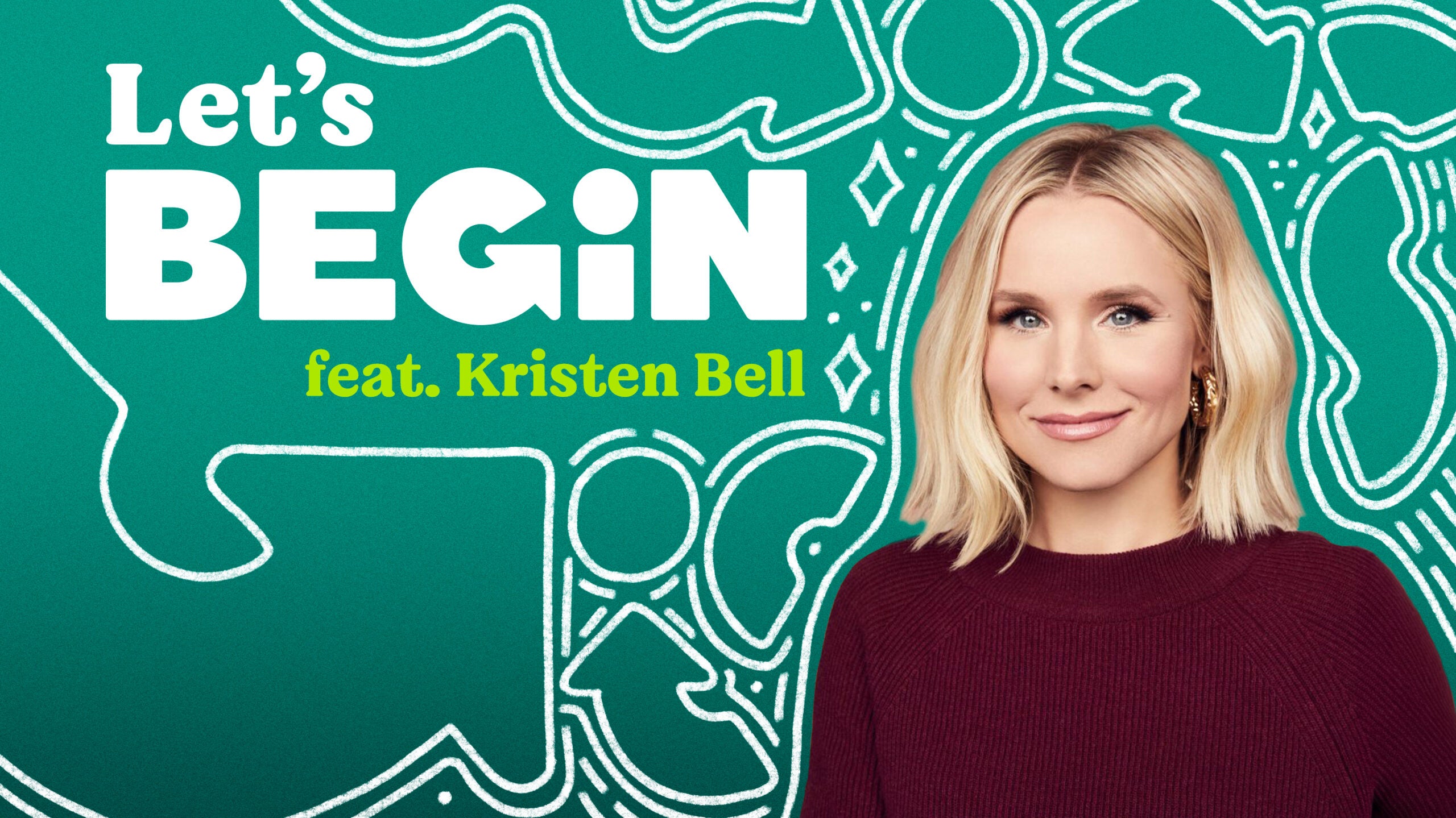
Kristen Bell, actress, children’s book author, and mother of two joins Jenna for a refreshing conversation about the magical gift of natural curiosity in children and the beauty of embracing uncertainty as parents.
Listen anywhere:



Whether it’s admitting that you don’t know the answer to your child’s question or embarking on an imaginative storytelling journey together, Kristen, Jenna, and child development experts agree that modeling curiosity and honesty helps create a more trusting, open environment between caregivers and their children.
Throughout this episode, listeners will hear personal anecdotes from Kristen’s parenting journey and reacquaint themselves with the freedom, joy, and hope that curiosity brings to learning.
To learn more about the importance of curiosity and the Milestones that Matter visit beginlearning.com/milestones
Recap
Guest: Kristen Bell (Actress, Producer, & Entrepreneur) & Dr. Jody LeVos (Chief Learning Officer at Begin) Host: Jenna Arnold
In this refreshingly honest episode of Let’s Begin, host Jenna Arnold welcomes Kristen Bell, the voice behind one of Disney’s most iconic characters and a parent navigating the same messy, uncertain world as the rest of us. Together, they dismantle the myth that parents need to have all the answers. Instead, they champion the idea that “I don’t know” is a complete sentence—and a powerful parenting tool.
From the “family square” strategy for conflict resolution to game-ifying curiosity about the unknown, Kristen shares how she models vulnerability for her children. Later, Dr. Jody LeVos joins to explain the science behind curiosity and why admitting ignorance is actually a superpower for building resilience in kids.
The Problem: The Pressure of Perfection
Kristen identifies a deep-seated cultural pressure, particularly on women, to be the “knower” of all things. We are raised to believe that having the right answer is the key to safety and success.
- The Trap: When parents pretend to know everything, they set an impossible standard of perfection. This teaches children that uncertainty is dangerous and that they must mask their own confusion to be safe.
- The Result: A generation afraid to ask questions, terrified of being wrong, and ill-equipped to handle the nuance of a complex world. As Kristen notes, “If you want to keep up, you better have the right answer” is a broken model.
The Philosophy: “I Don’t Know” as a Superpower
The antidote to perfectionism is curiosity. Kristen argues that admitting “I don’t know” isn’t a sign of weakness; it’s an invitation to learn.
Kristen’s Insight:
“The answer to any unasked question is ‘no.’ … Curiosity might be more of a key to happiness and success than previously thought. Research shows that people who rate high on curiosity scales also report higher satisfaction with their lives.”
3 Key Insights on Modeling Curiosity
The conversation revealed specific, actionable ways to foster a culture of curiosity and vulnerability in the home.
1. The “Family Square” (Conflict Resolution)
The Issue: Family conflicts often happen in passing or while distracted, leading to unresolved tension.
The Solution: Kristen’s family uses the “Family Square” rule. Anyone can call a “Family Square” at any time. All members must sit on the floor in a square, facing each other. The rule is you must be your most vulnerable self and only speak from your own perspective (“I felt left out” vs. “You were mean”).
The Lesson: It creates a physical and emotional container for vulnerability, teaching kids that conflict is safe to navigate if you show up honestly.
2. Modeling the “Pivot” (Intellectual Humility)
The Issue: Parents often feel they lose authority if they change their minds or admit a mistake.
The Solution: Kristen explicitly narrates her change of mind. “I’m going to sleep with Daddy tonight.” “Why?” “Because I got new information.”
The Lesson: Showing kids that changing your mind based on new evidence is a sign of strength, not weakness. It teaches them to be flexible thinkers rather than rigid ones.
3. The “Nonsense Play” (Imagination)
The Issue: We often rush to give kids the “correct” answer to factual questions, shutting down their wonder.
The Solution: When asked a question like “What color is the number four?”, instead of saying “Numbers don’t have colors,” Kristen leans into the absurdity. “I think it’s orange.” “No, it’s red!”
The Lesson: Engaging in “nonsense play” validates the child’s imagination and shows that playing with ideas is just as valuable as knowing facts.
The Science: Curiosity as a Life Force
Dr. Jody LeVos explains that curiosity is one of the “5 Cs” of thriving (along with Core Skills, Character, Critical Thinking, and Creativity).
- The Research: Curious people are happier and better learners. When we learn something we are curious about, we retain it better.
- The Application: Parents shouldn’t fear their own ignorance. Saying “I don’t know, let’s find out together” models the process of learning, which is far more valuable than just delivering an answer.
Final Thought: Embrace the mess
The episode concludes with a call to embrace the “messiness” of being human. Whether it’s a messy house or a messy emotion, trying to hide it only creates shame. Owning it creates connection.
“You know what you know, you know what you don’t know, and you don’t know what you don’t know. Spend as much time as you possibly can there.”
Episode Transcript
Kristen: We were raised to think we had to have the right answer. Particularly as women who are driven and ambitious. If you want to keep up, you better have the right answer. And kind of like you said in the beginning, there’s a way to laugh it off and go, “Look, we’re broken, okay? We’re not fixable. But what we’re going to do is paddle as hard and as fast as we can to make sure that our children are not broken like this.” Where they can walk into a room and say, “Oh, I don’t know.”
Jenna: There is one key, built-in toolset that we often overlook in our effort to raise ourselves and our children at the same time: Curiosity. We are all born curious. We know how to be confused and wonder how the world works. Curiosity might be more of a key to happiness and success than previously thought. Research shows that people who rate high on curiosity scales also report higher satisfaction with their lives. And isn’t that what we want for our little folks?
I invited a friend of mine, whom I only know as the voice in those Disney Frozen songs that I start singing loudly at school drop-off when my kids aren’t getting out of the car fast enough. Kristen Bell seems to be willing to ask the hardest questions—not just of the world around her, but of herself. We talk about how she stays curious, and most importantly, how we’re raising the next generation to protect their natural instinct to wonder. If you’re curious about this too, let’s begin.
(Transition)
Jenna: You and I became friendly because we both do a lot of obsessing over the state of the world and how we’re going to teach our children to navigate it, when we’re sort of not even quite sure ourselves. But we are trying to figure it out day by day.
Kristen: Yeah.
Jenna: What I’m carrying a lot of is the weight of what feels like a more complex landscape that we all have to navigate, and the speed of which it’s coming at us. And sometimes I’m like, “I can’t do this. I can’t do this. I just want to go reorganize the wrapping paper drawer and like, call it a day.”
Kristen: I love that you use that example because organizing a junk drawer is what I do. It’s like my version of sucking my thumb as an adult.
Jenna: I get upset when I go into people’s homes and if I open up their junk drawer and it’s not organized, I like want them to disappear for an hour. Like I love, I love organizing a junk drawer.
Kristen: But wait, okay, this is a tiny bit deeper. So why is it then that I can—and I often do—bypass the messiness in my own home, yet I am so intent on fixing other people’s? Like is that just narcissism or…?
Jenna: This is like the crux of what I think it means to be human today. What is it that I can offer outside of myself because anything inside might be too hard? And I feel like that’s the kind of honesty and curiosity that we need in these moments. Why can’t I do my own junk drawer but I can do everybody else’s so easily? Is just the kind of role modeling of the big hard questions that we need for our kids, for sure.
Kristen: 100%.
Jenna: But one of the things that I keep trying to navigate is how we just need to protect their—and sometimes our—dormant instinct to be confused, to explore, to be curious. So I think your willingness to already be like, “Well, I can do this for somebody else but I don’t want to do it for myself” is like just the freedom that we’re all desperately looking for.
And in a world that seems really, really heavy, that curiosity of not knowing is really freeing.
Kristen: Because it comes with the possibility of an answer, right? The answer to any unasked question is “no.” Always. There’s so much hope in curiosity. Sometimes hope is the only solution, and it leads to curiosity of like: “What if I ask some questions about this? What if I think differently about this? What if I reframe this? What if I get an alternate perspective?” Like that’s where the hope lies.
Jenna: We’ve inherited a system, specifically classrooms, which prioritize correct answers. And then if you don’t get that answer correct or if you’re still confused, like shame is like sitting right behind you ready to be like, “No you did it wrong.”
Kristen: I mean, one way that I attempt to rectify that in my household is like… I’m a big fan of modeling behavior. I do not think my kids will do what I say, but they will do what I do. And that goes for every value I want them to hold. If I want my kids to be patient, I need to be patient with them. If I want my kids to be curious, I need to let them see me be curious. If I want them to be prepared to apologize authentically, I need to be prepared to apologize authentically.
But I think that unless I’m modeling curiosity for my kids and holding my uncertainty high enough in my life where I go, “Wow. I didn’t know that. And I actually don’t know, and now I want to find out.” And there’s all these other lines of thought that you can go down with your kids like… when we all get to wonder together, isn’t that like so lovely? And isn’t that something, um, I don’t know, that’s kind of like other-worldly when we’re all able to be curious together?
And I often also tell them how important curiosity is in the way that it relates directly to knowledge. Because knowledge is the only thing people cannot steal from you.
Jenna: That’s right.
Kristen: So the more knowledge you get—and I also think it’s really important, one of the ways that I model the behavior is I say how often perspectives and facts even sometimes change. Like I say to my kids, “You know, did you know that 100 years ago we didn’t know washing our hands was important?”
Jenna: Right.
Kristen: And I find that giving them teeny tiny examples like that… like yeah, could you imagine a world where someone is about to do surgery on you and they don’t wash their hands? We didn’t know that! My son asked the other day how a rug was made. And it would have been easy for me to sort of like B.S. through the “It’s woven somehow somewhere.” But where like that World Wide Web tool comes in and you get into like the YouTube videos of like the hand woven vs. the machine woven vs. how long is it, how does it get cut… It’s fascinating. And like I actually don’t know how much I care about how rugs are made, but now I like look at rugs differently.
And I think that kind of curiosity… reminds me to be like a little bit more youthful and open to what else I might be missing in the world.
Kristen: There’s an emotional component also to what you’re describing, which is: you shared something with him. So their main drive in life beyond food and water and shelter is to connect with us. So when you are able to say to your kid, “I don’t know how a rug is made. Let’s look it up,” and then you share that information together… it’s the same as like doing anything. Playing a game of Rummy Cube, watching a TV show right next to each other where you’re paying attention…
Jenna: Stop, you’re a Rummy Cube player?
Kristen: Duh, it’s the best game on the planet. But I love that you… that when you’re doing that and you’re saying “I don’t know,” I feel like it’s so great because you’re modeling the behavior of saying “I don’t know.” You’re showing a child that an adult can say “I don’t know” and still be completely stable and not be, I don’t know, falling apart. Like everyone is so afraid to say “I don’t know.” It’s like an infection that everybody has. They’re terrified to say “I don’t know.”
I say “I don’t know” all the time. I am in business meetings where I should probably know these things, but also no, I went to theater school. So I’m in a business meeting and someone is like, you know, talking about ROI, ROI. And I raise my hand and I’m like, “I’m so sorry, I need you to tell me what ROI means.” And they’re like, “Oh, Return On Investment.” And I’m like, “Great.” And I write it down, and now I know.
But it took me a while, because of how I was raised, to get to a point where raising my hand and asking a question that I thought was stupid felt good to me. Um, and I am desperate to make sure that my children don’t have to overcome that hurdle. That they’re just like, “Raise your hand whenever you want to raise your hand.”
Jenna: Yeah, I feel like that “I don’t know-ness,” which is so key today, is a real empowering kind of musculature that we need to be building more of. And as a former elementary school teacher, I always used to say to my kids: “If you have a question, I promise there is somebody else in the room who has the same exact one.” And so whenever I’m in spaces where I’m like, “Oh my god I’m going to ask the dumb thing,” I’m always like, “But somebody else also doesn’t know. And I’ll just go be brave for both of us.”
But, you know, one of the things that you said about role modeling confusion… is that I think I’ve nailed it with my kids. You know, like, “Oh my god, let’s figure out how the dishwasher works.” But I’m not so awesome in role modeling that when I’m in conversation with adults. I’m often finding my way in conversation with adults eager to protect that insecurity that I was raised with that like, “Jenna, you better know.” Or it’s clear you didn’t do the assignment or that you didn’t understand what it was that you were taught.
Kristen: We were raised to think we had to have the right answer. Particularly as women who are driven and ambitious. If you want to keep up, you better have the right answer. And kind of like you said in the beginning, there’s a way to laugh it off and go, “Look, we’re broken, okay? We’re not fixable. But what we’re going to do is paddle as hard and as fast as we can to make sure that our children are not broken like this.” Where they can walk into a room and say, “Oh, I don’t know.”
And I feel like I truly think the answer is modeling curious behavior. And trusting also on the backbone of: I got new information. That’s why my perspective changed. That I think is a really, really big important sort of caboose…
Jenna: I changed my mind.
Kristen: Into the train of curiosity. The caboose is: I’ve changed my mind because I have access to new information. So, and sometimes I’ll model this in really, really little ways. Like, um, when my kids will be like, “Oh, are you going to sleep with us tonight?” And I’ll say, “Yes.” And then later on, I will say, “Oh actually no I’m going to sleep with Daddy because we’re going to wake up really early.” Or I’ll just say, “No I’m going to sleep with Daddy” and they’ll say “Why?” And I’ll say, “Because I got new information. And I had to change my mind.”
So what I’m trying to do there is identify: I gave them an expectation and I’m gonna have to break it. Because everybody knows that’s going to lead to a tantrum no matter how old the kid is. And sometimes even with an adult.
Jenna: That to me is so much about the structure… like the maze that we’re all having to navigate today together when it comes to like looking at all the data in the world. About whether it’s how you teach reading to a six-year-old or like Medicare vs. Medicaid. It’s the ability for us to be like: “Hmm. We got that wrong.” Or “That worked in 1910 but it doesn’t work today.” If we want, in 5, 10, 15 years from now, for our children to not be in the same combative, political, social, economic type of structure, we have to today with our eight-year-old say, “I’ve changed my mind and that’s totally okay.” Even if that made me wrong yesterday.
Kristen: Your gut as a caregiver is going to tell you how you need to wrap the information, right? What the wrapping paper needs to look like. So for my kids at their age now, I’m like, “I, you know I have a secret. I have a secret. And it’s that the highest level of intelligence and biggest way to use your brain is holding two conflicting things in your head at the same time.” Whether it’s emotions or ideas. Or “I really want to stay home today but I don’t want to disappoint Jenna by not going to her birthday.” Both things can be true.
And once I feel like I am encouraging them to allow both things to be true, the decision becomes a little bit easier because they don’t feel like either one is a failure. They simply feel like: it’s a hard decision. Right? And so I think that that sort of like is a big part of this… of allowing them to understand that not everything is going to feel right when you decide it. And you’re going to disappoint people. And I tell them all the time: “My job is not to make you comfortable or happy. My job is to keep you safe.”
Jenna: And I don’t see a lot of adults who can handle contradicting beliefs at the same time. You have to be able to hold all of these truths.
Kristen: Right. And also I think encouraging the idea that life is supposed to be hard. Life is hard. And you say it with a smile and with love and you say, “Yeah life is 90% hard and 10% leisure.” Like expect that. Like that’s the expectation. So yes, you know, I had a daughter that just started sixth grade and there was so much anxiety… all the stuff, right? She’s starting a new school. I felt like with the empathy or sympathy like I couldn’t… I couldn’t get through to her. And I finally was like, “You know what? Honesty is stronger medicine than sympathy.”
And so I sat her down and I said, “I’m gonna tell you something I told myself when I got pregnant. And I was really nervous. Right? Cuz like I was about to shoot another person out of my body. Hey Kristen. You’re not the first person that’s ever been pregnant. You don’t have to invent this. And by the way… chill. Chill out. You’re not the first person that’s done this. A lot of people have gone through it.”
And I said to my daughter I was like, “I know you’re anxious about sixth grade. And I’m gonna ground you for a second. You’re not the first person that started sixth grade. I went through it. Daddy went through it. Every adult you know went through it. And it is not supposed to be comfortable. Expect the discomfort.”
Jenna: The Great American myth was like if you check all of these boxes… the school, the grades, the relationship, the white picket fence… that like everything will easily fall into place. And I think what’s happening with the next generation—at least and this conversation in this podcast is directly focused on like 2 to 10 year olds—so what I’m about to say skews a little bit older. But I am seeing in teenagers… in like early 20s… is that they’re just sort of calling BS on what it is that was promised them.
And if we can like hold the tweens who were going into sixth grade—which when you said that like I was like “Oh my god I’m nervous about that for my daughter.” That if we can suggest that the discomfort is actually the right thing. That it’s exactly where they’re meant to be. Instead of: “You should know how to handle this.”
And I think the idea that everything sits in a binary versus everything sits in like the gray… is the kind of generation we want to raise because we have to like undo it with ourselves. Because a policy in like Bucks County Pennsylvania is not the same kind of policy that needs to be in Los Angeles California.
Kristen: What works for my older daughter does not work for my younger daughter. Binary thinking is so dangerous.
Jenna: Yeah. That’s right. And that’s where like the rules that we’ve inherited related to “There’s always a right answer and it should be simple and you should know how to get to it pretty quickly” have really harmed us. And it’s not just harmed generationally like how we’ve structured and built the world, but it’s really gotten in the way of us leaning into our own humility and grace and curiosity. And has the potential of really getting in the way of our kids too.
Kristen: Well, it’s also evolving, right? Like in order to evolve, you have to have grown. In order to have grown, you have to have received new information or changed in some way. And in order to have changed in some way or received a new information, you had to have either… you had to have asked a question. And in order to have asked a question, you had to have said to yourself “I don’t know.”
It’s like… it’s all connected. And my husband has a great way of talking to our girls and saying like, “You don’t ever need to be perfect.” And also there’s, you know, the idea of a “comparison hangover” when you’re looking at pictures of other people or comparing yourself to someone at work who you think is better. Like you… the only person you need to compare yourself to is who you were yesterday. That’s it. And if you are a little bit better or trying a little bit harder than who you were yesterday, that has to be the baseline.
One way that we’ve combated the pace of this lifestyle… because when we grew up there this pace wasn’t happening. Your parents weren’t on their phone all night. They weren’t taking phone calls at 9:00 PM to try to run a business or solve a world problem, right?
So I established what’s called a “Family Square.” Or a “Family Triangle” if one of us is missing. And it is… anyone can call it. And you can call it at any time of day. And you can just say “I need a Family Square.”
And all of us have to get together. We have to sit in a square because I want the physical proximity and eye contact to be there. No one’s really allowed to be doing anything other than paying attention. And in the Family Square, you have to be vulnerable. Your most vulnerable self. And you have to only say your point of view. You can’t say, “Well because she…” You have to say, “I felt left out. I felt berated. I was scared.”
Jenna: I was scared. Exactly.
Kristen: And we don’t always do it right. But it is a place where at least they feel as though we’re trying to hold space for all of our higher selves. So whereas kids can often go like, “Well I’m not even going to ask Mom that cuz I know what she’s going to say.” The Family… if she calls a Family Square, she might feel a little bit more capable of pushing against something I’ve said. Which I want to train her to do. I don’t want to train lemmings. I want critical thinkers, right?
Jenna: Well I appreciate you bringing up the word vulnerability, Kristen, because vulnerability has traditionally been tagged as a weakness. That you’re not strong, you’re not sturdy, you’re not capable of doing whatever fill-in-the-blank is. And I think your question earlier in the conversation of like, “What does that acronym ROI mean?” suggests a level of confidence and power in the vulnerability. And I have found—and I do think that this is one of the things that I try to do publicly… and I’m not always so great at doing in my intimate relationships… is say like, “I’m scared. I don’t know. I’m scared and I don’t know.”
And vulnerability, humility, and grace—like those words that we all love and are sacred at least for me, the way that I define it—of which do not ask me to because I don’t know how I would. But they are part and parcel with curiosity. And like looking out at a world that has so much to offer if you just bear witness more.
When someone is able to be curious in front of you and your only job is to bear witness… Tomorrow you are starting sixth grade. This is scary. And it a little bit sucks. And it’s also really exciting. All of those things are true. It allows people and the kids to say “I’m just going to bear witness to somebody else’s truth too.”
Kristen: Yeah. Well you can think about it in terms of storytelling, right? Like what I do for a living. I’m a storyteller. I would never read a script about a character who knows everything, has no problems, and want to watch that.
Jenna: Right. You’re like, “Let me see the train wreck, please.”
Kristen: Yeah. So vulnerability begets vulnerability. It is a chain reaction, right? And so like when you’re thinking about telling a story or reading a script… it’s got to be a character who is confused in some way about how to do something. And what I know is that draws me to the character. What I also know is that’s going to draw the audience to the character. And all we have to do is take that example and set it into real life. If I walk into a room as a know-it-all, I’m not going to leave with any friends. If I walk into the room wide-eyed and I go like, “I’m excited to be here, I’m excited to learn, here’s what I know, here’s what I don’t know.” I will walk away with more friends.
One thing I’ve been trying to do lately is: You know what you know. You know what you don’t know. And you don’t know what you don’t know. And spend as much time as you possibly can here. In “you don’t know what you don’t know.” What am I missing here?
Jenna: One of the other fears I have that keeps me up at night is how to make sure that my kids enjoy their life. And this isn’t just like “Have a joy-filled life” or “Have a thriving life,” but like be wanting to continue to learn more and to like move into that “I don’t know what I don’t know-ness.” Which is like punting the unknown is both empowering and freeing. And if I think about… studies have shown that the lives of curious people are far from boring. And I have this like fear of like when it comes time to retire, what are you going to do? And like, one, I want to retire and become a first grade teacher again. Or I’m like working on like Bridge or Rummy Cube.
Kristen: Yes!
Jenna: And I’m just going to move to the old age home and be like, you know, the black belt in those things. But I’m so excited to like know that I can open up an encyclopedia when I have nothing to do. And and want to teach kids that they can dive in there too.
Kristen: I think also for for younger kids… because you were saying 2 to 10… like one thing that I think is a really good connecting point from where their brains are to this idea you’re explaining is imagination. And more specifically like improv playfulness. Which is something we’re big in… that’s big in our family. Where it’s actually nonsense curiosity imagination games. Where like in bed at night, we’ll sit there with the girls and say, “Okay, what kind of vehicles do animals drive?” And we’ll say “A crocodile.” “Okay well a crocodile clearly rides a motorcycle.” There’s like… done. That’s it. “A tiger.” “A tiger drives a truck. Like probably a 454 SS. Like a vintage truck. That’s what a tiger drives.”
And we go around in the circle and we just make things up. And there’s no rhyme or reason to it. But in all the studies recently that have come out that have talked about how important play is, I think there’s a really important aspect to this conversation about being involved in your kids’ nonsense play. And showing them that you still want to.
And I don’t know exactly how that relates to the portions of our brains that need to be curious, but I know you’re still using your brain. Like you’re in charge of the thoughts in your brain and you’re putting them together. It’s not a screen. It’s not anything outside access. Um, and you’re communicating within this intimate group. Like when we’re lying in bed at night and talking about… Sometimes we do really random ones like “What are the colors of numbers?” Like number six is purple. I know that to be true. It’s purple.
Jenna: That’s the hardest question I have heard in like a month.
Kristen: Four is orange. I know it.
Jenna: No.
Kristen: Yeah.
Jenna: Is there science behind this? Are we creating a new science right now?
Kristen: Wait, what color is number one? Cuz I have got a strong reaction.
Jenna: Oh god. I want to say like gray-black-blue. Or like lilac?
Kristen: Mine was red. It’s red. I’m sorry. You’re wrong. You are wrong.
Jenna: You are wrong. It is binary. It is a very clear simple answer.
Kristen: Oh. Wait a minute. This might be the key. So when that happens, when we’re playing this game, if I were to say to my kids “No, you’re wrong. It’s red.” They goofily argue with me. And all of the sudden, the argument of what’s right and wrong gets put into the playful sandbox rather than the shame sandbox.
So they’re practicing the idea that “I don’t know,” “Ideas can come in all shapes and sizes,” “We’re just guessing.” We’re actually like practicing putting that into practice. And also like as a storyteller or particularly like comedians—of which there are a lot in our household—you realize when you stumble across embarrassment, that is your bread and butter. If you can embarrass yourself a little bit in a group, you will ingratiate yourself immediately. People will laugh, you will laugh together.
Role modeling vulnerability, humility, curiosity, goofiness… I think is critical to our children’s not just joyful and thriving and stable lives, but their actual survival. Because I feel like I’m wrestling that back into my own life as an adult. When I’m like “I gotta do this… oh shoot I haven’t answered this email… or oh my god what about this…” I’d like totally let that opportunity drop. It’s this idea of like being easier on myself. And not knowing. And saying that. I often say like “I’m not really vibing that” or “That doesn’t vibe with me” or “I changed my mind.” Or one of the things I say to myself: “Are you sure?”
Kristen: Are you sure?
Jenna: And it’s not… it just like… it’s like a weight is released. Like, are you sure?
Kristen: Well my mother-in-law also said something that like… when the kids were little she used to say like when they were in a tantrum or something as she’d be looking at them she’d go, “You’re having a hard time. I know. You’ve never been two years old before. You… this is the first time you’ve ever been two years old.”
Jenna: Can she record a ring for my phone? Like “Jenna, you’re not going to know what’s going to happen in an hour.”
Kristen: I will say that to myself and I will say that in front of my kids. When we’re in like… cuz I have two adolescent girls, okay? That are very stubborn and very… they’re just loud and they are self-assured and it it’s a lot of conflict, okay? So when I’m there and I’m trying to navigate a fight between them, I go, “Hey, hold up. Guys. Just a polite reminder. I’ve never been a mom of a 9 and 11 year old before. This is my first time. I’m doing the best that I can.” And even if just for a moment it grounds us into a reality that isn’t the fight, right?
Jenna: And sometimes I also invite… whenever I’m having conversations with big kids… also known as adults… particularly men… um I will invite um their… I will invite them to edit what they say later. So if you said something now or you can’t find the right words or if you say something now and you want to change your mind next week… you’re allowed to do that.
Kristen: Mmm.
Jenna: And for me, that freedom of like “Okay well now I’m gonna say the thing and I might really mess this up but the ability to be like I’m game to just continue to evolve publicly and out loud with you.” And that changes everything.
So on that note, Kristen Bell, thank you so much for joining us. I think you and I can both agree that our understanding of anything is incomplete at best. Even if we strive for a more complete understanding of the world, of ourselves. And on that note, thank you. Number one is definitely not red.
Kristen: Ugh. Okay. Well. And then this you know it’s this is a whole another topic for another podcast: agreeing to disagree. Right? You can be friends with people you disagree with, which is a whole other topic. Um I’m so happy to have spoken with you. I love talking with you. Um I love your brain. I love your efforts. And thank you for having me.
Jenna: And now to the actual expert, not just the two parents who pretend to be one, Begin’s Chief Learning Officer Dr. Jody. Dr. Jody, hi. I’m so happy you’re here.
Dr. Jody: I’m so happy to be here with you, Jenna.
Jenna: So I remember a while back when we were ideating around this podcast and talking about the kinds of milestones that we wanted to help parents be able to see and visualize and embrace and feel like they were having their successes. I asked you an impossible question. I said, “What is the most important milestone?” I know it’s not fair to pick one. But if you had to pick one—and you didn’t even let me finish my sentence—and you said, “That’s easy. It’s curiosity.”
Help us understand why curiosity is the key.
Dr. Jody: I believe that curiosity is what’s going to save us. When we truly learn to ask questions so that we’re seeking to understand, as opposed to trying to convince other people or to validate our own ideas, we learn that the world isn’t binary. We appreciate complexity. And we get excited about solving for the nuances.
There’s this quote in an article in Psychology Today that I love: “Psychologists see curiosity as a life force. Vital to happiness, intellectual growth, and well-being.”
And to unpack that a little bit, there’s research to demonstrate that when we learn a topic that we’re curious about, we’re more likely to retain that information. So it helps with learning. And curiosity combined with hard work is just as important, if not more important, than intelligence when it comes to certain measures of success. So we need to encourage curiosity in our children so that they seek knowledge because they want to understand, not because they’re looking for good grades. And that’s the critical difference.
Jenna: Curiosity cannot always be obviously visible. That it’s one of the milestones that I know I love is like the “who, what, where, when, why” questions. But sometimes kids aren’t necessarily like the broken record on those things. So they could just be like sitting and staring or like touching the same thing over and over again. And I know that children are innately curious. That’s how they raise themselves and participate in society. But how as caretakers do we both nurture it, protect it, find it within ourselves again?
Dr. Jody: Yeah, as you mentioned, Jenna, you know we’re born as curious humans. We are hard-wired to explore the world around us. That’s how we learn. And asking questions is one way that curiosity shows up in our kids. And we might have a child in our life that makes us exhausted by asking non-stop questions. But we may also have a child whose curiosity shows up by them exploring with their hands, studying something intently, deep thinking about ideas. So curiosity can look different.
And so the first piece of advice I have for caregivers is to model curiosity. It’s okay to admit if you don’t know something. In fact, that’s a beautiful thing. And so you can work with your child to learn more about whatever it is you don’t know. So you can go to the library together. You can listen to a podcast. You can watch a YouTube video. Not knowing something or being curious about something is not a weakness. Especially if it’s followed by a desire and an action to find out. So that’s one thing.
The second is to extend your child’s curiosity. If they’re asking questions, reinforce that question-asking behavior by adding on your own questions. Now this may take you down a rabbit hole, but it could lead to conversations that are hilarious and that you will never forget.
And then finally, the third thing is to capitalize on your child’s intrinsic motivation. What is it they already love? So for instance, I had a younger son who was super into trains. Which many children are. And you can use that as a hook to teach them other concepts. So we would go to a bookstore that had a train table. And while he’s playing with the trains, we could be counting all of the yellow cars. We could be talking about how tracks are parallel. And we could be describing stories and using our imaginations to describe all the places we would go if a train could fly.
Jenna: I love the chasing specific subjects. My children at the moment are obsessed with the digestive system. So I have become an expert on how the stomach actually works. And I am also laughing because as you said, kids explore curiosity not just with asking the where-what-when-why questions, but I have found my son in particular like sneaking bites of crayons or like tasting Play-Doh or like ripping paper he’s not supposed to because I know that is also part of the portfolio of “What is this thing?” So I appreciate you giving us space to watch our kids put things in their mouths that they’re probably not supposed to.
Dr. Jody: As long as they don’t swallow it.
Jenna: As long as they don’t—well, I can’t promise that he didn’t. But he didn’t choke.
Dr. Jody: Okay.
Jenna: I love how much you love curiosity and I also love that it feels so attainable. It’s not something else that’s on our to-do list that we have to manufacture. We just have to like look out for it and nurture it.
And I’m wondering, as you pointed out that there’s been so much research about it, how you and the rest of the team at Begin came to curiosity as being such a backbone for how we’re going to ensure that our children are thriving in the future.
Dr. Jody: Yeah. I mean curiosity is such a superpower to me because it relates to all other aspects of learning. So at Begin, we talk about the 5 Cs, which include:
- Core Skills (like reading and math)
- Character (which includes things like friendship skills and empathy)
- Critical Thinking (which includes problem-solving and executive functioning skills)
- Creativity (which is all about expression and innovation)
- And of course, Curiosity (which is about creating inspired, empowered, lifelong learners).
And we know from research that curious people are happier and they’re better able to acquire all kinds of knowledge. And those are critical components to setting our kids up to thrive in this rapidly changing world.
So curiosity isn’t just part of our learning framework, it’s part of how we’re designing our products for kids and families. So for instance, our Little Passports toys are a great way for kids to explore the world around them, ask questions, and really start to wonder about what it’s like to be in different countries or taste food from different parts of the world. So curiosity is a big part of the play pattern that’s inherent in those hands-on products.
And even within our digital apps, whether that’s coding and being curious about how to create your own games and share them with others in our CodeSpark app, or we have opportunities for kids to dive into topics that they’re deeply passionate about—which really taps into their intrinsic motivation—in Homer. So we’ve got so many experiences for kids who are passionate about trains or music in our Homer app and it really allows them to explore what they’re naturally curious about.
Jenna: I love this episode and this topic so much. It’s such a relief for me to know that I don’t have to manufacture an experience for my kid. I just need to protect something that is innate within them. And hopefully clear out the cobwebs and find it within myself. I’m committing to continue to ask myself the impossible questions and fan the flame of curiosity within my own kids.
I’m so glad you gave yourself the time to listen to this conversation. We’re in this together. And I think you’re doing great.
Jenna: Please subscribe to Let’s Begin wherever you get your podcast and leave us a review. We appreciate your feedback. A summary of this episode can be found at BeginLearning.com/podcast. And you can follow me on Instagram @ItsJenna and Begin @BeginLearning.
Please note that opinions expressed on this podcast are solely those of the host and guest, not of Begin. Let’s Begin is produced by Begin in partnership with Pod People. Special thanks to our production team: Alexia Liberman, Beth Roe, Brian Rivers, Caitlin Ryan, Leah Weinstein, and Susanna Vasquez. Show cover art is designed by Eleanor Green.