Transitions, big feelings, and everyday challenges are part of childhood. Whether it’s starting school, navigating family changes, or daily ups and downs, kids often experience stress and uncertainty. The good news? Raising resilient kids is possible — resilience is a skill we help them build.
Watch: Expert Advice on Raising Resilient Kids
In our Raise Resilient Kids webinar, three experts—Dr. Erin Brickley (pediatrician), Dr. Mamatha Chary (developmental psychologist), and Brian Matthews (MEd, board-certified educator and father of five)—shared research-based strategies that parents can put into practice right away. Below, we’ve gathered their most powerful takeaways and examples to help you support your child to build resilience.
Key Takeaways: 5 Powerful Ways to Build Resilience
Resilience grows through every day practices, not just big life lessons. Our experts emphasized four powerful ways parents can help: create predictable routines, give kids tools to manage big feels, build connection through open conversations, and model resilience by taking care of yourself. Let’s explore the practical strategies our experts recommend to help families build resilience together.
“There are lots of techniques we can look at. Some are physical, some are mental. This is something we talk about year-long, not just in the new school year. There are lots of great concrete ways we can [raise resilient kids].”
Dr. Erin Brickley, Pediatrician
1. Build Resilience With the Three R’s
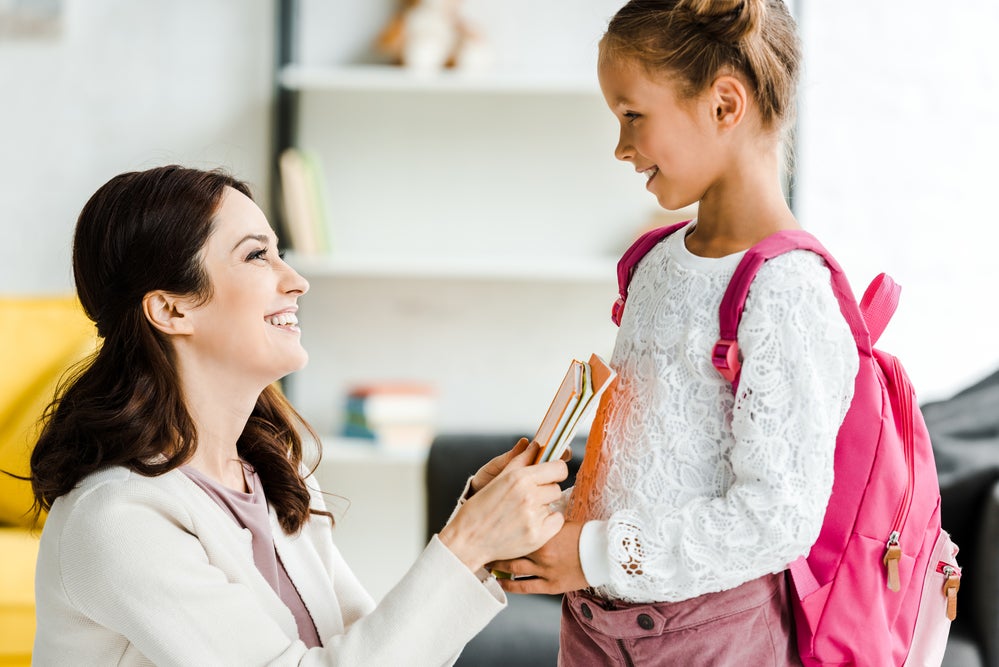
Dr. Erin Brickley introduced a simple framework for building resilience: Return to Routine, Regulate, Reassure.
- Return to Routine: Predictability provides kids with a sense of safety. Even something as small as having the same after-school sequence—snack, then homework, then free play, then dinner—can anchor children in comfort even when their day outside the home is full of change. For younger kids, routines like Thursday visits to Grandma’s or Saturday trips to the park help them know what to expect and give them a sense of stability.
- Regulate: Children need tools to manage their big feelings, and parents can model these strategies. Dr. Brickley recommends simple grounding techniques:
- Box breathing: Inhale for 4 counts, hold for 4, exhale for 4, hold for 4—like tracing the sides of a box.
- Belly breathing: Breathe in and puff out the tummy “like a bubble.” The silliness often sparks laughter, which diffuses tension.
- Muscle relaxation: Tense muscles tight, then slowly release them. This teaches kids that they can physically let go of stress.
- Stretching: Reach for toes, arms high like a tree, or stretch side to side. Playful movements help release pent-up energy.
- Box breathing: Inhale for 4 counts, hold for 4, exhale for 4, hold for 4—like tracing the sides of a box.
- Reassure: Kids need to know that no matter what happens, they are loved and safe. Dr. Brickley suggests making this part of everyday rituals. For example, one family used matching bracelets and a morning song to prepare for the first day at a new school—when the child felt nervous at school, she touched her bracelet and remembered the song, instantly feeling connected and reassured.
2. Help Kids Name and Manage Emotions
Dr. Mamatha Chary explained that emotions and feelings are different: emotions are physical responses (like a racing heart or “butterflies”), while feelings are the labels we give those experiences (“nervous,” “excited”). Just giving kids words for what they’re experiencing helps them feel calmer and more in control.
Want a simple way to help your child name their feelings? Try this free printable from Learn with Sesame Street. Kids can point to the face that matches how they feel.

Dr. Chary encourages parents:
- Reassure: “I’m here to help you work through it.”
- Validate: “I hear you saying you feel nervous.”
- Normalize: “Everyone feels nervous sometimes—it’s okay.”
- Accept: “All feelings are okay. Your feeling makes sense.”
When it comes to calming strategies, she recommends:
- Breathing games: Blowing on a pinwheel or practicing belly breaths.
- Body awareness: Pretending to be a tree or stretching to “reach for the stars.”
- Sensory strategies: Hugging a favorite stuffed animal or squeezing silly putty.
- Cognitive strategies: Counting to five or watching glitter settle in a jar.
“For kids, we definitely want to give them strategies that are fun, easy, and low-prep.”
Dr. Mamatha Chary, Developmental Psychologist
Dr. Chary also shared a simple mantra that kids can memorize: “I notice… I feel… I can.” For example, I notice my heart is beating fast. I feel nervous. I can try belly breathing.
Use this free printable to help your child practice naming and managing big feelings.

She reminded parents to practice these tools during calm moments. That way, when big feelings do arrive, kids are ready—they don’t see the tools as a rescue, but as part of their everyday toolkit.
3. Practice With Trusted Tools Like Learn with Sesame Street

Dr. Chary notes that familiar, research-backed resources can make practicing emotional skills easier for kids. The Learn with Sesame Street app helps children:
- Recognize and label emotions
- Practice calming strategies
- Build empathy and confidence
Explore Learn with Sesame Street
In a recent effectiveness study, using Learn with Sesame Street improved preschoolers’ ability to understand, express, and regulate their emotions. Kids also began using emotional regulation strategies from the program and talked about emotions more frequently and deeply.
4. Use Conversations to Build Connection
Brian Matthews (MSEd, board-certified educator) highlighted that open, ongoing conversations are one of the most powerful ways to build resilience. As a father of five, he’s seen firsthand that each child approaches changes and challenges differently—some with excitement, some with nervousness, and some with uncertainty.
His advice:
- Start the conversation: Ask gentle, open-ended questions like, “Tell me about your day,” instead of “Did you have fun?” This keeps the door open for honesty.
- Listen first, fix later: As a parent, it’s easy to want to fix it! However, Matthews recommends slowing down: mirror what your child says, label the feeling, and validate it. Only then should you move to possible solutions.
- Explore solutions together: Share your own experiences, remind kids of strategies they already know, or role-play situations (like asking a friend to play) in a safe space.
“Help them feel heard, give them information, share experiences, role play. These are four great strategies as we’re exploring solutions.”
Brian Matthews, Board-Certified Educator and Father of Five
Matthews also noted that timing matters. Children are often most ready to talk at bedtime, in the car, or while playing.
5. Don’t Forget About You
All three expert panelists emphasized the importance of parental self-care. Kids notice how we handle stress. By modeling calm confidence, parents give children a roadmap for how to respond to challenges.
That doesn’t mean parents need to be perfect. On the contrary,, showing children that we make mistakes—and then calmly correcting them—teaches resilience more powerfully than any lecture. As Matthews put it: when you spill a glass of water at the dinner table, take a deep breath and say, “Oops, I made a mistake. Let’s clean it up.” Children see that mistakes aren’t failures—they’re opportunities to learn.
And for parents feeling their own worries, Dr. Chary suggests acknowledging them out loud: “I’m excited and a little nervous too.” This kind of modeling normalizes feelings and shows children that it’s okay to have mixed emotions. Finding grounding routines for yourself—like deep breathing, journaling, or even a quiet moment with coffee—can make a big difference. It’s easy to feel guilty about taking time to recharge when the world seems to tell us we should always be “on” for our kids. But giving yourself even a few quiet moments is anything but selfish; it’s an act of care that allows you to show up calmer, steadier, and more present for your child.
Final Thoughts on Raising Resilient Kids
Helping children return to routine, regulate their feelings, and feel reassured equips them with skills that go far beyond childhood. In addition, by naming emotions, practicing calming strategies, and building strong conversations, parents create an environment where kids feel safe to face challenges and grow stronger through them.
Ultimately, resilience isn’t about avoiding stress — it’s about building confidence and tools, then using them to move through it. And in doing so, we discover just how strong we really are.