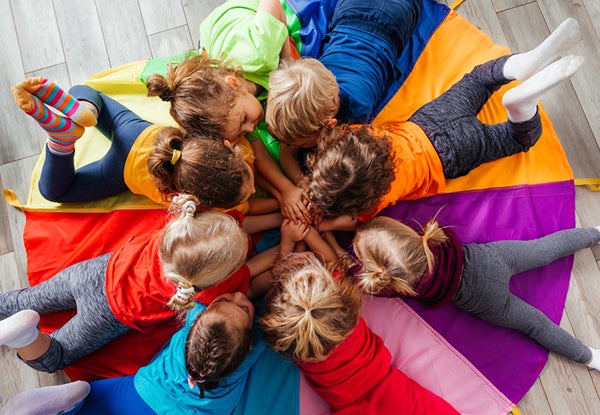
Team-building can happen in any situation where kids, or kids and grown-ups, are gathered together for a common purpose. Teaching kids how to work together and be valuable members of a group will help them develop skills they’ll use throughout their lives.
In this article, we’ve compiled several fun and easy team-building activities you can do with your child!
Key Takeaways
- Teamwork builds empathy by helping kids understand their friends’ feelings. When children collaborate to solve a problem, they develop the kindness and patience needed to become great neighbors and confident future leaders.
- While playing with you is great, peer-to-peer play is vital. It teaches kids to resolve disagreements independently, sharpening their active listening, flexibility, and conflict resolution skills without needing adult intervention.
- When leading activities, focus on the process rather than the final result. Step back to let kids problem-solve on their own, and ask thoughtful questions to help them reflect on their progress.
- Turn chores into “team missions” by using “we” language. Instead of asking for clean rooms, challenge the family to a “5-Minute Cleanup” to make the household work feel like a fun, shared goal.
Table of Contents
- Why Is Team Building Important?
- Team-Building Activities for Kids
- Tips for Grown-Ups: How to Guide the Team
- Common Household Activities That Encourage Team Building
Why Is Team Building Important?
Peer-to-Peer Team Building
Peer-to-peer team-building activities help your child develop the social skills they’ll use in every aspect of their life. Communication, problem-solving, and patience develop as your child works with others toward a common goal, and their relationships grow stronger through trust and collaboration.
When your child works with others in their own age groups, they’re also engaging in social-emotional learning (SEL) and practicing empathy in real time.
For example, if a teammate is struggling to perform a task, your child learns to offer a helping hand or a word of encouragement. A child who knows how to collaborate well like this will develop the essential skill to be a good friend, a helpful neighbor, and a compassionate leader.
Child-to-Adult Team Building
Equally important is the process of child-to-adult team building. Think of it like a second exercise for the same body part. The more ways you flex that body part, the stronger it gets.
In most cases, when you team up with your child, you are the ultimate coach. That provides a safety net of sorts that allows them to try big ideas to see if they work. You can also model good communication and problem-solving skills that your child can then use in other interactions.
Child-to-adult team building also teaches your child how to interact with people outside their peer group. This builds their confidence and gives them a blueprint for what a healthy partnership looks like.
Team-Building Activities for Kids
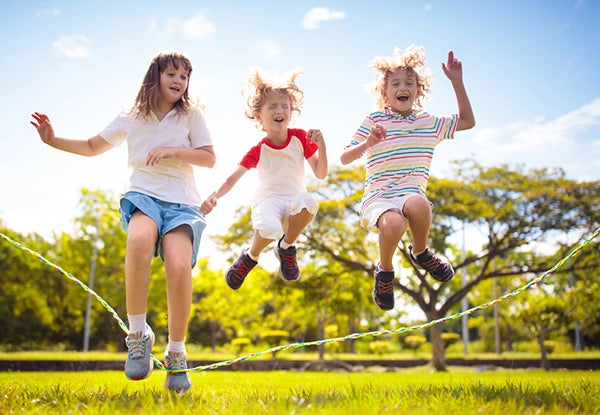
1) Group Jump Rope
What You’ll Need
- One long jump rope
What to Do
- Determine how many kids will be jumping the rope at the same time.
- Two kids turn a jump rope, while the other kids run in, jump, and then run out.
- See how many times the kids can jump without missing or getting in each other’s way.
2) Hula Hoop® Challenge
What You’ll Need
- A Hula Hoop
What to Do
- Everyone stands in a circle.
- One child places the Hula Hoop on their shoulder, and everyone joins hands.
- Without letting go of anyone’s hand, the kid with the Hula Hoop has to get it off of their shoulder and pass it to the next child.
- Each subsequent kid does the same until the Hula Hoop has made it all the way around the circle.
3) Over-Under Relay
What You’ll Need
- A ball
What to Do
- Everyone forms a line.
- The first kid passes a ball over their head to the child behind them.
- That kid passes it under their legs to the next kid.
- The ball gets passed down the line, over and under, until it reaches the last child.
4) The Circle Grows
What You’ll Need
- A ball
What to Do
- Everyone stands in a circle close together.
- The first kid throws the ball to someone else.
- If they catch it, everyone takes a step back and the circle widens.
5) Scavenger Hunt
What You’ll Need
- Paper
- Pens
What to Do
- Give kids a list of items you’ve hidden plus clues as to where they can be found.
- Have them work as a team to find all the items on the list.
6) Moon Ball
What You’ll Need
- Beach ball
What to Do
- Everyone works together to keep the ball up in the air without it touching the ground.
7) Seeing Spots
What You’ll Need
- Small round stickers in a variety of colors
- Enough kids so that at least two of them can have the same color sticker
What to Do
- Place one sticker on each child’s forehead without them seeing it.
- They need to find other kids with the same color stickers as theirs without verbal communication.
8) Cup Stacking
What You’ll Need
- Paper cups (15 per group)
- String
- Rubber bands
What to Do
- Divide the kids into groups (any number of kids per group works)
- Give each group 15 paper cups.
- Tie 1-2 foot-long strings around the rubberband—one string per kid.
- Each child holds onto a piece of string and pulls it to stretch the rubber band so it will fit around a cup.
- The kids use the rubber band to pick up paper cups and stack them into a pyramid shape.
9) We’re Going On a Picnic
What You’ll Need
- A space to sit comfortably
What to Do
- Ask the kids to sit in a circle.
- You begin by saying, “We’re going on a picnic, and I’m bringing—” and name something that starts with “a,” like “apple.”
- The kid next to you repeats, “We’re going on a picnic, and I’m bringing—” and they need to say “apple” and then something that starts with “b,” like “banana.”
- Go around the circle until you get to the end of the alphabet.
10) Animal Charades
What You’ll Need
- Paper
- Pencil
- Basket
What to Do
- Write down a different kind of animal on each piece of paper and put all the papers in the basket.
- One kid picks a piece of paper and acts out the animal’s behavior without speaking and the others guess the animal.
11) The Great Egg Drop
What You’ll Need
- Various materials you have around your house such as:
- Fabric
- Newspaper
- Cardboard
- Bubble cushion material
- Cotton balls
- Tape
- An egg
What to Do
- Give the kids an egg.
- Ask them to work together to design a package, using the materials, that will keep the egg from breaking when it’s dropped.
- Test the design by dropping the egg.
- Discuss outcomes: What worked? What didn’t? How could they improve their design?
12) The Big Picture
What You’ll Need
- A simple picture on a piece of paper
- Pencils
- Markers
- Paper
What to Do
- Cut the picture into enough squares so each child gets one.
- Give each kid a piece of paper and ask them to reproduce their section of the picture, filling the whole piece of paper.
- The kids put their drawings together to create a new (bigger) replica of the original picture.
13) Service Project
What You’ll Need
- Materials for a service project (i.e. food for a bake sale or bags for a clothing drive)
What to Do
- Organize a group of kids to do a service project.
- Some ideas include:
- Making cards for people living in a senior center
- Gathering clothes or canned goods for a clothing or food drive
- Holding a bake sale to raise money for an animal shelter
14) Community Garden
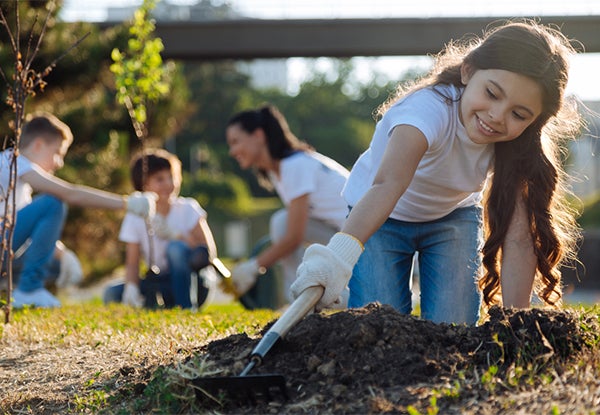
What You’ll Need
- Rakes
- Shovels
- Dirt
- Seeds or plants
What to Do
- Do a long-term project by planting a garden in a communal space in your neighborhood.
- Make a plan with your child and the neighbors who want to participate. What will the garden look like? What will you plant? Who will do each job, like planting, watering, and harvesting?
- Work with your child and your neighbors to implement the plan.
15) Sidewalk Art Gallery
What You’ll Need
- Chalk
- Sidewalk or concrete patio
What to Do
- Choose a theme (like favorite animal or activity).
- Ask each child to draw a picture that fits the theme.
- When everyone is finished, the kids walk through the art gallery together discussing why they chose their ideas and what details they love in other people’s art.
16) Spider Web
What You’ll Need
- Ball of yarn
- Space to sit
What to Do
- Everyone sits in a circle.
- One kid begins by holding the end of the yarn and tossing the ball to another kid.
- The catcher becomes the thrower. Holding onto their part of the yarn, the new thrower tosses the ball to someone else.
- Continue until everyone in the circle is connected by the yarn spider web.
17) Collaborative Storytelling
What You’ll Need
- Your imagination
What to Do
- One kid provides the first sentence to a story.
- Then, one by one, each kid adds another sentence to it until everyone has had a turn.
- You can continue around the group as many times as you like. The length of the story is up to you!
18) Did You Hear That?
What You’ll Need
- Blindfold
- A small toy with wheels in a jar
What to Do
- Have the kids form a circle.
- Choose one kid to wear a blindfold and stand in the middle.
- The kids pass the jar without making noise.
- If the kid in the middle hears something, they point to where they think the noise is coming from. If they’re right, another kid goes into the middle and dons the blindfold.
- The group succeeds when they can pass the jar around the entire circle silently.
19) Applause Hide and Seek
What You’ll Need
- A large group of people (perfect for groups with varying levels of mobility)
What to Do
- Divide the group into hiders, seekers, and helpers (the folks who can’t or don’t want to move around).
- Once the hiders are hidden, the seekers work together to find them.
- The helpers applaud the finders when they get close to a hider.
20) Secret Handshake
What You’ll Need
- 6 kids or more
What to Do
- The kids form a circle.
- Together, they make up an elaborate handshake and practice it.
- A child starts the game by shaking the hand of the kid to their right, who shakes the hand of the kid to their right and so on.
- If someone messes up the handshake, the game starts from the beginning again.
- Once everyone gets the handshake right, the game starts again, this time with everyone going faster. Challenge the kids to see how fast they can “pass” the handshake around the circle.
21) The Human Knot
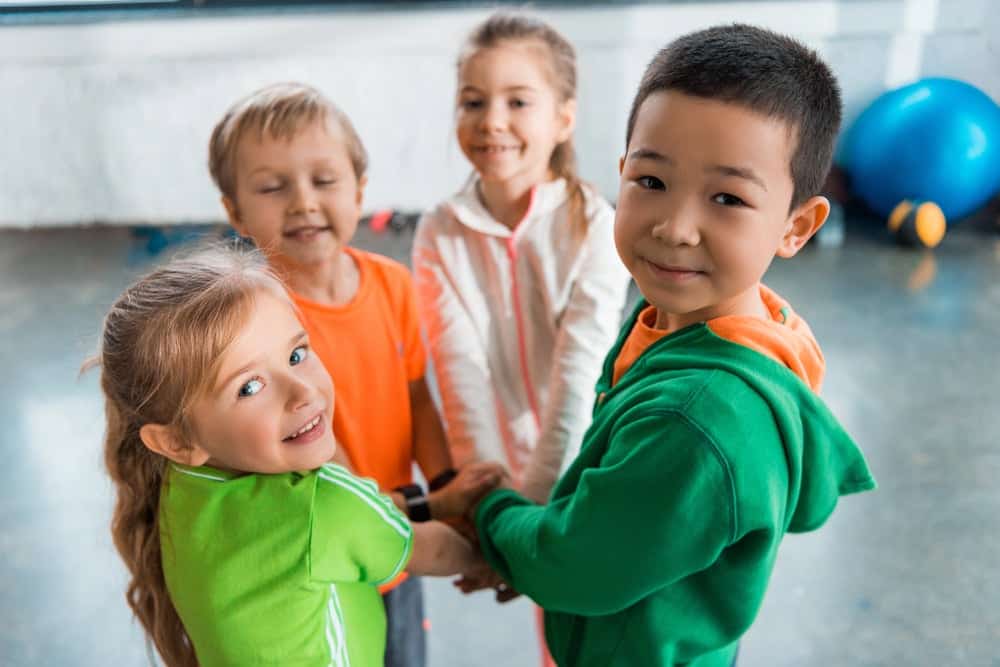
What You’ll Need
- A group of at least six kids
What to Do
- Have the kids stand in a circle facing each other.
- Ask everyone to put their right hand into the center and grab the hand of someone standing across from them.
- Next, have everyone put their left hand in and grab a different person’s hand.
- Now for the challenge: The group must try to untangle themselves into a perfect circle without ever letting go of each other’s hands!
- Kids will have to step over arms, duck under shoulders, and communicate constantly to untangle the knot.
22) Bridge Builders
What You’ll Need
- Masking tape
- Drinking straws or popsicle sticks
- A small toy car
What to Do
- Divide the kids into two teams (or work as one big team).
- Their goal is to build a bridge across a “canyon” (like the space between two chairs).
- The catch? The bridge must be strong enough to support the weight of the toy car as someone pushes it across.
- This requires a lot of engineering talk, and kids have to decide together if they should use more tape or more straws to make the structure as sturdy as possible.
23) Pictionary Relay
What You’ll Need
- Large paper or a whiteboard
- Markers
- A list of simple objects (like “tree,” “house,” or “dog”)
- Stopwatch or 10-second timer
- A team of drawers (can be two, three, or more kids)
- A team of guessers
What to Do
- This is like regular Pictionary, but with a twist!
- One child starts drawing the object but only gets to do so for 10 seconds.
- When the timer dings, the next child has to jump in and continue the drawing from where the first child left off.
- Continue to switch drawers every 10 seconds for a total of one minute.
- While the drawers are drawing, the rest of the team tries to guess what the final masterpiece is. This teaches kids to pick up where someone else left off, which is a vital part of working in a group.
24) Mystery Bag Skits
What You’ll Need
- A bag filled with 5 random items (like a spoon, a hat, a TV remote, a stuffed animal, and a shoe)
What to Do
- Give the group of kids the bag and tell them they have 10 minutes to create a short play.
- The rules: Every single item in the bag must be used in the story, and every child must have a speaking role.
- This activity is great for encouraging quiet kids to speak up and for helping natural leaders learn to share the spotlight.
25) Joint Storyboarding
What You’ll Need
- Paper
- Colored pencils, markers, crayons
- Can also be done with a tablet or computer and a simple drawing app
What to Do
- Task groups of two or three to work together to create a short comic book.
- One person can draw while the other person (or two) writes.
- Switch roles every page.
26) Collaborative Video Games
- What You’ll Need
- Learning app like codeSpark
What to Do
- Instead of playing separately, give the kids a mission or goal that requires them to work together.
- If you only have one device, switch out who gets to “push the buttons” every few minutes.
27) The Three-Course Challenge
What You’ll Need
- Simple ingredients for a meal
What to Do
- Assign “departments.” One child is the Head of Veggies (washing and prepping), another is the Sauce Specialist, and a grown-up can be the Heat Manager (handling the stove).
- Encourage them to check in with each other throughout the process: “Is the lettuce ready for the salad?” “Do we need more salt?”
- When the meal is served, celebrate the fact that it took everyone to make the dinner taste so good.
28) Assembly Line Cookies
What You’ll Need
- Cookie dough (either a pre-made tube or the ingredients to make a batch)
- Toppings
What to Do
- Set up an assembly line for making cookies, and see how fast and efficiently the team can work together.
- Give an assignment to each child (e.g., Child A scoops the dough onto the baking sheet, Child B flattens it, Child C adds the toppings, etc.).
- Encourage the team to come up with ways to prevent one part of the assembly line from falling behind and to keep everything moving smoothly.
- Celebrate success with the finished product.
29) Blindfold Artist
What You’ll Need
- Blindfold
- Paper
- Crayons, colored pencils, and/or markers
What to Do
- One person is the “Artist” (blindfolded) and the other is the “Guide.”
- The Guide tells the Artist exactly what to draw: “Move your hand two inches to the left and draw a circle.”
- This helps build trust and requires the Guide to be very specific with their words.
30) Blanket Volleyball
What You’ll Need
- A beach ball
- Two large blankets
- At least four children
What to Do
- Each team holds a blanket by the edges.
- Place the beach ball on one blanket and show them how creating slack in the blanket and then pulling it tight will launch the ball up (and, hopefully, away!).
- Challenge teams to pass the ball back and forth.
- This task is impossible to do alone. Teams must communicate and move in sync both to catch the ball and to launch it where they want it to go.
- For a more challenging version of this game, you can substitute a “heavier” foam ball or rubber ball so that the ball travels farther and is a bit easier to send in a specific direction.
Tips for Grown-Ups: How to Guide the Team

Whether you’re working with your child in a child-to-adult activity or supervising a peer-to-peer activity, here are some tips to help you guide the team.
Be a Coach, Not a Player
When you’re supervising peer-to-peer activities, it’s extremely tempting to jump in and “fix” any problems that come up. But, when it comes to encouraging teamwork, the best thing you can do is to be a coach, not a player.
Think of yourself as the person on the sideline with the clipboard, not the one taking the shots. You can provide some guidance once in a while, but take a step back and leave the bulk of the decisions to the kids, and, by all means, give them the chance to figure it out on their own.
Focus on the Process, Not the Result
If the team-building exercise ends in disaster, that’s OK. The goal isn’t a perfect project; it’s the conversations that happen along the way!
Find something that the team did well and praise them for it. For example, you could highlight how the team worked together to try new things, how each team member listened to the other’s input, and/or how everyone stayed patient even when things got difficult.
When you celebrate the effort rather than the result, kids feel safer taking risks the next time around.
Reflect on What Happened
Once the activity is over, help your team reflect on what happened by asking questions that make everyone think about what they did.
For example, to help build self-awareness, you could ask, “What was the hardest part?” To encourage gratitude, you could ask, “What did someone else do that helped you?” Or, to spark problem-solving, you could ask, “What would you do differently next time?”
By asking these (and other) questions, you’re turning a relatively simple game or activity into a lifelong lesson in collaboration.
Common Household Activities That Encourage Team Building
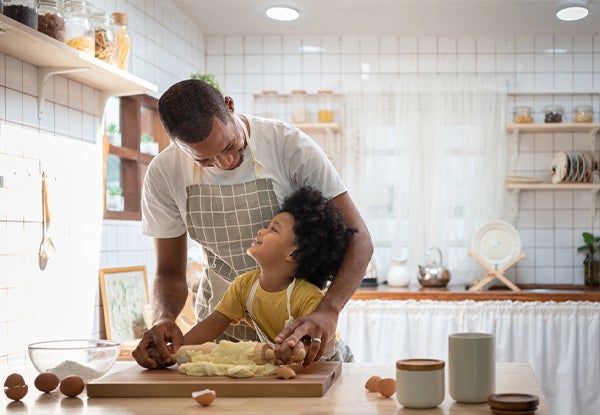
Many family activities can strengthen team-building skills—you just need to be intentional about the way you approach them. Be clear about the goal and emphasize how your child’s role, and everyone’s role, is important to a successful outcome.
Some family activities that work well for this are:
- Planting a vegetable garden
- Cooking a special family meal
- Painting a mural on a fence or garage wall
- Building something together
Keep in mind that teamwork doesn’t have to be a scheduled event. You can incorporate it into your everyday activity just by using “we” language and reframing chores as missions rather than boring jobs to get done.
For example, instead of saying, “Please go clean your room,” use “we” language and say, “Let’s see how fast we can get the house ready for Grandpa and Grandma’s visit!” This reframes the task so that it feels like a shared mission rather than something only they have to do.y you approach them. Be clear about the goal and emphasize how your child’s role, and everyone’s role, is important to a successful outcome.
Go,Team!
The Begin team is here to support your family with award-winning learning programs that help your child develop the skills they need to thrive. Explore social-emotional awareness with beloved friends like Elmo with the Learn with Sesame Street app to set the stage for healthy, happy relationships with others!
Frequently Asked Questions
What are the four main types of team-building activities?
While there are different ways to categorize team-building activities, a common method is dividing them into those that focus on:
- Communication
- Trust-building
- Problem-solving
- Decision-making
Of course, most team-building activities incorporate more than one.
How do sports teach team-building skills?
When your child is a member of a sports team, they’re collaborating with others to achieve a common goal. They must use team-building skills such as communication, cooperation, and problem-solving, which fosters a sense of trust and camaraderie.
How does leadership grow out of team-building?
A good leader needs the same set of skills as a good team player: communication and problem-solving skills, patience, and the ability to collaborate creatively. Developing team-building skills lays the groundwork for becoming a confident and empathetic leader.