These free vertical addition worksheets introduce the column format, showing numbers stacked on top of each other. This visual layout helps children organize their thinking and lays the foundation for place value understanding in later grades.
Each worksheet download contains a practice sheet and an answer sheet.
Vertical Addition 1 – 10: Worksheet #1
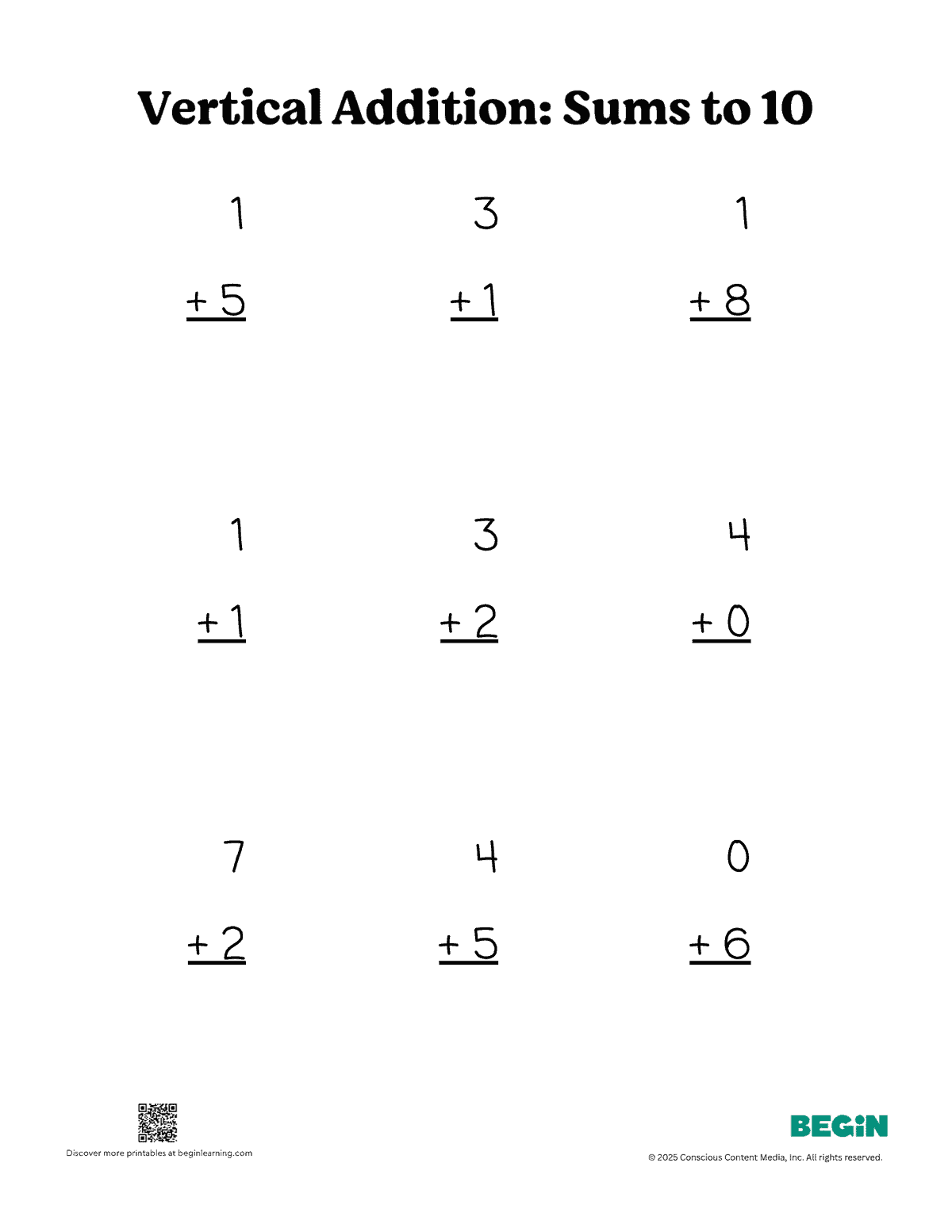
Vertical Addition 1 – 10: Worksheet #2
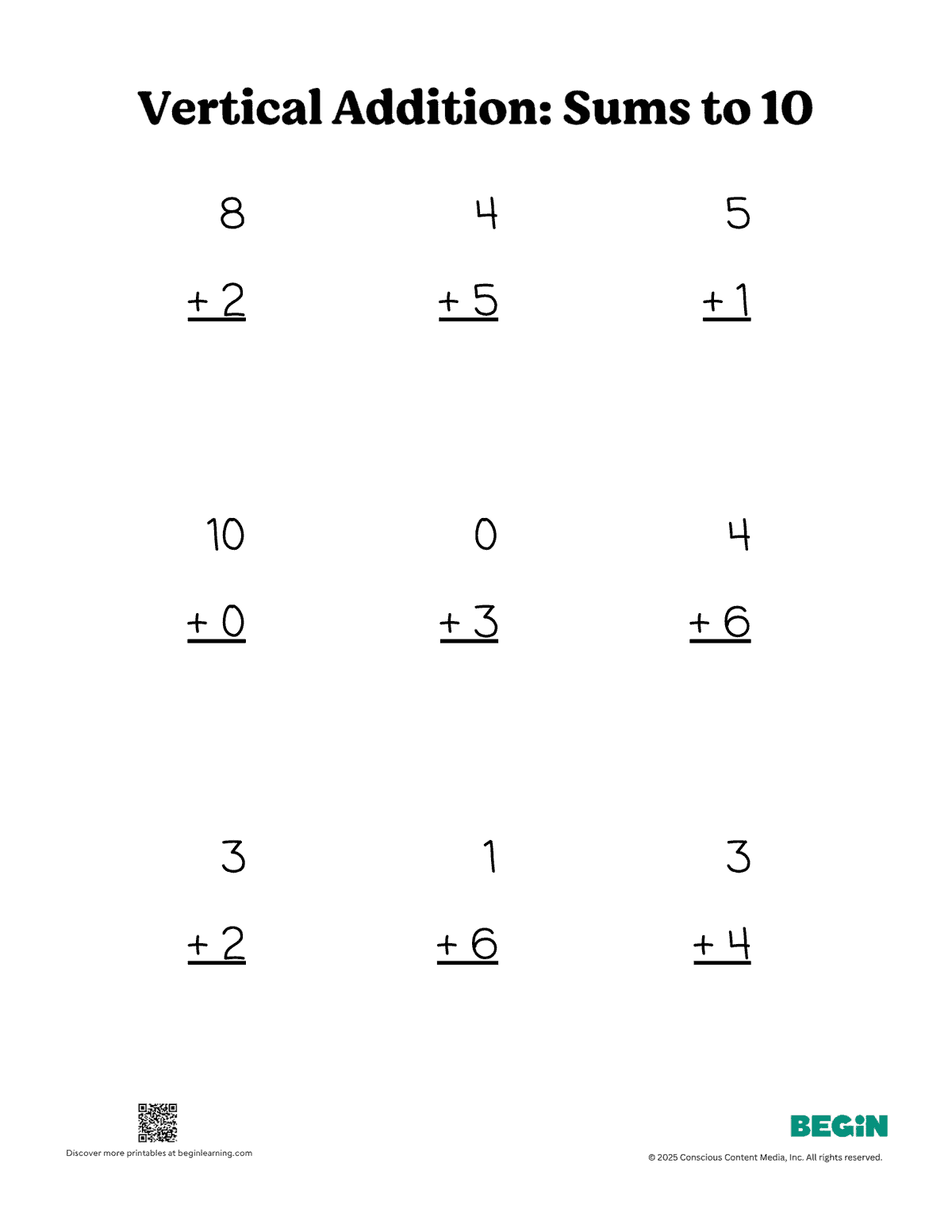
Vertical Addition 1 – 10: Worksheet #3
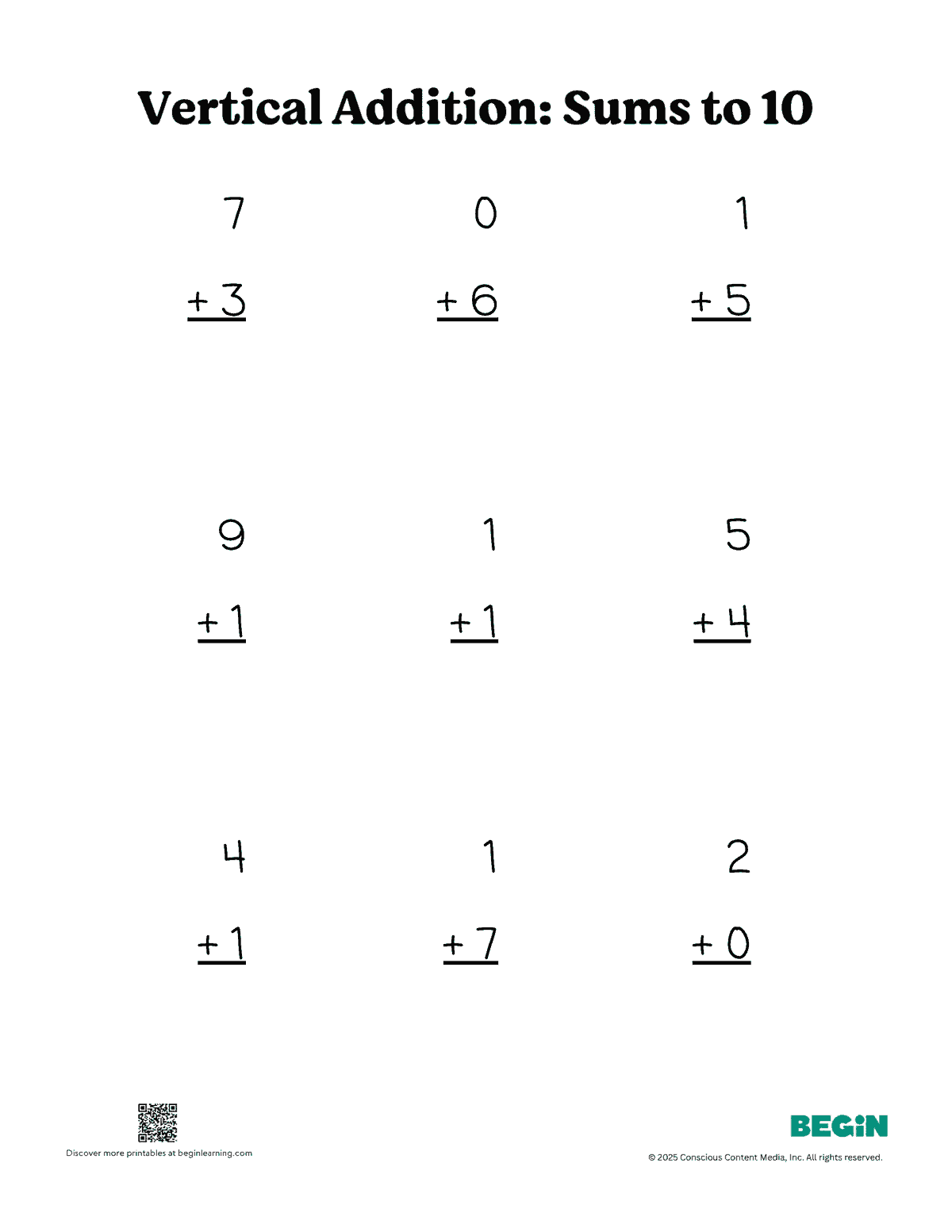
Vertical Addition 1 – 10: Worksheet #4
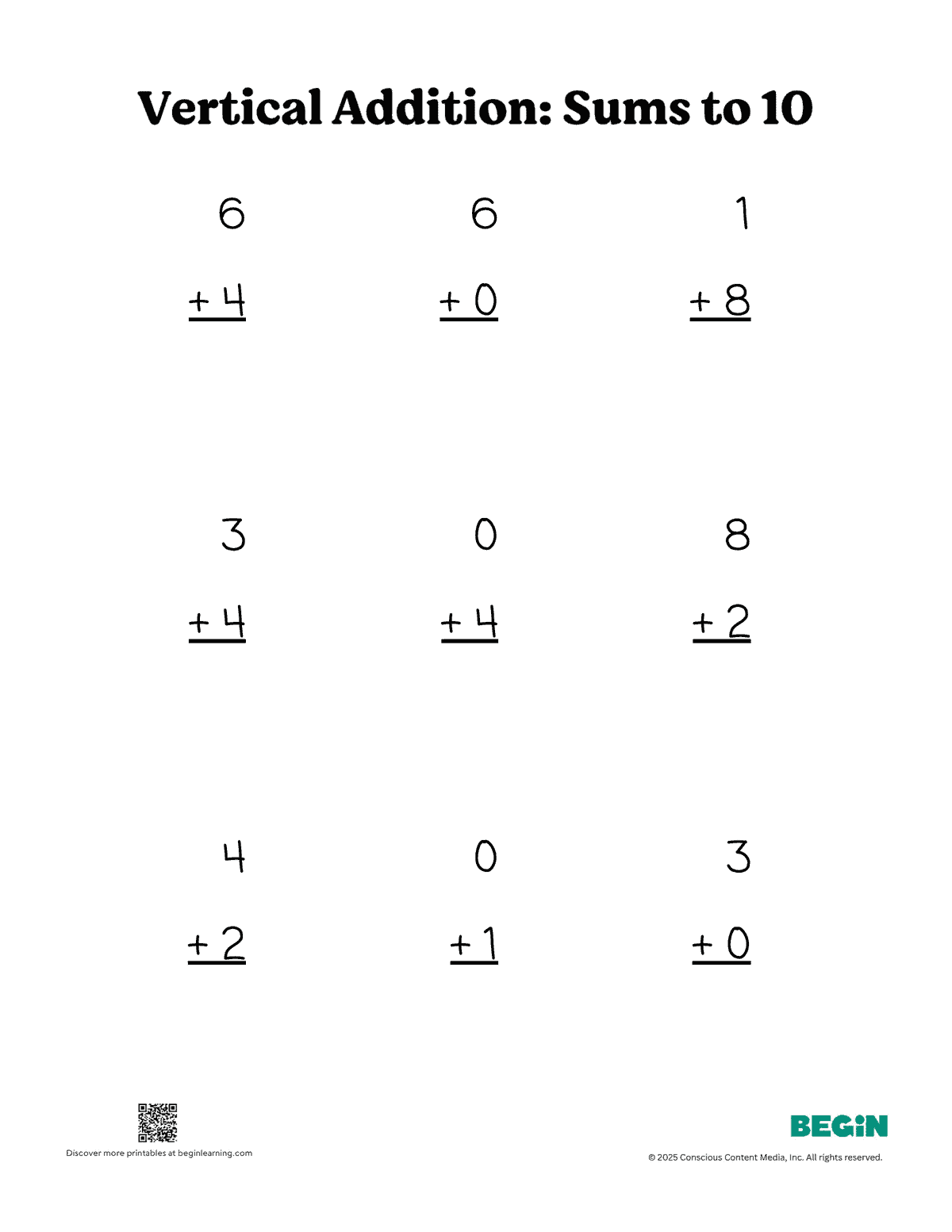
Vertical Addition 1 – 10: Worksheet #5
Frequently Asked Questions (FAQs)
What is vertical addition?
Vertical addition is when numbers are written in columns, stacked on top of each other, rather than side by side. Instead of writing 3 + 2 = 5 across the page, your child sees the numbers arranged with one above the other and a line underneath where the answer goes.
This format helps children organize their work visually and prepares them for adding larger numbers in future grades, where lining up digits becomes important.
Why should my child learn vertical addition if they already know horizontal?
The column format teaches organizational skills that become essential as math problems grow more complex. When children eventually work with two-digit and three-digit numbers, they will need to line up ones, tens, and hundreds correctly.
Starting with simple vertical problems now makes that transition much smoother. It also gives children another way to see and solve the same problems, which reinforces their understanding that addition works the same regardless of how it appears on the page.
What if my child keeps writing the answer in the wrong spot?
This is common when children first encounter the vertical format. The answer line at the bottom can be confusing when they are used to writing answers at the end of a horizontal equation.
Try drawing a small arrow pointing to where the answer goes, or use your finger to trace from the top number down through the plus sign to the answer line. With a few practice problems, most children quickly learn where to place their answers.
Can my child still use counting strategies with vertical problems?
Absolutely. The format does not change the math itself, so any strategy that works for horizontal addition works here too. Your child can count on their fingers, draw dots, or use small objects to find the answer. The only difference is where they write the result. As children become comfortable with the layout, they often find that vertical problems are actually easier to track because everything is organized in one place.
How do I explain the line under the numbers?
Tell your child that the line works like an equals sign. It means “this is where the answer goes.” Some children find it helpful to think of it as a “magic line” that shows where the two numbers above combine.
You can demonstrate by writing the same problem both ways: 3 + 2 = 5 horizontally and then stacked vertically, pointing out that both problems ask the same question and get the same answer.
My child gets overwhelmed by worksheets with a large number of problems. What should I do?
Start by covering up all but one or two problems at a time with a piece of paper. This reduces visual clutter and helps your child focus on one problem without feeling overwhelmed.
You can also set a small goal, like completing just three problems, then take a short break. Gradually increase the number as your child builds stamina. The goal is confidence, not volume.
Should I correct mistakes right away or wait until the worksheet is finished?
For young learners, gentle correction during practice often works better than waiting until the end. If you notice an error, you might say something like, “Let us count that one together,” rather than marking it wrong.
This keeps the experience positive and helps your child understand where they went off track while the problem is still fresh. That said, follow your child’s temperament. Some children prefer to finish first and then review.

Want to support your child’s early literacy, math skills, and creativity?
Try HOMER free for 30 days