
Addition and subtraction are two of the earliest math skills your child will learn and are crucial for learning more complex math concepts later. They’re not only taught in a classroom, though; you can find opportunities to strengthen these skills in everyday life.
For instance, if your child sets the table and gets three spoons out of the drawer, you might suggest they get two more. Then they could count them: “One, two, three, four, five,” and you could reinforce the concept of addition: “Yes, three plus two equals five.”
You can find many addition and subtraction “moments” within your child’s day. This is great news! Whether they’re giving one of their trucks to a friend or adding two more books to their bedtime routine, they’re practicing their number fluency and getting ready to tackle harder math.
Here we discuss when your child will learn addition and subtraction, the math milestones that set them up for these skills, and ways you can help them feel comfortable and confident as they learn.
Key Takeaways
- Kids begin to learn the concept of addition around age five and subtraction between the ages of six and eight.
- Early math milestones such as rote counting and cardinality build a foundation for addition and subtraction skills.
- Addition and subtraction skills are necessary for understanding more complex math concepts.
- Addition and subtraction facts, math language, and story problems are math building blocks.
Table of Contents
- The Importance of Addition and Subtraction
- Early Math Milestones
- When Do Kids Learn Addition?
- When Do Kids Learn Subtraction?
- Components of Addition and Subtraction
- 3 Ways to Help Your Child Learn Addition and Subtraction
The Importance of Addition and Subtraction
Addition and subtraction are important because, once kids grasp these skills, they’re ready to work with more advanced math concepts. But before kids can master addition and subtraction, they need to reach the early math milestones that pave the way for more advanced learning.
Early Math Milestones
Before your child can dive into addition and subtraction, they need to reach the early math milestones that pave the way for more advanced learning.
Quantity Recognition
By the time your baby is six months old, they may be able to understand quantity in a basic way (they’ll start to recognize when they want more of something). As they continue through their first year, they may start asking or signing for more food, for example.
Rote Counting
As your child approaches two, they might be able to recite the numbers 1 through 10 when singing a song or reading a counting book. But they might skip a number here and there.
This is called rote counting. Your child is forging a relationship with number order but hasn’t fully connected the dots yet.
Enumeration
In order for your child to connect those dots, they need to understand enumeration, or the ordered listing of a group of objects. This involves three important steps:
- Saying number words in the correct order
- Matching one number word with only one object
- Counting each object only once
One-to-One Correspondence
A critical component of enumeration is the idea of one-to-one correspondence. This is the idea that one number corresponds with only one object. Children typically learn these concepts when they’re between three and four years old.
Cardinality
Cardinality is the idea that the number assigned to the last object in a counting sequence equals the total number of objects. By the time your child is four, they may grasp the idea that if they count six blocks (“one, two, three, four, five, six”), they actually have six blocks.
Numerals and Quantities
Around the same time your child grasps the concept of cardinality, they solidify their understanding of numerals and quantities. They can count precise quantities.
They’ll start using the “count on” principle to combine groups of objects by counting one group and then another by continuing where they left off. So if they have three apples in one group and two in another, they can count: “one, two, three (then move to the next group) “four, five.”
After your child learns these early math skills, they’re ready to jump into the adventure of addition and subtraction!
When Do Kids Learn Addition?

Kids typically begin learning addition when they’re around five years old. But like all early childhood skills, the age range for mastering it is wide. Ideally, kids know their basic addition facts (sums up to twenty) by the time they get into second grade.
When Do Kids Learn Subtraction?
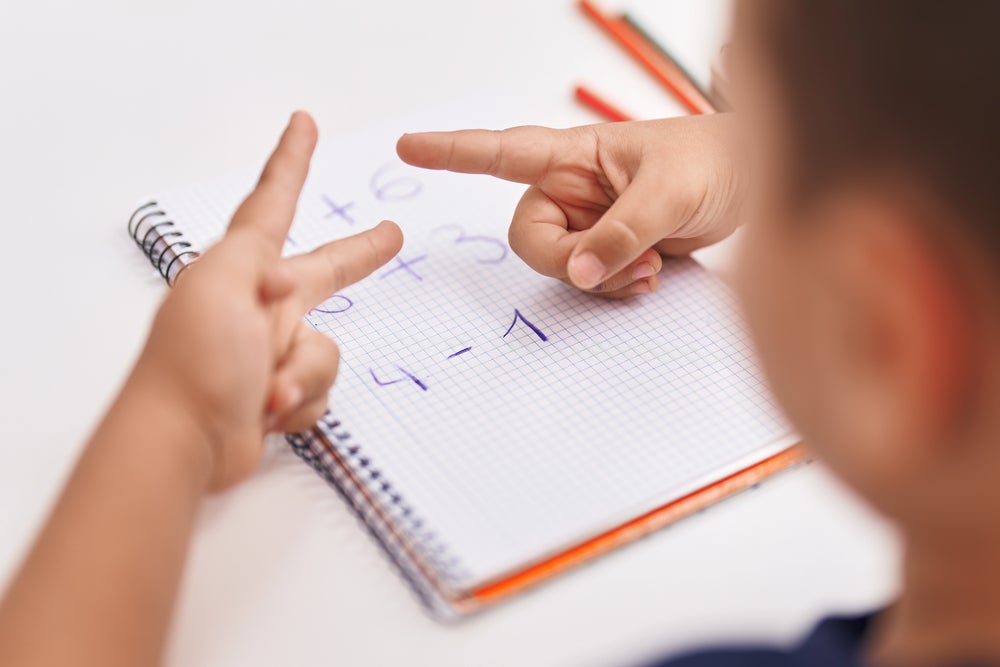
Once kids grasp the concept of addition, they can move onto its inverse: subtraction. This learning typically begins when they’re six or seven, and by the time they’ve finished second grade, many kids know some subtraction facts.
Components of Addition and Subtraction
Addition and subtraction break down into a few distinct components. Understanding each one can help your child strengthen their adding and subtracting skills.
Basic Addition and Subtraction Facts
Basic addition facts are the addition combinations of the numbers 1-10. (1+1, 1+2, 1+3, all the way up to 10+10). Basic subtraction facts are similar. They are the differences from 2-1 to 20-10. (2-1, 3-1, 4-1, all the way up to 20-10).
Fact fluency (being able to quickly know simple addition and subtraction answers like those above) matters because it lays the foundation for more complex math concepts.
Math Language
Learning addition and subtraction is easier for kids if they understand math language. For example, if you said to your child, “7+3 is an addition problem,” they may not be able to understand what you mean.
But if you said, “7+3 means putting the numbers 7 and 3 together,” they might get it. “Putting the numbers together” is a type of math language. Other math language includes words like “more,” “less,” “bigger,” and “smaller.”
Story Problems
Your child might feel lost if you simply ask them to add 7+3. But if you told your child a story (“I got seven apples from the kitchen. Then you got three. How many do we have together?”), the equation becomes real. Your child can visualize getting those apples.
And if your child needs a little more help, enacting the story (really going into the kitchen to get those apples!) makes the equation concrete.
You may even want to make this a bit more fun by reading a story (or making one up!) about counting.
3 Ways to Help Your Child Learn Addition and Subtraction

You and your child can have fun practicing their addition and subtraction skills at home. Try using these four tools as your child plays. (And learns math skills along the way!)
1) Chore-Time Math
No, math doesn’t have to be a chore, but try using math when you and your child are doing household chores! Ask your child to divide the laundry into clothing categories groups and then practice addition using the “count-on” principle.
Ask your child to help you cook, and spend time counting tools and ingredients like cups, teaspoons, and eggs. Add up the number of pans or muffin tins you use. You can even practice some subtraction by using a count-down timer.
2) Daily Math
Addition and subtraction opportunities are all around us! When your child has a group of something (blocks, books, or blueberries), count them, take a few away, add a few, and then count them again.
This works well at mealtime. Your child might have five slices of an apple. See if you can count them before your kid eats one. Then count them again. This kind of playing with food has a purpose!
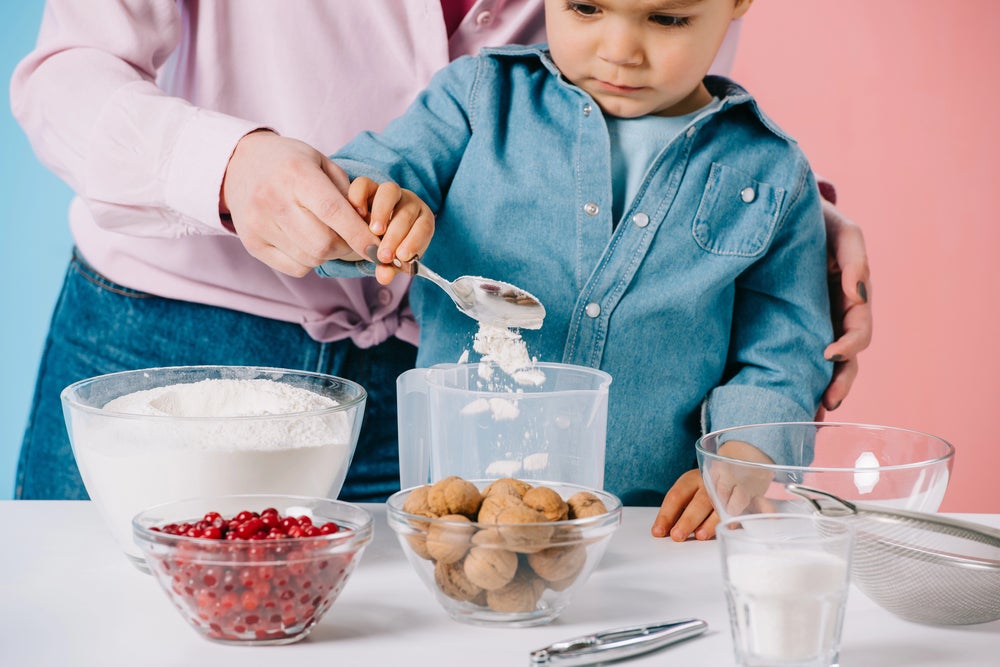
You can also incorporate math into mealtime by asking your child to help set the table (place one spoon next to each plate, count how many glasses you need, etc).
3) Math-Centric Stories
Reading is a powerful way to bring any kind of learning into focus. Choose picture books that center on numbers. The combination of text and illustrations will strengthen your child’s ability to absorb information.
Finger plays, rhymes, and songs are another great way to incorporate addition and subtraction lessons into your child’s routine. Five Little Monkeys Jumping on the Bed is a perfect example of this. Every time “one falls off and bumps their head,” you can drop one of your fingers!

Looking for Math Fun? Just Add Begin!
When do kids learn addition and subtraction? Typically, around the ages of five to seven, but each child is different and learns in their own time. Remember to celebrate each step along the way!
Begin is here to help your child on their math journey. Our HOMER app contains fun math activities that encourage learning.
And with our codeSpark app, your child can practice skills important in math as they create their own games, puzzles, and stories. Check out these and our other award-winning products to get kids playing and learning!
Frequently Asked Questions
Why do children have more trouble with subtraction than addition?
Some kids have a harder time with subtraction than addition because the idea of “taking away” can be harder to conceptualize than “adding to.”
Because subtraction is the inverse of addition, you can actually help strengthen your child’s understanding of subtraction by continuing to practice addition.
At what age should kids be able to count backward from 10?
Kids start counting backward sometime between three and five years old. They start by counting backward from numbers less than 10, then gradually work their way up.
Don’t forget that this is a general age range. Your child may learn to count backwards sooner than age three or later than age five, and both are OK.
When should I worry about my child’s addition and subtraction skills?
How can you know if your child is struggling to learn addition and subtraction, or any math concept for that matter? Paying attention to their emotional state can be a clue. Is your child anxious when they do math? Do they get easily frustrated?
You can help alleviate those tough feelings by making math fun at home with games and activities. Just like reading books to your child, try to make math a part of your daily routine. If your child is working on a math problem, praise their effort.
Sometimes, however, kids have a slight lag in skill-building even with extra practice. But if you sense something greater at play, it’s always a good idea to talk with your child’s teacher.
Signs to watch for include consistent trouble with math facts, struggling with math phrases (like “greater than”), using fingers to count (beyond when it’s age-appropriate), and trouble recognizing patterns and number symbols.