Words that start with the letter A are a gateway into a world of stories and ideas that your child will use for the rest of their life. This guide is designed to help you introduce a rich and growing vocabulary to learners of all ages, starting with the letter A.
Along the way, we’ll sprinkle in some facts about the letter A and provide engaging activities to make learning exciting. So, let’s begin this amazing adventure into words that start with the letter A!
Key Takeaways
- As you begin teaching your child about the letter A, be sure to bring up the fact that A can make both a short sound and a long sound.
- As your child’s vocabulary grows, make learning fun by introducing games and activities that stimulate their imagination and encourage them to use letters and words creatively.
Table of Contents
- Fun Facts About the Letter A
- Beginning Vocabulary: Kindergarten and 1st Grade A Words
- Growing Vocabulary: 2nd and 3rd Grade A Words
Fun Facts About the Letter A
Like the other vowels in the English language, the letter A makes two unique sounds: a short sound (as in ant) and a long sound (as in ape). In most cases, the sound that A makes depends on where it is in the word and the letters that surround it.
This is something you’ll want to teach your child so they don’t get confused as the words they’re learning grow in length and complexity.
Here are some more fun facts about the letter A that you can use to spark your child’s imagination:
- The letter A is one of the most common letters in the English language.
- It started as a hieroglyph in ancient Egypt that was a picture of an ox’s head.
- The word alphabet is a combination of the first two words of the Greek alphabet, alpha and beta.
- If you write out numbers as words, you won’t use the letter A until you get to thousand.
Beginning Vocabulary: Kindergarten and 1st Grade A Words
For kids this age, choose easy, familiar words so they can see and use them as much as possible. Here are some examples of 1st grade words that start with the short A sound:
- apple
- and
- ant
- alligator
- all
- at
- am
- as
- ask
- add
Here are some examples of 1st grade words that start with the long A sound:
- ape
- age
- April
- acorn
- apron
- ate
- agent
- aid
- aim
- able
Activities
Make up fun sentences: Encourage your child to use the new A words in simple sentences. For example, “The ant walked on the apple,” or “The ant, alligator, and ape all wore aprons.”
Draw pictures: Ask your child to pick a word that starts with A, then draw a picture of it.
Go on a scavenger hunt: Encourage your child to go on a scavenger hunt to find things that start with the letter A. You can do this outside (acorn, apple tree, animal), or you can create a scavenger hunt inside by hiding specific objects throughout your house.
Growing Vocabulary: 2nd and 3rd Grade A Words
For 2nd and 3rd graders, introduce slightly more complex words into their vocabulary. Choose words that they’re familiar with, that come up in regular conversation, and that they can use every day.
Here are some examples of 2nd and 3rd grade words that start with the short A sound:
- around
- animal
- amazing
- astronaut
- alone
- after
- address
- across
- always
- above
Here are some examples of 2nd and 3rd grade words that start with the long A sound:
- alien
- apex
- acre
- Asia
- ache
- ail
- ancient
Activities
Word Bingo: Word Bingo is a variation on the classic Bingo game that uses words instead of numbers.
To play, create cards with a variety of words that start with the letter A for your child. Then write each word you used on the card on slips of paper and put them in a hat, bucket, or other container.
Draw a slip of paper out of the container, call it out, and ask your child to find the word on their card and cover it with a chip, block, or other small item. When they’ve covered a complete row horizontally, vertically, or diagonally, they can yell, “Bingo!” and win the game.
“A word” story challenge: Ask your child to draw a picture illustrating certain A words. For example, you could ask them to draw a picture of an ape hugging an alligator or an alien that went on an adventure.
Act it out: Take turns acting out the A word while the other person tries to guess the word. For example, your child acts like an ape while you try to guess what they are. Then you act like an alligator while your child tries to guess what you are.
Keep Learning!
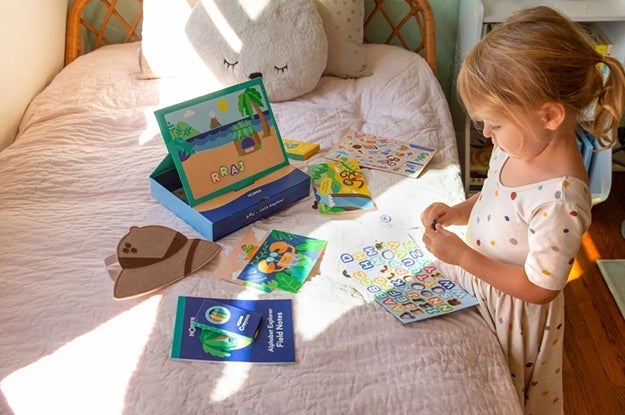
Building a strong vocabulary, including words that start with the letter A, is one of the most important things you can do to prepare your child for a lifetime of learning.
Award-winning programs Learn with Sesame Street and HOMER are designed to support your child’s growth every step of the way.
By providing personalized, play-based learning across core academic and life skills, Begin’s solution-based products help children build the confidence and knowledge they need to thrive.
Frequently Asked Questions
Should I introduce the letter A first?
No, you don’t have to introduce the letter A first when teaching your child about the alphabet.
In fact, it might be better to start with some of the most common consonants first, like B, C, D, F, G, H, K, L, M, and N. After that, you can introduce the short A and other vowels so that your child can start to recognize and form simple words.
Once they’ve got a good grasp on how consonants and vowels work together, you can introduce less-common consonants like J, R, V, W, Y, Z, X, and even digraphs like CH, SH, CK, and TH.
Should I teach my child letter sounds or letter names first?
It’s actually better to teach letter sounds and letter names at the same time. Teaching letter names alongside sounds has been shown to improve letter-sound learning more effectively than teaching sounds alone.
What’s more, for many letters, like B, the name contains its sound. This allows children to use their name knowledge to help them remember the sound.
What should I do if my child knows letter sounds but not names?
First of all, don’t stress! Knowing letter sounds is actually more critical for reading than knowing the letter names. That said, it is important for your child to learn the names of the letters at some point.
Here are some strategies to help them bridge the gap between sound and name.
- Start with the letters in your child’s name
- Use fun songs and mnemonics, like letter association songs (you can find them online) and the ABC song to help with rote memorization
You can also play fun games to engage different learning styles. Try the matching game where you spread out a group of letter flashcards, say the name of the letter, and ask your child to find the matching card.
Or create a letter hunt, where you hide letter flashcards or magnetic letters around the room and ask your child to find them. To “capture” the letter once they’ve found it, they have to say its name.