Rhyming words for kindergartners are much more than just fun to say. They are a fundamental building block for early literacy. Understanding rhyme is an essential skill that acts as a powerful predictor of future reading and writing success. test test test
This guide will explore why the seemingly simple act of matching word sounds (like “hat” and “mat”) is so crucial for young learners and how you can use those rhyming words to make learning fun.
Key takeaways
- Rhyming words for kindergartners help improve phonological awareness, strengthen predicting and decoding, build vocabulary and fluency, and make learning fun.
- Examples of rhyming words for kindergartners include cat, hat, fan, man, pet, wet, pig, wig, pot, top, sun, fun, king, swing, fish, dish, and many more.
- To help your child learn rhyming words, keep learning fun, work rhymes into your day, and read rhyming books.
- Activities are a great way to teach rhyming words, too! These can include games like hopscotch or art like drawing a picture of two things that rhyme.
Table of Contents
What Are Rhyming Words?
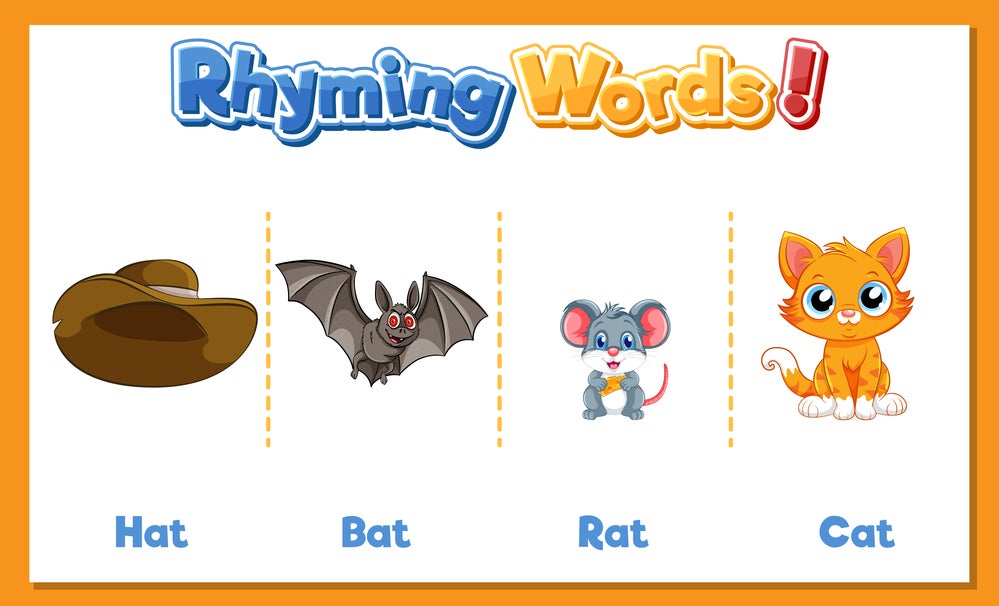
Rhyming words for kindergartners are two or more words that share the same ending sound. In a more technical sense, they’re words whose final vowel sound and all the sounds that follow are identical.
For example, in the words bat and mat, the final /a/ and /t/ sounds are the same. The first sound is different, but the final syllable is a perfect match. In fact, bat and mat are members of a long list of words called perfect rhymes that are pleasing to the ear and helpful for learning.
Understanding what makes these and other words rhyme is part of the foundation of becoming a better reader and speller.
To make things easier, rhyming words are organized into word families based on their shared ending. For example, the “-op” family includes words like top, mop, and hop. The words don’t have to be spelled the same, but the sound must be nearly identical (think blue and through).
Why Rhyming Words Matter

Why do rhyming words for kindergartners matter? Because they’re a fundamental building block of literacy that help young children more easily master language.
Perhaps most importantly, rhyming words help kids improve their phonological awareness. This is a key skill that lets your young learner recognize, and eventually manipulate, the different sounds within each word.
Rhyming also strengthens your child’s ability to predict and decode new words. For example, when they learn the word cake and then see the word bake, they can use their knowledge of rhyme to quickly figure out how to say the new word.
Strong phonological awareness and predicting and decoding skills allow kids to become much faster, more confident readers, which naturally helps build vocabulary and fluency. Reading becomes less of a struggle and allows your child to focus on the story instead of just the words.
Finally, rhyming is just plain fun! Using songs, silly poems, or simple games turns learning into an enjoyable activity that keeps your child engaged and motivated to learn and read more.
Easy Rhyming Words for Kindergarten
When introducing rhyming words to your child, start with one-syllable, short-vowel words that follow the CVC (consonant-vowel-consonant) pattern. This helps them more easily see and hear the repeating pattern.
Here are some examples of easy rhyming words for kindergartners.
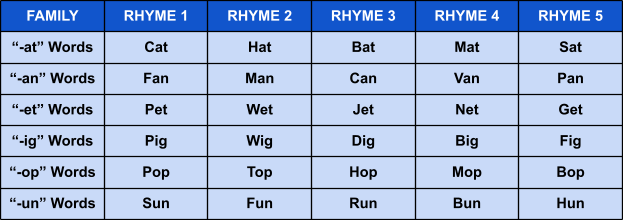
Read books that include these simple rhymes and try to use them when you talk to your child.
More Challenging Rhyming Words for Kindergarten
Once your child masters the easy words, you can introduce them to more challenging rhymes that incorporate consonant blends, digraphs, and two-syllable words.
Here are some examples of more challenging rhyming words for kindergartners.
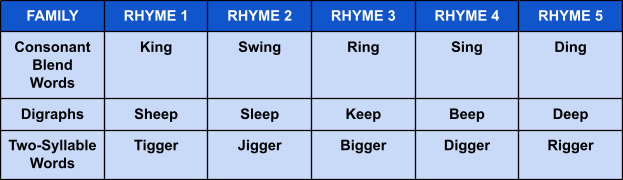
Though these examples are more advanced, they teach your child that rhyming is about matching the ending sound that each word makes.
Tips for Using These Lists to Teach Rhyming Words
Keep Learning Fun
The most effective way to teach rhyming is to make the process fun and engaging. Learning shouldn’t feel like a chore. It should feel like a game!
Do your best to engage in activities and play games with your child that incorporate basic rhyming. We’ll introduce some options in the next section. And, whenever you rhyme with your child, smile, laugh, and act silly so they feel a sense of joy about the process.
Work Rhymes into Your Day
Whenever your child is around, work rhymes into everything you say. You don’t even have to be talking directly to them. Just them hearing you use rhyming words (when talking to yourself, for example) helps to reinforce the concept in their young brain.
For example, instead of saying, “Let’s go outside and play,” you could say, “Let’s go outside and have fun in the sun!” When you use a recipe from a cookbook to make lunch, you could say, “I’m going to use my book to cook!”
Read Lots of Rhyming Books
Throughout it all, read lots of rhyming books, such as Green Eggs and Ham by Dr. Seuss, Goodnight Moon by Margaret Wise Brown, Llama Llama Red Pajama by Anna Dewdney, and Giraffes Can’t Dance by Giles Andreae.
Books like these expose your child to the rhythm and patterns of language, and you may even find that they can help kids develop the ability to naturally predict the next rhyming word. This is how you can tell that your child is building a strong foundation for literacy.
Engaging Activities to Teach Rhyming
To keep learning fun, use a variety of engaging activities that move beyond simple repetition and rote memorization. Here are some examples.
Rhyming Bingo
Make or purchase small bingo boards (3×2 or 3×3) that feature short words from the easy rhyming words table earlier in this article. To make it even more fun, include pictures of the words for easy identification.
If you’re making your own game, you’ll also need to create individual cards that match the words and pictures you’ve used on the larger bingo board.
To play, mix up the single cards and place them face down on the floor or table. Take turns drawing a card from the pile. If it matches, place the card on your bingo board. The first player to cover their entire board and call out “BINGO!” wins.
Hopscotch with Rhyming Words
Make or draw a hopscotch board with words instead of numbers. Mix it up and include words from two of the Families in the Easy Rhyming Words for Kindergartners section earlier in this article.
For example, if you choose the “-at” and “-op” families, your board might look something like this:
Take turns hopping only on the “-at” words. For an extra challenge, place the rhyming words farther apart.
Creative Arts
Pick two rhyming words and ask your child to draw a picture of those two things. For example, have them draw a picture of a mouse in a house, a jet in a net, or a bat in a hat. For more advanced learners, you can help them make a rhyming book of their very own!
Bring the Magic of Rhyming Home for Your Kindergartner
Helping kindergartners master rhyming words is an essential step in their educational journey. Rhymes provide a fun and effective foundation for literacy by enhancing phonological awareness, aiding in word prediction, and building vocabulary.
To support this crucial learning phase, Begin offers the HOMER app, which is specifically designed to make mastering word families and building phonological awareness enjoyable and successful for young learners.
Using these resources helps ensure that your kindergartner develops the strong literary foundation they need for future academic success.
Frequently Asked Questions
How can I tell if my child is ready to learn about rhyming words?
You can often tell your child is ready to learn about rhyming words when they start to enjoy wordplay, songs, and poems. If your kindergartner can clap along to a beat or loves repeating silly sounds, they are showing the attention and skills needed for rhyming.
Should I try to introduce near rhymes to my kindergartner?
At this early age, it’s best to avoid near rhymes (like bait and paid) so you don’t confuse your child. Instead, stay with perfect rhymes (those with the exact same vowel and consonant sounds, like fox and box) when they’re first learning.
Similarly, avoid confusing your child with heteronyms. These are words that look like they should rhyme but don’t (like move and love).
Sticking to simple, clear-sounding rhymes helps your young learner master the concept of rhyming without getting frustrated by tricky spelling or subtle sound differences.
Is it OK if my kindergartner doesn’t understand rhyming right away?
Absolutely! Rhyming is a developmental skill that takes time and practice to master. If your child is struggling, they are likely still developing the skill of isolating the sounds in a word.
Instead of forcing them to say the rhyme, try playing games where they only have to listen and tell you which two words sound the same. Making it a fun, low-pressure game of listening helps build the skill without the stress of feeling like they’re being tested.