
You know those lightbulb moments? The ones when you cross the threshold from not understanding something to the pieces falling into place? Decodable books set your child up for those kinds of bright moments!
Decodable books are carefully crafted books designed to help your child learn how to blend and segment sounds. Using them over time builds phonics skills, vocabulary, reading fluency, comprehension, and confidence.
In this article, we’ll dive more into what these books are, why they’re important, and tips for supporting your child as they use them.
Key Takeaways
- Decoding in reading means translating the written word into the matching spoken word.
- Decodable books are written specifically for beginning readers to help them practice letter-sound matching.
- Decodable books help kids gain reading fluency, which builds their confidence, literacy skills, and enjoyment of reading.
- Some ideas for supporting your child’s reading at home include creating a reading ritual, keeping decodable books at home, reading together, praising your child’s efforts, making the stories relevant to your child’s life, and monitoring their progress.
Table of Contents
- What Is Decoding in Reading?
- What Are Decodable Books?
- Why Decodable Books Are Important
- Tips for Helping Your Child Use Decodable Books
What Is Decoding in Reading?

Think about a typical spy movie. The secret agent gets a message written in code that they need to translate into a familiar language. Decoding in reading is the same thing: translating the written word into the matching spoken word.
Just like the cinematic spy has to discover the rules of the code, a reader has to learn how to pull apart a word into its distinct sounds to understand how to say it. For example, they see the word cat and need to separate it into three sounds: /k/ /a/ /t/.
Once the reader takes the word apart, they can put it back together by blending the individual sounds. Ideally, it’s a smooth process. They see a word, pronounce each separate sound, and then say the sounds together to remake the word.
The Importance of Decoding
Decoding helps kids read more fluently. It improves their reading comprehension, spelling, vocabulary, and reading speed. Once a child has these vital tools, they can use them with any book they’re reading.
And when they do that as they begin to read on their own, their confidence grows!
What Are Decodable Books?

Are all books decodable? Yes and no. All books can technically be read and understood, but only if the reader has the skills to meet a book’s complexity.
Decodable books are designed to build those skills. The purpose of decodable books is to give kids practice using phonics skills to help them become more fluent and confident readers.
Decodable Text vs. Predictable Text
Decodable texts and predictable texts are not the same thing. Decodable texts gradually and systematically introduce specific sound and letter patterns, while predictable texts are written for specific skill levels and rely on repetition, rhyme, and illustrations to help readers.
Predictable texts rely on contextual clues and guessing. That reading method can be tough for some kids and slow down their ability to learn. Decodable texts focus on the ways sounds and letters create words. They give kids a successful launching pad.
Here’s a table showing the differences between decodable and predictable text:
| Decodable Text Zac the Rat by the Starfall Team | Predictable Text I Went Walking by Sue Williams |
| Zac is a rat. Zac sat on a can. The ants ran to the jam. Zac had a pan. Zac had a fan. The ants ran and ran. Zac had a nap. | I went walking. What did you see? I saw a black cat looking at me. I went walking. What did you see? I saw a brown horse looking at me. I went walking… |
| vowel: short vowel /a/ | vowel: short, long, and diphthong |
| letter-sound matching: z, c, r, t, s, n, j, m, p, f | letter-sound matching: nt, lk, ng, bl, br, ow, rs(silent)e |
| single syllable; three-letter words; (simple CVC structure) | single and double syllable; one-, three-, four-, five-, seven-letter words |
The above decodable text gives a child an opportunity to practice the short /a/ sound, using a variety of consonants, while the predictable text relies on both the illustrations (for the color and animal words) and memorization for the refrain (“I went walking. What did you see?”).
Why Are Decodable Books Important?
The words in each book are decodable based on the phonics patterns children have learned so far. The earliest decodable books often focus on short vowel sounds and simple CVC words (like cat, bed, hop, run).
As instruction progresses, decodable books expand beyond CVC words to include:
- CVCC / CCVC words (hand, stop, flag)
- Digraphs (ship, thin, chat)
- Long vowel patterns (cake, seed, boat)
- R-controlled vowels (car, bird, fork)
- Complex vowel teams (train, cloud, boat)
This practice helps them gain fluency and build a sense of confidence (and hopefully lots of enjoyment!) in reading.
Tips for Helping Your Child Use Decodable Books

1) Establish a Reading Routine
Try to incorporate reading into your child’s daily life. Is there a natural time in their day to dedicate to it?
Your child may have high energy first thing in the morning. They could read in the kitchen when you’re making breakfast. Or maybe wrapping up the day with a book works best for you both.
2) Create a Positive “Decodable Reading” Environment in Your Home
One of the best ways to encourage decodable reading is to have decodable books in your home. Lots of them! Place the books within easy reach so your child can grab a book whenever they want.
You can even custom-make your own decodable books:
- Staple, sew, or simply stack and fold three pieces of paper to make a six-page book.
- Pick a sound your child is working on (like /a/).
- Choose a topic relevant to your child (e.g., cats).
- Write one sentence per page using variations on the sound. For example:
- My cat ran.
- My cat ran and ran and ran.
- My cat sat at a fan.
- The fan was on a mat.
- My cat had a nap on the mat.
- Add illustrations if you want, or ask your child to draw them!
You can take advantage of technology, too! Some reading websites provide decodable story generators. You plug in details like the specific sounds your child is working on, custom words, and the length of the story, and these tools create stories for you.
3) Read Together
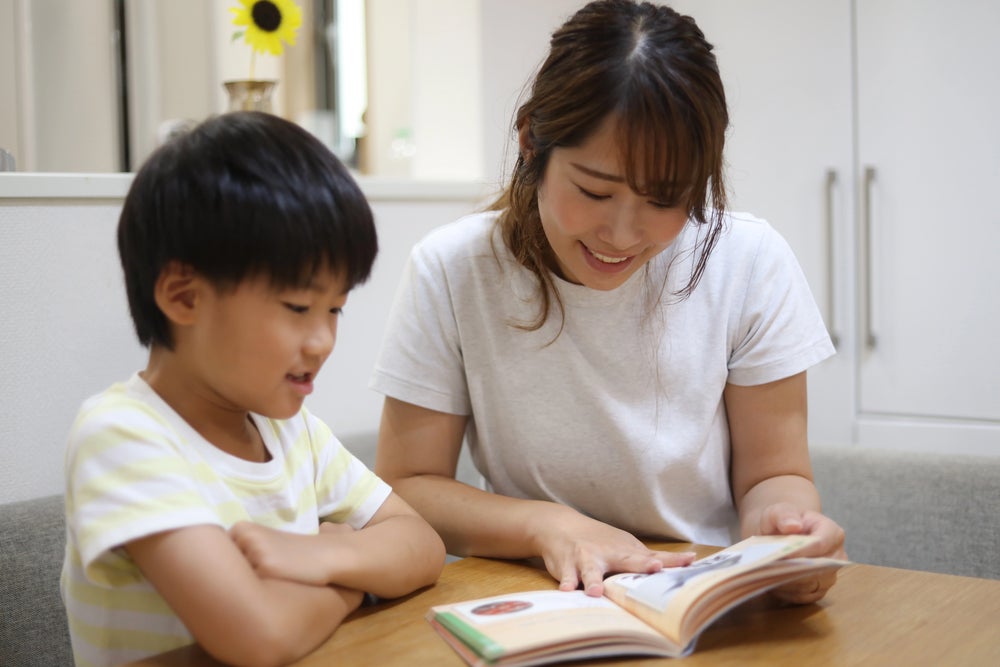
As your child reads, encourage them to point out words they don’t understand so you can support them in the decoding process. Remind them to use the phonics skills they already know. You could also have an alphabet chart printout on hand for easy reference.
4) Praise your child for effort
In addition to being a support, you can also be a cheerleader!
Make a point of giving your child a shout-out when you see them using sounds they know to decode new words. Remind them of how far they’ve come in their reading process. Celebrate if you see them use their phonics and reading tools when they get stuck on something.
And always praise your child for trying. Reading is a complicated skill to learn!
5) Take the Story off the Page
If your child feels connected to the stories they’re reading, they’ll be both more interested in them and more apt to retain the information they read. Asking open-ended questions is a great way to get kids involved with a book’s content.
Ask your child to explain a plot point in the story or guess the reason a character made a specific choice. From there, you can expand your conversation to include your child’s experiences. You could ask, “Would you make the same choice? When have you felt this way?”
6) Monitor Progress
Keep an eye and ear out on how your child is progressing with their reading.
If they seem to be struggling, make sure the book’s phonics level matches your child’s skill level. If it doesn’t, try some easier books. If you notice they’re only stuck on a specific set of sounds, you can point out the tricky words before they read or even read the book to them first.
Finally, if they’re cruising through the books they’re reading, try giving them more advanced stories with a wider range of spelling patterns and vocabulary.
Crack the Code with Begin

We all want our kids to fall in love with reading. Books open up worlds for them. But for your child’s love to bloom, they need a strong understanding of the basic building block of reading: how sounds blend to create words.
Decodable books are an important part of that foundational learning. Technology that focuses on essential reading skills is, too. The HOMER App by Begin offers personalized lessons, games, and activities to help your child learn to read.
The app also includes a parent dashboard where you can check on your child’s progress and receive ideas for supporting their reading. Let the reading fun begin!
Frequently Asked Questions
What’s the difference between a decodable text and a leveled text?
A decodable text gradually and systematically introduces specific sound and letter patterns. A leveled text is any text labeled with a difficulty level based on word count, sentence length, and word choice.
When kids enter kindergarten, their teacher often tracks their reading level by regularly using literacy assessments. If this is true for your child, you can ask their teacher about their level and supplement classroom learning by having similar books in your home.
How many times should my child read a particular decodable text?
Ideally, your child should read a specific decodable text (or any text, for that matter!) three times. Once for decoding, a second time for fluency, and a final third time for comprehension.
What’s the difference between memorizing and mapping a text?
When your child memorizes a word, they’re learning it as a whole unit, rather than understanding each of its individual parts. This often leads to confusion with similar-looking words, like house and horse.
But when your child maps a word, they’re learning that the word is made of individual sound-letter components and mapping those patterns in their brain.