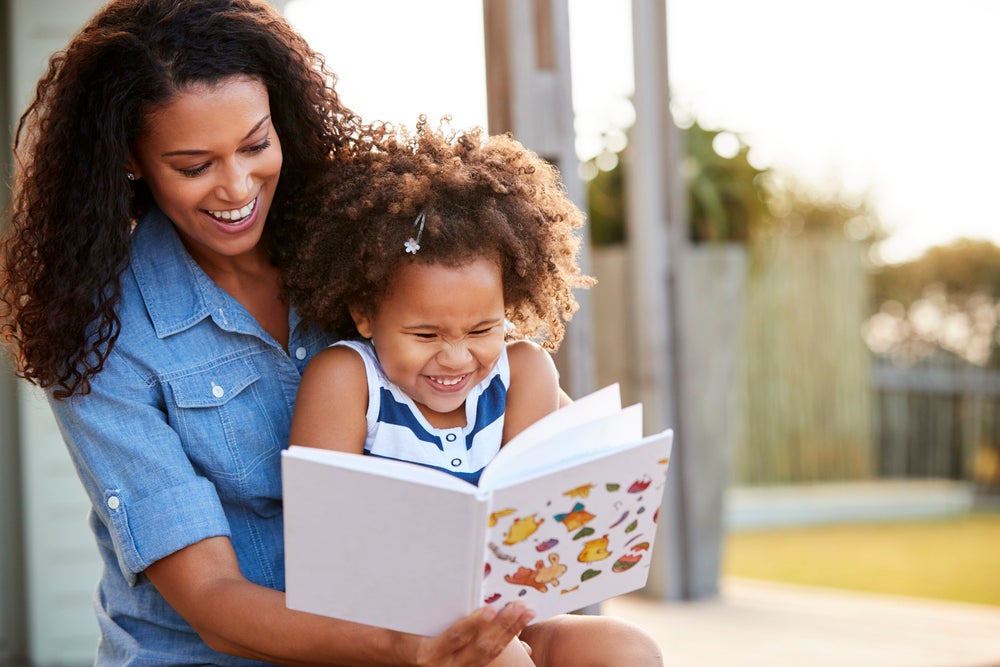
You may have seen the studies: reading to your child is so good for them! In fact, children who are read to at least three times a week are more likely to recognize letters of the alphabet, count to 20, write their names, and even read when they get to kindergarten.
It’s never too early to read to your child. But even better? Reading with your child. Dialogic reading is an interactive experience where your child is just as much the reader of the story as you are.
Dialogic reading builds kids’ vocabulary and strengthens the building blocks they need for reading comprehension. It’s also fun to do! In this article, we explore dialogic reading and share some tools you can use to enjoy it with your child.
Key Takeaways
- Dialogic reading is part of communication and content, two of the research-based 6Cs that inspire the Begin Approach to helping kids thrive in school and life.
- Dialogic reading is an interactive reading experience that makes your child the primary teller of a story.
- Dialogic reading improves vocabulary, language skills, and reading comprehension.
- Dialogic reading involves inviting your child to recite text; asking them questions about plot, characters, and illustrations; and engaging in conversation about how the story relates to them.
Table of Contents
- What Is Dialogic Reading?
- Why Dialogic Reading Is Important
- Making the Shift to Dialogic Reading
- Dialogic Reading Prompts
What Is Dialogic Reading?

Dialogic reading is a conversational read-aloud activity between an adult and a child. It’s a natural (and fun!) way to engage with your child about a story. With your guidance and prompting, your child becomes an active participant in the story, noticing details, exploring emotional content, giving insights, making connections to the characters, and more.
The basic reading technique at the heart of dialogic reading is the PEER sequence:
- Prompt the child to say something about the book.
- Evaluate the child’s response.
- Expand the response by rephrasing and adding information.
- Repeat the prompt to make sure the child has learned something.
What does this look like in action? Let’s say you’re reading a book about a duck. . You might follow the PEER sequence like this:
- You prompt your child first by pointing to a duck in a picture and asking, “What is this?”
- When your child says, “A duck,” you evaluate their answer: “Yes, that’s correct. That’s a duck.”
- Then you expand on their response by adding more detail: “It’s a white duck, and it says ‘quack.’”
- You repeat the prompt by asking, “What does the duck say?” to reinforce the new vocabulary and support your child in saying, “The duck says ‘quack.’”
Why Dialogic Reading Is Important
We know kids learn best when they’re actively involved in something. The dialogic reading approach to literacy education is a perfect example of this.
Engaging in a serve-and-return kind of conversation during reading improves print awareness, vocabulary, oral language skills, and reading comprehension. It’s a fun and dynamic way to build literacy skills.
What’s more, studies show that dialogic reading builds vocabulary skills that benefit behavior and social interaction. When a child can communicate and make themselves understood, they are less likely to act out and more likely to establish and maintain relationships.
Making the Shift to Dialogic Reading
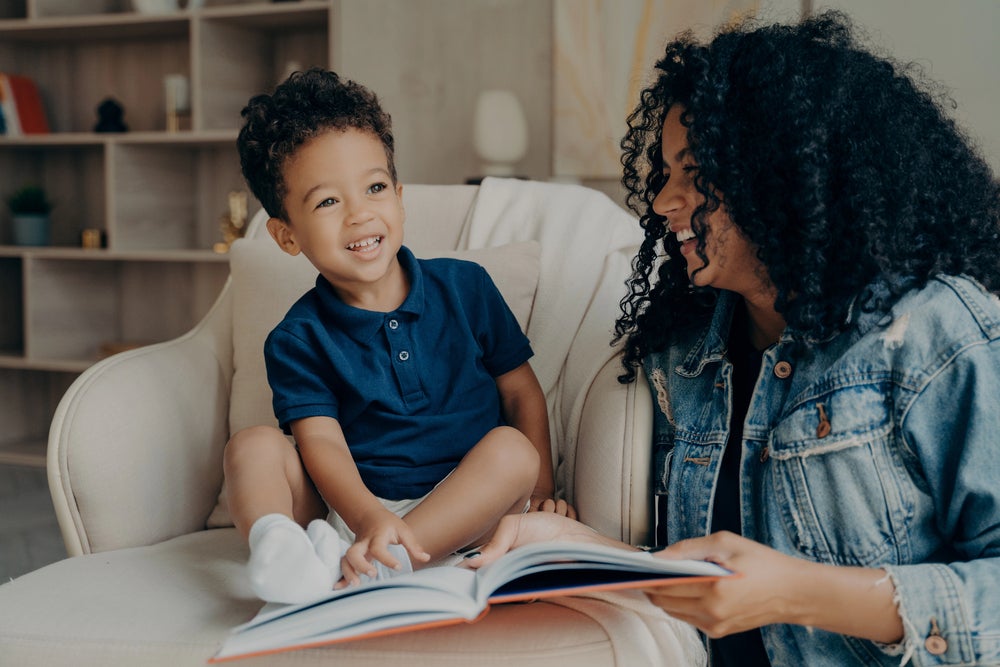
First and foremost, dialogic reading is all about creating a dialogue based on what’s on the page. Here are a few ideas to try:
- Repeat words your child says while reading (They look at an illustration and say “bear,” and you say, “Yes, that’s a bear!”)
- Offer new descriptive words (“The bear is brown.”)
- Add information (“The bear is grumpy because the bird woke him up.”)
- Connect to your child’s world (“Remember how you didn’t like it when I woke you up?”)
- Pinpoint differences (“The bear looks angry on this page, but here he looks happy.”)
- Ask open-ended questions (“Why do you think the bear looks so sleepy?” or “What do you think will happen next?”)
Dialogic Reading Prompts

CROWD describes the types of prompts you can use during PEER interactions, like those described above. These prompts help keep conversations rich, varied, and cognitively engaging.
There are five kinds of prompts you can incorporate as part of the PEER method: completion, recall, open-ended, wh- questions, and distancing (together known as CROWD).
It’s important to first read a new book all the way through without interruption so your child can enjoy the story and get familiar with it. Then, during the second or third reading, begin using one or more of these prompts on each page to deepen understanding and encourage conversation.
Each time you read the book using the PEER method, your child will do more of the reading and storytelling.
1) Completion Prompts
You leave a blank at the end of a sentence or stanza, and your child fills it in. This technique is often used with books that lean heavily on rhyme. Completion prompts help your child begin to understand the structure of language.
Example
You might start reading Dr. Seuss’s The Cat in the Hat, which begins with this stanza: “The sun did not shine. / It was too wet to play. / So we sat in the house / All that cold, cold, wet __.”
When you get to that last word, stop reading and wait for your child to fill in the blank.
2) Recall Prompts
Use recall prompts at any point in the story. Ask questions about something on a page you’ve just read, or ask predictive questions about something that’s coming later.
Recall prompts are a great way to help your child understand plot and event sequencing.
Example
Here’s another example from The Cat in the Hat. You’re at the place where the cat picks up the fish. Before you turn the page, ask something like, “What does the cat stand on when he is holding the fish?”
Your child might answer the question before you turn the page. And if they don’t, you can turn it and give them time to look at the illustration and then answer.
3) Open-Ended Prompts
Illustrations are an integral part of a picture book. Open-ended prompts can focus on these visual elements. Rich in detail, they are a jumping-off point for your child’s imagination. Open-ended prompts help kids get better at expressing themselves.
Example
You’re almost at the end of The Cat in the Hat. The cat comes back into the house after making a mess, and he’s riding the cleaning machine.
You might say, “Look at the cat’s cleaning machine! What do you see on it? What is that cat doing?”
4) Wh- Prompts
Wh- prompts also focus on illustrations and consist of “wh” question starters: what, where, when, and why. (And an additional “how” question, too!) This dialogic reading prompt can help teach your child new vocabulary.
Example
When the kids in The Cat in the Hat capture Thing 1 and Thing 2 in their net, the cat looks sad. While you and your child look at this illustration, you could ask, “Why is the cat sad? What did he do with Thing 1 and Thing 2?”
5) Distancing Prompts
Finally, distancing prompts help your child bridge the distance between the story in the book and real life. They often lead to lively and important conversations. They help your child build fluency, comprehension, and narrative skills and tap into empathy.
Example
The Cat in the Hat is an excellent example of this kind of prompt because it’s built right into the story. The final text reads, “Should we tell her about it? Now what should we do? Well…what would you do if your mother asked you?”
This is a perfect launching point for all kinds of questions you can ask your child: What do you do when you’re bored? Do you remember making a mess like the cat did? Has it ever been hard to tell the truth?
Begin Can Be Part of the Conversation

Kids love dialogic reading. It brings a story to life and brings your child’s life into a story! It makes literacy learning collaborative, meaningful, and fun.
Our HOMER app is a perfect reading companion. It can help your child gain the skills and confidence to become a successful reader. And storyteller!
Frequently Asked Questions
What if my child’s favorite books don’t have the ideal characteristics for dialogic reading?
Books with lyrical texts, rich illustrations, and dynamic plots are great for a shared reading experience. That said, virtually any book can offer a worthwhile dialogic reading experience. Your child just needs to be interested in the book.
Isn’t dialogic reading what I naturally do with my child when I read to them?
Dialogic reading has its roots in the experience of reading aloud with your child. Exploring illustrations, asking questions, and encouraging interruptions are probably second nature to you.
Dialogic reading just takes those elements a little further. It’s a more structured set of methods that are proven to teach very specific literacy skills.
Can I use the dialogic reading process with a wordless picture book?
Absolutely! Wordless picture books work well for creating a collaborative storytelling experience. You and your child can imagine the text that might go with the illustrations.
What can I do if my child resists dialogic reading practice?
If your child is resistant to trying dialogic reading, try letting them pick the books you read together. If a book captivates them, they’re more likely to become engaged in dialogic reading with it.