
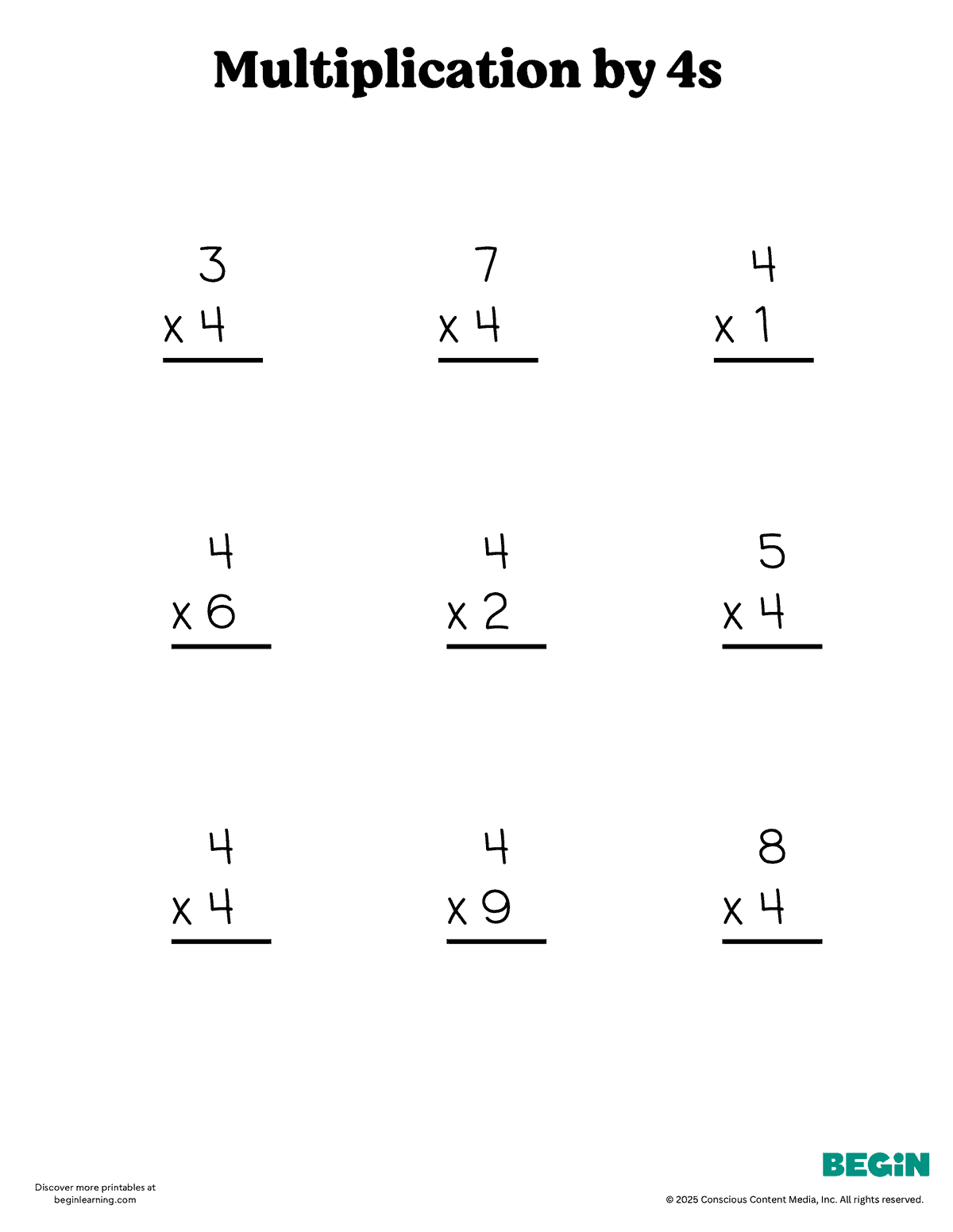
This free multiplication by 4 worksheet gives your child focused practice with one set of facts at a time. The page presents 9 vertical problems in a 3×3 grid, covering most of the 4 times table in a single session. The focus number appears in both the top and bottom positions across the set, so your child learns to recognize each fact regardless of the order it’s written in.
The vertical format matches what your child will see on classroom worksheets and tests, so they’re building familiarity with the layout and the facts at the same time. Print the PDF, grab a pencil, and let them work through it at their own pace.
Multiplication By 4 Practice Sheets – Free PDF Printables
Frequently Asked Questions (FAQs)
What does this multiplication by 4 worksheet include?
This free printable PDF has 9 vertical multiplication problems featuring 4 as the focus number. Problems are arranged in a 3×3 grid with space to write answers clearly, and 4 appears in both the top and bottom position so your child practices each fact in both directions.
What grade do kids learn multiplication by 4?
Most kids start learning multiplication in second or third grade, with the goal of memorizing all facts through 10 by the end of third grade. The exact timing depends on your child’s school and curriculum, but if they’re being introduced to times tables in class, this multiplication by 4 worksheet lines up with what they’re working on.
How many facts are in the 4 times table?
There are 11 facts in the 4 times table, covering 4 x 0 through 4 x 10. This worksheet pulls 9 of those facts into a single page so your child can work through most of the set in one focused session.
When is my child ready for a multiplication by 4 worksheet?
If your child understands what multiplication means and is working on times tables in class, they’re ready. They don’t need the 4s memorized first, that’s what the practice is for. If they’re brand new to multiplication overall, starting with an earlier multiplier can help build confidence before moving to 4.
How long should my child practice the 4 times table?
One worksheet per session is usually enough. Most kids can finish a page in 5 to 10 minutes, and short focused sessions tend to stick better than long ones. If your child finishes quickly and wants to keep going, printing the same page again and timing a second attempt builds speed without introducing new material too soon.
How do I know when my child has mastered the 4 times table?
When they can finish the worksheet accurately without counting on their fingers or pausing for long stretches, they’re ready to move on. Accuracy matters more than speed at this stage. If they’re still making frequent errors, another session or two on the 4s will make the next multiplier easier.
What is the best order to learn multiplication tables?
Most teachers recommend starting with 0, 1, 2, 5, and 10 because those facts follow simple patterns. From there, 3, 4, and 9 are common next steps, followed by 6, 7, and 8, which tend to be the trickiest. There’s no single right sequence though, if your child is motivated to work on a specific number, that motivation is worth more than following a set order.
How is this multiplication by 4 worksheet different from mixed multiplication practice?
Mixed practice tests what your child already knows across multiple times tables at once. This worksheet builds fluency with 4 specifically through focused repetition. Once the 4s are consistent, mixed practice is a great next step to make sure they can recall facts out of order and not just in sequence.

Want to support your child’s early literacy, math skills, and creativity?
Try HOMER free for 30 days