In 2nd grade math class, your child will continue to build the basic math skills they learned in kindergarten and 1st grade. They’ll dive deeper into place value, addition, and subtraction. They’ll also explore time, money, measurement, and basic geometric principles.
While these may seem like simple concepts, they provide the foundation for more complex math skills in the years to come.
Key Takeaways
- Second grade math skills are part of content, one of the 6Cs* that inspires the Begin Approach to helping kids thrive in school and life.
- In 2nd grade math, kids learn place value, addition and subtraction, data and probability, geometry, measurements, telling time, and money value.
- You can help your 2nd grader practice their math skills at home by engaging in simple learning activities that are fun and engaging.
- Some activities include guessing games like “I’m Thinking of a Number,” card games like “Flip to 100,” and role-playing games like “Come to My Store.”
Table Of Contents
2nd Grade Math Skills
In 1st grade, your child learned many basic math principles. They learned how to count, add, and subtract within 20, identify shapes, and tell time by the hour. This year, your child will take all those skills to the next level.
Here’s a closer look at some critical math skills covered this year.
Place Value
Last year, your child learned about the tens and ones places. For example, they discovered that it takes two tens and three ones to make the number 23.
This year, your child will extend their knowledge of place value to the thousands place. They’ll be asked to compare two three-digit numbers to see which one is bigger.
They’ll also need to write numbers up to 1000 using words, numerals, and expanded form. Here’s an example with the number 947:
- Nine hundred forty-seven
- 947
- 900 + 40 + 7
Addition and Subtraction
By the end of 2nd grade, your child will have learned how to add and subtract numbers up to 100 using a variety of strategies. They’ll also be expected to have memorized some math facts.
Second graders also practice addition and subtraction facts in story problems. They’ll learn to solve two-step word problems like this: “Tristan has 7 apples in his basket and picks 4 more. After that, he gives away 5 apples to his friend. How many apples does he have left? He has 6 left: 7+4=11, 11-5=6.”
Your child’s teacher will introduce them to regrouping, also known as borrowing and carrying, for subtraction.
Data and Probability
In 2nd grade, your child will work on drawing and interpreting data from pictographs and bar graphs. They’ll make line plots to show how often a piece of data occurs (how many crayons students in a classroom lost one week, for example) and solve simple problems using the data.
Second graders also study basic probability concepts, such as the terms “likely,” “unlikely,” “possible,” and “impossible.” They may also experiment with spinners or dice to create and compare probabilities.
Geometry and Fractions
By 2nd grade, your child may already know a lot about basic geometric shapes. This year, they’ll learn about quadrilaterals, pentagons, hexagons, and cubes. They’ll count angles and faces and practice drawing 2D and 3D shapes.
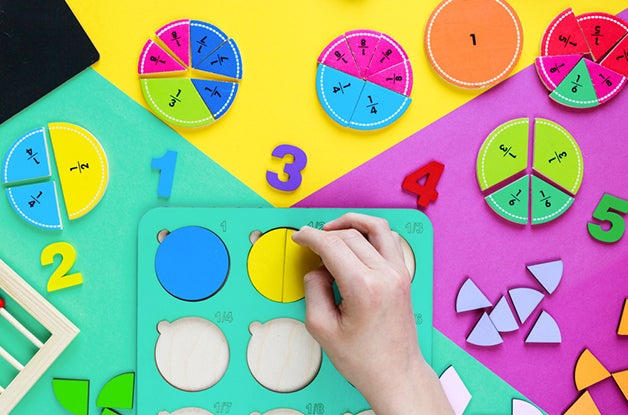
Fractions are another skill covered in 2nd grade. Your child will divide circles and rectangles into halves, thirds, and fourths.
Measurements
Your child learns about the concept of measurements in 2nd grade. They’ll estimate lengths and measure objects using different units like inches, feet, yards, centimeters, and millimeters.
Comparison skills are highlighted in 2nd grade, too. Your child will compare the lengths of objects and use addition and subtraction to figure out how much shorter one object is than the other.
Practice with standard measuring tools (such as rulers, scales, and thermometers) also happens in 2nd grade.
Telling Time
Your child began learning about telling time in 1st grade and continues in 2nd grade. They’ll discover how to tell time to the quarter hour, then to the nearest five minutes, and the difference between AM and PM.
They may learn how to combine time-telling concepts with addition and subtraction, too. For example, if a child needs to leave for school at 8:00 a.m. and it’s currently 7:45 a.m., how much time do they have before they leave?
Money Value
In 2nd grade, your child learns how to identify dollar bills, quarters, dimes, nickels, and pennies. They’ll practice solving word problems that include currency, and they’ll also begin to grasp the idea of making change.
For instance, if something costs $5 and they only have a $10 bill, how much change will they get back?
Learning Activities to Reinforce 2nd Grade Math Skills
Now that you know what to expect from 2nd grade math, let’s talk about some fun ways to help your child practice these skills at home.
These math games and activities are:
- Simple to learn
- Fun and engaging
- Focused on one primary math skill
Best of all, most don’t require any special materials, so you can start playing immediately. Let’s have some fun!
1) I’m Thinking of a Number
If you have a few minutes of downtime, you can play a round or two of this quick number game.
What You’ll Need:
- At least two players
What to Do:
One person starts by thinking of a three-digit number. Once you have one, say, “I’m thinking of a number that…” Then give your child a clue to help them narrow it down.
Here are a few suggestions:
- Has a (specific number) in the ones place
- Is bigger than 200
- Doesn’t have a 2 in it
- Is even
Ask them to guess what number you’re thinking of. If they don’t get it right, tell them if their guess was bigger or smaller than your number.
You can give them additional clues as they try to guess your number. After they get it, have them pick a number for you to guess.
2) Make Me a Pizza
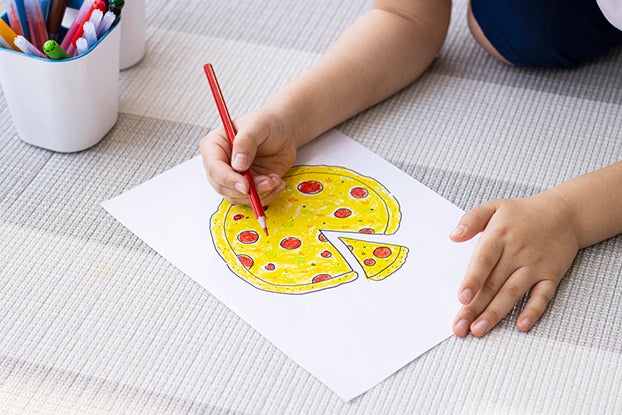
If your child enjoys pretend play, they’ll have fun with this fraction activity!
What You’ll Need:
- Drawing paper
- A pencil
- Crayons or colored pencils
- Something round to trace (like a Tupperware lid or a small plate)
What to Do:
Show your child how to trace the round object to make a circle on the paper. Then, ask them to listen carefully to your pizza order so they can deliver just what you want.
Pretend to call and place a pizza order. Use specific, fraction-based directions, such as “I’d like a pizza that…”
- Has ¼ plain cheese, ¼ pepperoni, and ½ sausage and mushroom
- Is half pepperoni and half cheese
- Is cut into four equal pieces, with exactly five pieces of pepperoni on each one
- Has anchovies on only ⅓ of your pepperoni pizza
Once you place your “order,” ask your child to draw lines to divide the pizza into the correct number of slices.
Then, have them use the coloring supplies to decorate each piece to match your order. When they deliver it to you, if it’s incorrect talk through how to fix the order and guide them to do so.
If desired, you can switch places and take a turn as the chef. That way, your child gets a chance to order.
3) Big Number, Small Number
Help your child compare numbers using the principles of place value with this simple activity.
What You’ll Need:
- 10 index cards
- A permanent marker
- A bag to keep the cards in when you’re done playing
What to Do:
With the marker, write a numeral 0-9 on each index card.
Shuffle the cards and randomly select three to give to your child. Ask them to make the biggest number possible. Then, have them make the smallest number they can.
Here’s an example:
- Your child gets the numerals 4, 9, 2
- The biggest number they can make is 942
- The smallest number they can make is 249
If they get them right, hand them three different numbers. If they need help, ask them to start with the hundreds place and decide which of their numbers is the biggest (or smallest). That one goes first. Then, they can do the tens place. The final number goes in the ones place.
After a few rounds, hand your child all the cards and ask them to make the biggest three-digit number they can (987). Finally, have them make the smallest one possible (102).
4) Flip to 100
Your child can practice their addition skills with a standard deck of playing cards.
What You’ll Need:
- A deck of playing cards with the face cards removed
- A piece of paper and a pencil for each player
What to Do:
For the first turn, ask each player to turn over one card and write the number at the top of their paper.
On each subsequent turn, players:
- Flip over one card
- Write the number below the previous one
- Add the two numbers to get a new running total
The first person to reach 100 without going over is the winner! If you get through all the cards and no one is at 100, the player with the highest number wins.
Here’s a fun variation:
Each player starts with 100. After flipping a card, they write down the value and subtract it from their current number. The person who gets the closest to 0 is the winner.
5) Shape Drawing
Help your child recognize the basic shapes in everyday objects with this hands-on drawing activity.
What You’ll Need:
- Paper
- Pencil
- Colored pencils or crayons (optional)
What to Do:
Challenge your child to draw different objects using only geometric shapes. Here are some ideas they can try:
- Castle
- Car
- House
- Tree
- Rocket ship
Encourage them to get creative and use a variety of shapes like circles, squares, triangles, rectangles, and ovals. For a harder challenge, see if they can work in some 3d shapes like cylinders or cubes.
They can also add details or color their drawing for extra fun.
After they’re done, see if they can name all the shapes they used. They can keep a tally of how many times they used each one and see which one they used the most (or least).
6) Come to My Store
This is a classic activity that taps into creativity, imagination, and math skills. It works well with a small group of people (like siblings), and it’s always fun to play!
What You’ll Need:
- Paper
- Index cards (or paper cut into smaller pieces)
- Pencils or pens
- Items (to “sell”)
- Coins and bills (real is best, but you can also use play money)
What to Do:
Ask your child to pick out a few items from their room or play area. Things like stuffed animals, balls, books, and blocks work well.
Place the items on a table, shelf, or just the floor, and price each one. Write the prices on index cards in front of each item. Choose one person to be the seller and one the buyer, and give each of them some money to start.
Then let your child’s imagination soar! As you “buy” and “sell” the items in the store, focus your child’s attention on the relationship between the written price of an item and the actual currency that equals. Take turns playing different roles.
If your child is learning how to add and subtract bills and coins, you can incorporate making change into your play.
7) Clock Art
Each number on an analogue clock face is actually two numbers. A “one” means one o’clock, but it also means five minutes after the hour, and so on. This art activity helps with learning how to tell time.
What You’ll Need:
- Two pieces of cardstock paper or two paper plates
- Markers
- Scissors
- Brass fastener
What to Do:
Cut out two circles (or just use the paper plates). Write the numbers one through 12 on the top circle, making sure they’re spaced at equal intervals. Then cut the numbers into flaps. (Cut three sides of a rectangle around each number.)
Create the clock hands next by cutting out a slim arrow and labeling it “minutes” and a wider one labeled “hours.” Place the top circle on the bottom one, stack the two arrows on top in the center, and attach all four parts with a brass fastener.
Finally, write the numbers five through 55 (the minute representations) under each corresponding flap. For instance, under number one, write five, under number two, write 10, and so on.
Your child can have fun making the clock and then practice telling time. Once you set the hands of the clock, they can guess the time and then check their answer by lifting the flap.
8) Measurement Hunt
A twist on a scavenger hunt, this version will have your child practicing with a ruler as they search for items that are just the right size!
What You’ll Need:
- Piece of paper
- Ruler or tape measure
- Pencil or pen
What to Do:
Before you start the game with your child, make a table on a piece of paper, with two columns and five rows. Then write a list of measurements in the first column, one per row, like: “six inches,” “nine inches,” and “one foot.”
Once you’re ready to begin, give your child the list, the pencil, and the ruler, and explain that they need to find one item for each measurement. When they find something, they mark it in the second vertical column.
Once your child finds something for each measurement, you can switch roles!
9) Mystery Shape Bag
Reinforce geometry shapes with this fun sensory game.
What You’ll Need:
- Paper bags
- Different shaped objects (a ball, a playing card, a block, etc.)
What to Do:
Place one object into each bag. Then, with their eyes closed, ask your child to reach into a bag, feel the object, and tell you its shape. You can also ask them to count its sides, reinforcing the connections between the shape, its name, and its number of sides.
10) 4 Corners
Help your child learn the probability concepts “likely,” “unlikely,” “possible,” and “impossible” with this on-your-feet game!
What You’ll Need:
- Paper
- Pen or pencil
What to Do:
Label each corner of the room with a different level of probability: “likely,” “unlikely,” “possible,” and “impossible.” You can use sticky notes or paper and tape to label corners.
Ask your child a series of probability questions like “What’s the chance it will rain today?” and “Will you have ice cream for dinner?” Have your child move to the corner that best reflects their opinion about the likelihood of the event happening.
Have fun asking outlandish questions as well as thought-provoking ones. The idea here is to give your child a chance to get comfortable with these probability terms. You can reverse roles, too, and your child can ask you the questions!
Build Math Skills with Begin
Here at Begin, we know how important 2nd grade math skills are. That’s why we built them into our age- and stage-based learning memberships. Your child will have so much fun while they’re learning. It really is screen time you can feel good about!
*The 6Cs Skills Framework is a science-backed framework designed by acclaimed developmental psychologists and learning scientists Dr. Kathy Hirsh-Pasek and Dr. Roberta Michnick Golinkoff (Becoming Brilliant, 2016).
Frequently Asked Questions
What math should my 2nd grader know by the end of the school year?
By the end of 2nd grade, your child will most likely know how to add and subtract big numbers, some foundations for multiplication, and be able to do some math in their head.
They may be able to measure in inches, feet, centimeters, and meters, as well as do money-math problems. And they may also begin to understand fractions and tell time.
Is there a big jump between 1st grade math and 2nd grade math?
There is a big jump from 1st to 2nd grade math, primarily because kids are moving from concrete math to math that’s more conceptual.
For example, kids can use their fingers for most of the math they do in 1st grade. When they add 5 and 8, they can see each number represented on their hand. But in 2nd grade, they’re dealing with place value and numbers greater than 10.
The “whys” of math start coming into play in 2nd grade, too. Instead of solving an equation and being done with it, kids often have to explain how they arrived there.
At this age, they also start connecting math with the real world more. For example, if they want a toy that’s $20 but they only have $8, they’ll be able to do math and discover that they’re $12 short.
How can I help my child understand word problems?
Word problems can be tricky to learn because the math operations are part of longer narratives. So, instead of your child seeing the equation 3+4 and solving it, they see “One chicken sat on 3 eggs and another chicken sat on 4 eggs. How many eggs are there in total?”
You can help your child by reminding them to read slowly. Suggest they circle the information they need to solve the equation, so they can more easily identify the math operation. Drawing the math problem can be helpful, too.