Counting, numbers, shapes, and plenty of beans—there’s a lot to learn in pre-K math. In fact, although many parents pay a lot of attention (rightly!) to reading, math skills at kindergarten entry are the strongest predictor of later academic success.
So Pre-K math skills are important. But which skills matter most, what order are they learned in, and how can you help your kids develop them? We’re here to help!
The Short Cut
- Pre-K math is a Core Skill, one of the 5 C’s at the heart of the Begin Approach to helping kids thrive in school and life
- In pre-K, kids learn numbers and counting, addition and subtraction, geometry and spatial reasoning, sorting and patterns, and the language of math
- Kids’ understanding of math begins with hands-on manipulation (e.g., counting beans) and moves through representation (counting pictures of beans) before becoming abstract (knowing 2+2=4)
- Parents can help kids learn pre-K math with fun hands-on activities like guessing games, dice games, and number races
Understanding what skills your child will be exposed to as a math beginner will give you an idea of what concepts you can emphasize in fun, easy ways at home!
Fortunately, kids start to learn many math concepts from a very young age. Putting puzzles together, sorting objects, and even playing with building blocks all help build a good foundation for math.
In this article, we’ll take you through the most important pre-K math concepts so you can encourage and motivate your budding mathematician!
What Are the Components of Pre-K Math?
There are five basic components of pre-K math. They act like umbrella terms, each with many different elements hidden inside their broad concepts.
Your child will become acquainted with all of these essential concepts when they begin learning pre-K math.
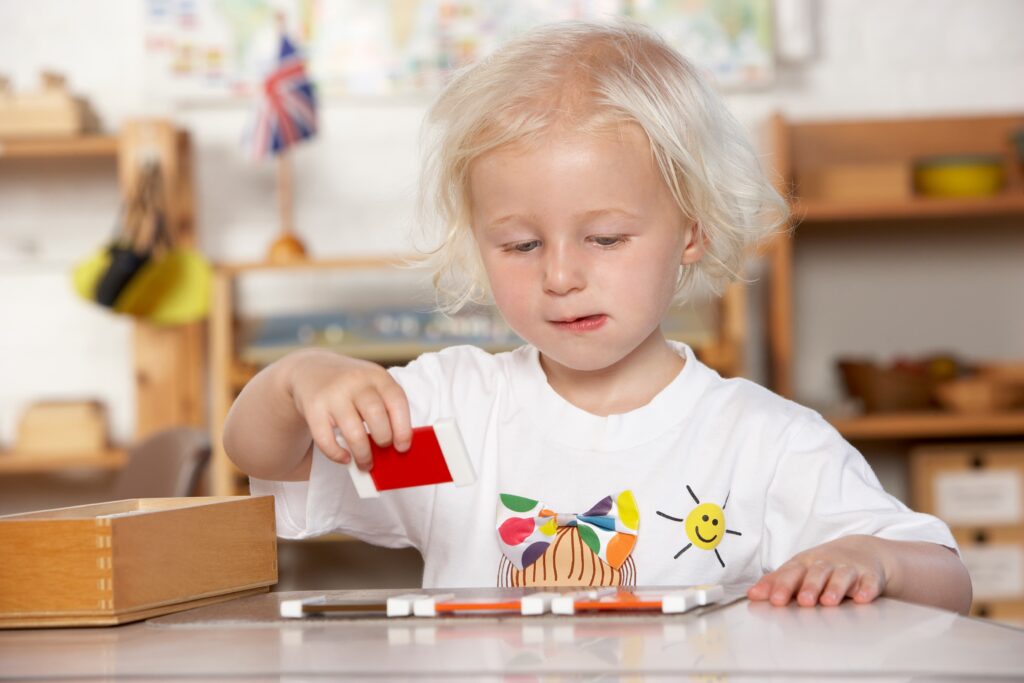
1. Numbers and Counting
Children typically start with the bedrock of math—numbers! They’ll learn number names and how to write numbers, typically beginning with 1–10.
Counting isn’t easy! While your child learns how to count—first with physical objects, then conceptually—they’re bound to make mistakes. This is perfectly all right. Counting will take time to master.
Most of kids’ initial math exposure will be through representational counting. This could mean counting the number of strawberries in their lunch box or how many blocks are on the floor. These simple counting activities create a strong foundation in math.
As they realize that numbers represent objects, your child will begin to understand one-to-one correspondence (each object counted gets its own number and only that number) as well as the counting principle that when counting the number of objects, the last number counted equals the amount present.
Over time, a child’s reliance on physical objects for counting will decrease. They’ll depend more on conceptual counting as their skills develop.
This conceptual counting is called “number sense.” They’ll understand that quantities, whether tangible or theoretical, are countable. They’ll also learn that numbers can be compared: two or more numbers can have a more-than, less-than, or same-as number relationship.
There are many fun ways to get your child comfortable with numbers and counting at home without making it feel burdensome.
Here are a few simple yet effective strategies you can try:
- Encourage your child to touch and count objects they see in everyday life—for example, a bunch of bananas or a stack of books
- After they count a set of objects, help them write down the corresponding number on a piece of paper
- Have your child compare different items using the appropriate language—for example, “Let’s count the number of blueberries and strawberries on the plate. Are there more strawberries than blueberries?”
- Hang a simple number line on the wall or tape one to your refrigerator. Throughout the day, point to each number with your child and count from 1–10 together.
- Ask your child to help set the table by counting out the right number of forks and spoons. Once they’ve collected them, they can count them again as they put one at each place setting.
These simple activities allow children to make sense of numbers. And the more they practice counting principles outside of the classroom, the more they’ll realize how relevant they are to everyday life.
2. Addition and Subtraction
Once your child has a firm grasp on counting and is developing number sense, they’ll explore the relationships between numbers more often. Describing how numbers are the same or different will lead into learning how to combine two numbers to make a new number!
Similar to the last concept, children will typically learn how to add and subtract by relying on counting activities with tangible objects. For example, you could set up two separate groups of apples and ask how many you will have if you join them together.
The first group may have three apples, while the second group has two apples. At first, many children will count one group and then start over to count the second group. It is a good idea to count both groups individually and then bring them together and count the total amount.
This is their first introduction to addition! The same idea works for subtracting. What happens when you begin with five apples and then take away two of them?
“Taking away” objects may be a little harder for your child to master at first. This is why many children will remove apples first and then count the remaining apples rather than counting backward.
To help, practice counting backward together. Pretend to be a rocket ship, and start counting down from five to one, gradually increasing the beginning number each time. After you get to one, shout, “Blastoff!” and jump into the air as high as you can. This fun game can help your child become more comfortable with counting down.
Pictures can also help your child master addition and subtraction concepts. For addition practice, present one sheet of paper with three apples and another with two. Then say, “Count the apples on both pieces of paper. How many apples do you have total?”
For subtraction problems, present this scenario: “On our paper, we have five apples total. How many apples will you see if I cover up two of them?” Then, count the remaining apples together.
Pictures are an effective way for your child to visualize mathematical problems. But, if you prefer not to draw, you can also use real objects instead. You could get out several apples (stuffed animals, cups, or whatever) and count them. Then, use those items for math practice.
Remember that adding and subtracting are basically making comparisons between numbers or establishing relationships between them. There are many strategies a child might use to solve a problem, which is a good thing since our main goal is to help children think mathematically.
3. Geometry and Spatial Reasoning
Shapes are everywhere in our world, which will be one of your greatest assets when it comes to teaching your child about shapes and spatial reasoning.
They’ll start out by learning about the basic 2-D shapes that are used in math: squares, triangles, circles, rectangles, rhombuses, and ovals. Learning how to draw these basic shape illustrations can be helpful for their learning process.
Some of these shapes you’ll be able to reference easily in your day-to-day life. This will help reinforce your child’s understanding of the shapes after their initial introduction.
For example, when making breakfast with your child, you could hold up a plate and ask them, “What shape is this? Do you think it’s a square or a circle?”
Other shapes, like triangles or rhombuses, may be a little harder to find hanging around. Challenge your child to find these shapes in nature. Are there any flower petals in your garden that are shaped like triangles (or an aloe vera plant hanging in their windowsill)?
Encourage your child to be creative with identifying shapes! It will help them with learning geometry in the long run.
Next, learning 3-D shapes will come after learning 2-D shapes. Like their flatter cousins, 3-D shapes are all around the world, too! Your child’s soccer ball is a sphere; the paper towel roll in the kitchen is a cylinder.
We recommend learning the basic form of these shapes and how they appear first. Then, you can use the natural 3-D shapes in your child’s environment to reinforce their learning!
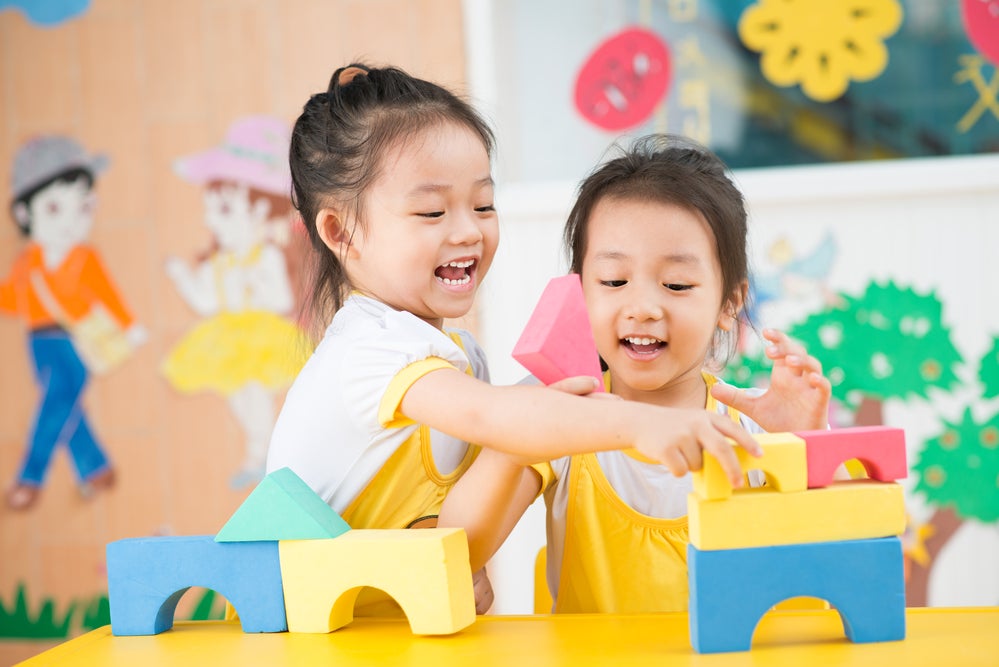
Point out shapes when you see them and play a shape version of “I Spy” to practice. If your child has a set of blocks, talk about the different shapes of the blocks. Challenge them to use only one shape to build something. Then, see what they can make by using all of the shapes.
Kids also learn about spatial reasoning by discovering how to describe the shapes they see and play with. They can compare them with dimensional adjectives like “big” and “small,” or characteristics like “straight” and “curvy.”
This includes the spatial relationship between different objects, too. Look out for observations using location adverbs like “under,” “beside,” or “around.” These are all different ways for your child to “measure” or observe how shapes take up space.
4. Sorting and Patterns
We categorize things in our daily lives without even realizing it. Your child probably already does this, too—they may arrange their stuffed animals or toys in a certain way. For example, they may keep farm animals separated from dinosaurs.
Sorting and patterns are related to categorical reasoning. In the same way grocery stores sort out items by their parallel uses, your child will learn how to sort things based on their characteristics and how they are the same or different from other objects.
They’ll sort objects by weight, shape, quantity, texture, color, and other traits, often without even realizing it!
It’s important to note here that sorting and counting aren’t sequential. Your child might begin sorting before they begin counting, in fact.
For instance, if you want your child to sort a bowl of fruit, you can ask them to count all of the strawberries. They’ll sort the strawberries from the rest of the fruit. If you ask them to count the red fruit, they’ll sort out strawberries, cherries, and watermelon and count them together.
Once a child has learned to isolate characteristics, they can begin to identify, extend, and even create patterns. Your child will learn how to:
- Copy a pattern
- Identify the parts that repeat and continue a pattern
- Correct a mistake in a pattern
- Explain a pattern
- Create their own patterns
To encourage your child to explore patterns, take a few moments to build a pattern for them when you play together. Use whatever materials you have available and create a simple AB pattern, such as truck, car, truck, car.
Next, point to each object. Say its name aloud. Then, when you get to the end of the row, ask them what comes next. If they aren’t sure, grab the next object and put it down. Once you’ve completed one round, start at the beginning and repeat each item to reinforce the pattern.
5. The Language of Math
Part of learning how to do math means learning how to “speak” math. We don’t mean your child will turn into C-3PO—just that they will learn how to use mathematically correct language, or how to tell a story with math terms.
This can happen in daily life. While picking out an afternoon snack, your younger child may say, “Hey! My brother has more crackers than me!” Then you might agree to “add” to the cookies on the younger child’s plate so that both plates are “equal.”
These skills may be naturally exciting for your child—they’ll feel like they’re learning how to speak “grown-up!” Show them how fun it is to incorporate mathematically appropriate language into their daily speech and use it to tell stories about what’s going on around them.
Using math words to describe things in their lives will help them give ownership over ideas and observations. You can motivate them to think about math in the world around them by using words such as:
- More than
- Less than
- Shape names
- Light or heavy
- Small or big
Mastering math language will help them in their quest to become robust mathematicians! It’ll also help them develop a strong vocabulary so they’re better prepared for kindergarten.
Basic Pre-K Math Checklist
Now that you know some of the concepts your child will be learning in pre-K math, let’s look at some of the skills they’ll build during this time.
- Rote count to 10
- Use one-to-one correspondence to count up to 10 objects and tell how many there are altogether
- Recognize basic shapes (circle, triangle, square)
- Understand the concept of quantity (more/less)
- Sort objects by one characteristic
- Understand and use directional terms, such as up, down, in, out
- Pick what object goes next in a simple pattern
While these aren’t all of the math skills your child might learn in pre-K, they will give your child a solid mathematical foundation to build on in kindergarten. And they’re all skills you can practice in fun ways!
Pre-K Math Development
As your child grows and learns, they’ll work through three phases of mathematical development: concrete, representational, and abstract. They’ll likely be in the concrete stage at the beginning of pre-K.
During this phase, students need hands-on activities and real-world examples to help them understand mathematical concepts. This is why math manipulatives are so crucial in the early years. It’s also essential to present math concepts in a very concrete way during this stage.
For example, if you’re teaching your child about numbers, don’t just tell them that five is more than three. Instead, show them five objects and three objects, and let them count for themselves. This will help them understand the concept of more and less.
As your child continues to learn and practice a mathematical concept, they can move into the representational phase. Here, students can count pictures or images instead of actual objects. For example, they realize that numbers can be represented by lines or drawings.
Then, they’ll be ready to try the abstract stage. At this point, children understand that numbers can be represented by symbols. They don’t need manipulatives or visual aids to do math problems. They can start using numbers and symbols such as + or – to solve math problems.
Math activities will help your child build their understanding of mathematical concepts so they can move through the different stages.
But, in pre-K, it’s important to focus on the process, not the answer. So don’t worry if your child doesn’t get the solution right away. Let them work through the problem and try to figure it out for themselves.
A strong foundation in pre-K math sets children up for success when they start kindergarten. By providing opportunities for them to explore and experiment with math, you can help them develop the skills they need to be successful in school and beyond.