
Children whose parents read them one book a day hear over 290,000 words by age five. Reading and exposure to words are critical for both language and cognitive growth. Looking at books with your child, even before they can communicate verbally, lays critical groundwork for literacy.
What are the different stages of reading development? How can you help your child hit their reading milestones? Here’s a look at how children learn to read, as well as tips to help your child develop these important skills according to their age.
Key Takeaways
- Early reading skills lay the foundation for learning to read. These include phonological awareness, alphabet knowledge, print awareness, and phonemic awareness.
- You can keep track of your child’s reading journey using research-backed milestones as checkpoints.
- Learning to read has many age-related stages, beginning with being read to, then playing with a book and progressing to finally sounding out words and understanding storylines.
- Exposing your child to lots of books, according to their interests, is the best way to foster a love of reading.
- In addition to literacy skills, reading helps support the development of social, emotional, and cognitive skills.
Table of Contents
- Early Reading Skills
- What Are Reading Milestones?
- Reading Milestones by Age
- Reading Milestones as Guidelines
- 5 Ways to Support Reading Development
Early Reading Skills
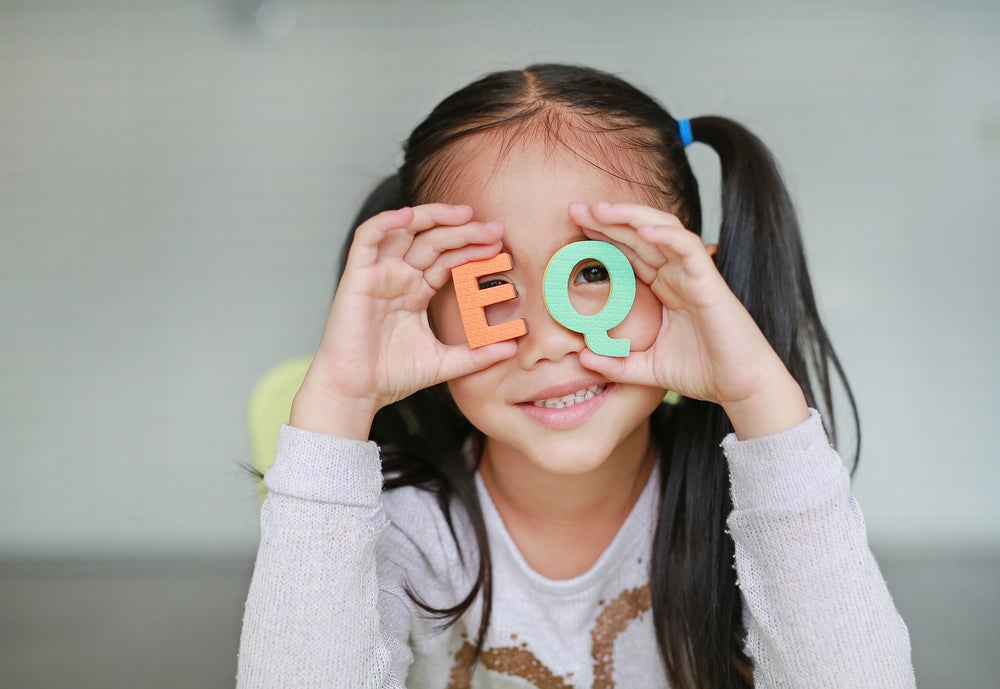
Early reading skills lay the groundwork for actual reading. (Think of them as the foundation on which the library is built!) Check out our reading fundamentals article to learn more about these four key skills:
- Phonological awareness
- Alphabet knowledge
- Print awareness
- Phonemic awareness
What Are Reading Milestones?

Learning how to read is a big step in your child’s early development. Being able to independently dive into books and feel the joy of reading on their own is important for your child’s confidence. Knowing about reading milestones can help you help your child!
Milestones are like checkpoints that can help you keep track of where your child is in their reading journey. They are not hard and fast rules about when your child should know how to do something.
Instead, they’re a tool to help you keep track of what support your child might need at different stages. Knowing what concepts they could be learning and interacting with can help you support their at-home reading!
Most reading milestones are tied to an age range. While this can be useful, it’s important to remember that there’s no such thing as the “right” age for your child to master a certain skill.
Your child will have their own unique timeline as they develop the skills that lead to becoming an excited and independent reader. As their interests evolve, their motivation for reading may change, too.
This timeline depends on many different factors. Remember,all kids are different! Your child may learn certain reading skills a few months or even a year after a peer. Or they might learn a year before that child. Both scenarios (and everything in between) are perfectly normal!
We want to emphasize the importance of discovering the joy of reading rather than focusing on checking off boxes.
With that said, here are the reading milestones (by age) to keep in mind as your little one grows older and progresses on their reading journey.
Your child will have their own unique timeline as they develop the skills that lead to fluency and then to becoming an excited and independent reader. As their interests evolve, their motivation for reading may change, too.
This journey depends on many different factors, and remember that all kids are different. Your child may reach each milestone earlier or later than other kids their age.
This is perfectly normal! We want to emphasize the importance of working on reading skills a little bit at a time and consistently (and in a fun way!), rather than focusing on checking off boxes.
With that said, here are the reading milestones (by age) to keep in mind as your little one grows older and progresses on their reading journey.
Reading Milestones by Age
Infants (Up to Age 1)
Milestones
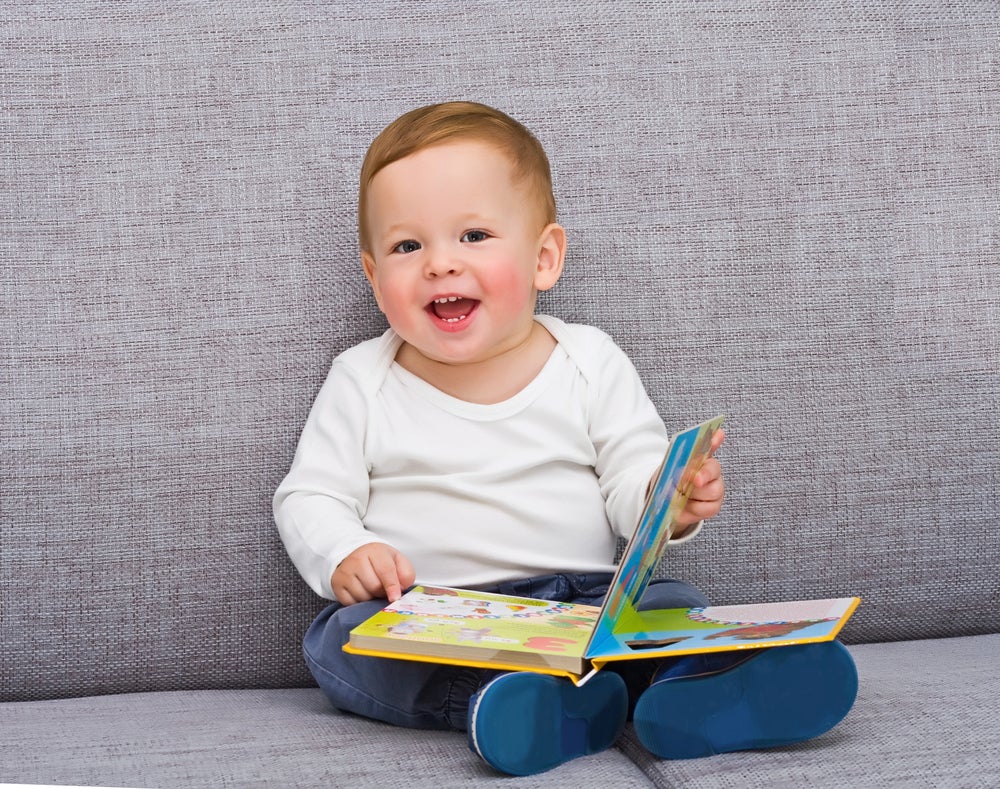
Although it may not be obvious, children start accumulating the skills they’ll need to help them on their reading journey as early as infancy. Interactions with books and words (before they can even talk, far less read) help set the foundation they need for a love of reading later on.
Your little one might receive lots of board books or soft, fuzzy books for holidays and birthdays. These are great! They help get your baby engaged with storytelling and illustrations. Reading books to them is the first step on the road to reading!
Not only that, but the warmth and connection you share as you read to your baby helps make reading a positive, special time.
As your baby nears the end of their first year, they might try to help turn the pages of the books you’re reading together. Listen for verbal responses to the stories, too. The noises they make indicate a level of attentiveness.
Helpful Hints
Choose books with high-contrast colors and strong graphics that will attract your baby’s eye! Once you’ve got their attention, respond to their verbal enthusiasm. If your baby coos, stop reading for a moment and engage in a conversation with them: “Yes, that’s a horse,” or “I see that yummy ice cream, too!”
Toddlers (Ages 1-3)
Milestones
As your little one gets older, the noises they make will transform into baby babble and, soon enough, their first words!
Their receptive language skills will grow, too. As you read them a book, they’ll hear words (e.g., cow, bus, rainbow) and connect them to the pictures on the page that represent them. Pictures that show up often in kids’ books might become part of their toddler vocabulary.
Another way to involve them in the reading process is to let them hold the book and turn the pages. At first you’ll have to prompt them when to turn each page, but once books become daily favorites, they may surprise you by knowing on their own!
Your toddler might begin to recognize their favorite book covers and ask for them again and again (and again!). They may even be able to recite parts of the stories they love from memory.
Helpful Hints
By about 18 months, some kids will probably move from babbling to using words. Encourage them to identify people, animals, or objects by pointing and asking “What’s that?”
Model how to react to parts of a story as you read (“Wow that surprised me!” and “I wonder what will happen next!”).
Preschoolers (Ages 3-4)
Milestones
All of the groundwork you laid in your child’s earlier years becomes evident now as they learn in leaps and bounds. At this point, kids may know about half of the letters in the alphabet, notice rhyming words, and begin matching sounds to letters.
If your child is going to daycare or preschool, this is when their teacher will start to introduce the different parts of books (i.e., the title, author’s name, illustrator’s name, page numbers, etc.).
Your child will discover that in English we read words from left to right and turn the pages from right to left. They may also learn to recognize the spine and cover of a book and the names of the main characters. They might summarize a story: “This book was about a cat who wore a tall hat.”
Lastly, at this stage, children may be able to recognize a good handful of alphabet letters and some letter sounds.
Helpful Hints
Boost your child’s rhyming and language skills by helping them discover books they like, encouraging them to engage with books, pointing out letters, and finding simple rhymes to read them. You can also play listening games like Simon Says or Red Light, Green Light.
Kindergarteners (Age 5)
Milestones
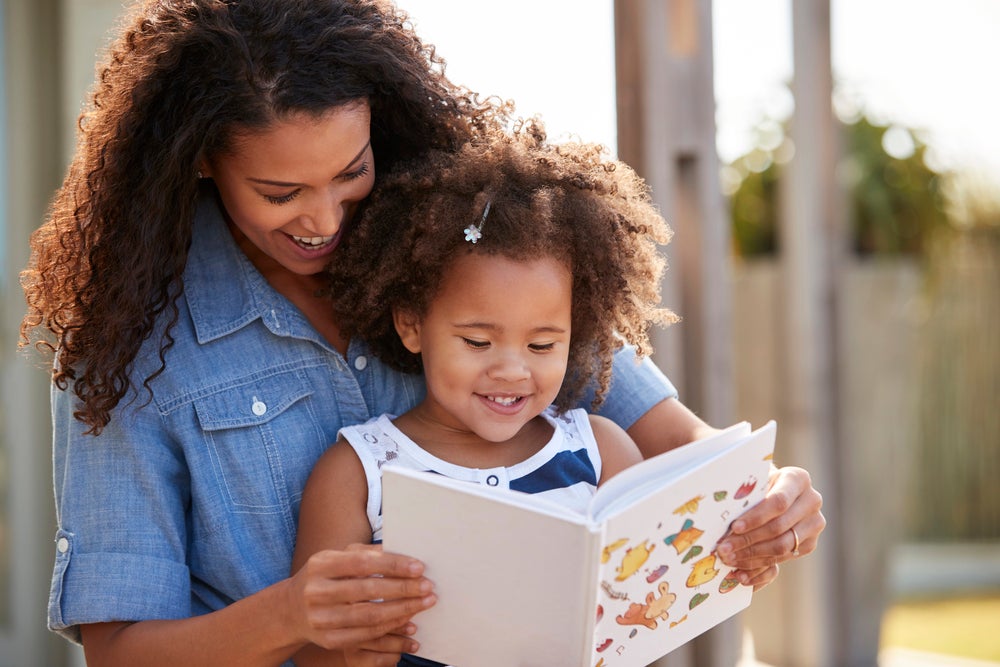
At this age, kids learn all about phonics (the relationship between written letters and the sounds they make) and the alphabetic principle (the overarching idea that letters represent sounds and can be used to make words).
The work of decoding words will also most likely begin now for most kids. Your child will start learning how to distinguish the beginning, middle, and end of words into individual phonemes.
They might understand how to make new words by adding and replacing letters (for example, changing the first letter of cat to make rat).
They will also be introduced to advanced phonics and begin to learn about digraphs (a combination of two consonants that have a single sound, as in “sh” in ship) and blends (a combination of two consonants that are each pronounced, as in the “bl” in blend).
Expert tip: If you’re looking for help with phonics, you can visit the Begin Parent Resource Center for tips, advice, and fun game ideas!
Along with learning words that are phonetically regular (meaning they sound the way they’re spelled), your child may be exposed to sight words that are phonetically irregular. This is an advanced learning skill, and it may take some time for your child to read these sight words with ease.
In terms of comprehension, your child might be able to ask (and answer!) who, what, when, where, and how questions about the stories they are being read and eventually, reading themselves.
Being able to sequence the events in a story appears at this stage of reading development, as does predicting what comes next in a story.
Helpful Hints
Ask your child to summarize the books you read. Make it a game by pretending you can’t remember what the story is about. Then ask them questions about what they read, encouraging them to elaborate on different things that happened.
We also recommend making sight words fun and easy by pointing out sight words in your everyday life (like on road signs, for example) and focusing on recognizing a few sight words at a time.
Early Grade Schoolers (Ages 6-7)
Milestones
By this age, your child’s reading confidence is really growing! Their skills are becoming more substantial, and they may begin exploring independent reading (or reading quietly beside you).
Your child’s sight words will increase. They will also begin learning some advanced phonics, like silent “e” and vowel teams like “ea” and “oa.”
Their vocabulary and word recognition will likely grow, especially with high-frequency words such as would, which, there, and some that appear often in things they read.
At the same time, their decoding skills will grow stronger as they practice reading unfamiliar words more and more. They may also begin noticing punctuation and how it affects the meaning of the sentences they read.
Context clues help kids decipher words at this point in their reading development. They might reread sentences they don’t understand at first to grasp the story better.
Finally, all of the new (and old!) stories they read will help them feel confident as readers and all the more eager to read more!
Helpful Hints
To help nurture a love of reading, encourage kids to choose both fiction and nonfiction books to read and see what subject matter interests them. Throw some age-appropriate comic and graphic novel formats into the mix. Explore books in a series so your child will want to come back for more!
Late Grade Schoolers (Ages 8-10)
Milestones
In an exciting step forward, the literacy skills kids have gained now allow them to shift from learning how to read to using reading as a way to learn about other things.
At this age, your nights of bedtime stories might change, but it doesn’t mean they have to end! Your child will seek out books that interest them, and may want to read to you, rather than you to them. Having a good supply of books for your child to choose from on hand can be huge for your young reader!
Most likely, they can identify the themes of a book and make inferences to understand the story better. They may be able to explain a story’s arc (the rising action, climax, falling action, and resolution), as well as use evidence from a book to answer questions.
Different reasons for telling a story might also become more apparent to them. They’ll understand that some stories are made to teach, others to entertain, and others to persuade readers.
Your older elementary child may also be exposed to read-aloud sessions during which they practice taking the reins in reading the story. This is a great way for you to spend time together. Sit back and listen as your confident reader shows off their achievements!
Helpful Hints
Even though your child may be reading independently at this point, don’t stop reading to them! It’s a great way to stay connected with your child and to tackle books that might be too difficult for them to read on their own.
Reading Milestones as Guidelines
Learning to read isn’t a perfect science. We recommend using these reading milestones as guidelines, not rules. There are many variables involved, and all children are different! So, of course, they’re going to learn to read at different rates.
5 Ways to Support Reading Development

1) Read Often
Books help kids make sense of the world around them by representing things in their own lives as well as exposing them to new people, places, and things.
Reading to your infant helps their brain get ready for language and talking. And when your child is older, conversations about what you’ve read together builds vocabulary and critical thinking skills.
2) Make Books Available
Simply having books within reach allows kids to “practice” reading. Opening a book, turning pages, telling a story, and using language all develop critical literacy skills.
3) Ask Questions
Asking kids questions about the books you read to them encourages them to listen actively. Try to focus on open-ended questions, which facilitate conversation and vocabulary development.
4) Embrace Interruptions
When your child asks for a word’s meaning or shares a story inspired by a book, think of that interruption as an opportunity for conversation.
5) Read Wherever You Are
Reading supports language development, so don’t limit it to just books. As you go about your day, look for opportunities for your child to practice reading. Signs, cereal boxes, and magazines at the dentist’s office can support literacy, too!
Help Your Child Begin to Read!

With love,encouragement, and practice, kids will learn to read in their own time. Your child will reach their age-appropriate reading milestones when it’s right for them. Begin would like to help.
Our apps and kits connect kids with activities that teach them the skills that matter most, including how to read. Using our HOMER app for just 15 minutes a day has been proven to raise early reading scores by 74%!
Let’s get reading!
Frequently Asked Questions
Is it OK if my five-year-old isn’t reading yet?
Yes. Reading is a complicated, many-layered skill, and kids develop it in their own time. At this age, look for signs that your child is starting to understand and use phonics. If they are, they’re progressing on their learning journey.
What are the differences between reading aloud, shared reading, and guided reading?
During Read Alouds, teachers read a book to the whole class. They model reading behaviors and ask questions to prompt class discussion about the theme and characters. This type of reading experience helps build vocabulary, comprehension, and a love of reading.
Shared Reading is a more interactive experience than Read Alouds. Teachers and students read a text together, like a big book or a poem on a chart. The teacher models reading strategies, like decoding, while students join in. This experience helps students develop early reading skills and strategies, fluency, and confidence.
Guided Reading happens during small-group instruction. A teacher works with a student or a small group of students to read a book at their own level with support. The teacher introduces the phonics and skills needed to read the book before students read, and then guides them as they read, helping them practice decoding and problem-solving strategies as they go.