It’s hard to wait. You’re eager for the thing that’s coming, but it’s not here yet. So you think about it. You might feel like you’re sitting around doing nothing. But sitting and waiting, having patience, isn’t nothing. It’s a very specific skill that can be tricky to learn.
It’s especially tricky for kids. So, how do you teach kids patience in a way that makes sense to them? In a way that’s doable and fun? We’ve collected useful tips and activities to help you lay the foundation for this critical mindset.
Key Takeaways
- Patience is the ability to calm your mind and body in a challenging situation.
- Some tips for practicing patience include modeling it, reflecting to your child what you see in them, understanding your child’s point of view, starting small, and setting your child up for success.
- Other tips include using visual cues, practicing conscious waiting, using the power of “yet”, “now,” and “next,” using kid-friendly comparisons, noticing what keeps your child’s attention, and finding fun ways to pass the time.
- Activities for teaching patience include games like Red Light-Green Light, Egg and Spoon Walk, Catch the Drizzle, the Silence Game, jigsaw puzzles, baking, gardening, birding, painting, making “patience art,” and practicing basic turn-taking.
Table of Contents
Why Is Patience Important?
First, what is patience, exactly? In some ways, it’s simply another name for self-regulation: the ability to calm your body and mind in a challenging moment. Cultivating patience has never been easy, but it’s especially tough for kids growing up now.
Cause and effect can happen in less than a second on a computer or a cell phone. One click gets you from point A to point B. As a result, kids often expect quick results in all aspects of their lives. But meaningful experiences take time and practice and, yes, patience.
Patience isn’t only about learning the art of waiting. It’s also a critical part of finding your purpose in life. Finding what you love and what you’re good at isn’t necessarily easy. It takes trying new things, making mistakes, reflecting on them, and trying again. It takes a long time.
This process can’t happen unless you can practice patience. It is behavioral (slowing down, calming down, redirecting your energy), and it is also emotional (transforming anger or fear into contentment, determination, and even hope). It looks like slowing down and self-reflecting.
If you can begin educating your child about how to be patient when they’re young, they’ll more easily integrate those practices into their life as they get older. This is a good thing. Patience is a lifelong journey.
Tips for Teaching Patience
Kids often live in the moment. They’re engaged now. They’re active now. They don’t spend time and energy anticipating the future. While this is a vibrant way to live (and we as adults can learn from kids in this regard!), it also makes waiting hard.
If your child is inexperienced in the patience it takes to wait for something, the frustration they feel makes sense. Remember to empathize with your child on their journey to mastering patience, and celebrate the wins along the way.
Model It
The best teaching is often anything but direct. If you tell a child you want them to be quiet, they may continue to make noise, but if you demonstrate the act of being quiet, they are more likely to study and then imitate you.
Consistent modeling of behaviors you want your child to learn can be extremely successful. Our kids spend a lot of time watching us! They absorb what we present to the world.
Reflect to Your Child What You See in Them
The more you can give voice to what your child is feeling, the more they will be able to recognize and express their emotions.
Try gently explaining what you see happening to them: “You have 10 minutes until we go to the park. I see the idea of waiting frustrates you. I also see you’re trying to stay calm.”
When kids have help identifying their emotions, experience their full depth, and, finally, feel understood, they have the opportunity to relax into a state of calm and patience.
Our Learn With Sesame Street app is a wonderful tool for this kind of social-emotional learning, too.
Understand Your Child’s Point of View
Your empathy and your child’s patience are linked and often take the form of cause and effect. If you can put yourself in their shoes and imagine their waiting process, you can authentically validate their frustration, boredom, or anxiety.
This ability to see the moment from your child’s point of view and connect around it (cause) gives them the comfort and safety they need to practice something hard and new (effect).
Start Small & Set Up Your Child (and Yourself) for Success
How do you teach kids patience? By taking baby steps.
You wouldn’t be able to run a marathon if you didn’t practice running a mile. Your child can’t be expected to be patient while they wait three hours to go to the playground if they haven’t learned to wait five minutes.
Start with micro-pauses. These are small, intentional increments of time in response to lower-stakes requests or interruptions. They give your child the opportunity to understand that wanting and receiving aren’t simultaneous, but instead are two separate things.
For instance, ask your child what they want for a snack. Even let them help you prepare it. Then ask them to wait a few minutes before they can have it. Knowing exactly what’s coming will help them stay calm.
Try the Patience Stretching Technique
You can be even more intentional by practicing a “patience stretching technique.” Wait until your child asks you for something. Maybe they want you to read a book to them. Get the book, but instead of sitting to read it right away, ask your child to wait as you do something else.
You don’t have to ask them to wait long. At first, the wait can even be as little as five seconds. After the allotted wait time, give your child plenty of praise for their patience, and then read the book.
Increase the wait “stretch” each time you do this to expand your child’s resilience.
Use Visual Cues
Try using a timer when you first introduce the idea of patience. Your child can even help set it.
A concrete object that symbolizes the abstract concepts of time and patience helps your child to understand what you’re asking of them.
Practice Conscious Waiting
A long-term goal with the practice of patience is transforming it into something positive and even creative and fun. You can address this idea in the small moments of your child’s life by resisting the urge to fill their time with activities that are meant to distract them.
Take driving in the car, for example. Instead of handing your child a tablet to use (which we agree is sometimes a life-saving idea!), ask them to play a game of I Spy out the car window.
This kind of active observation allows your child to become aware of time passing, in a positive way.
Use the Power of “Yet”
You know that just because you can’t do something now doesn’t mean you’ll never be able to do it. But your child may not know this. They may feel frustrated, or even defeated, when they can’t accomplish what they want.
Help your child understand this is just one moment in time by adding the word “yet” to the thing they can’t do right now: “You don’t know how to ride a bike yet, but you’ll learn.”
A great way to put the moment into context is to remind your child of something they used to struggle with, but now can do: “Remember when you couldn’t put on your shoes by yourself? You sure can do it now!”
Incorporate “Now” and “Next”
Similar to the idea of “yet,” the dual idea of “now” and “next” is a useful way to frame patience, especially within the context of short-term waiting.
For example, your child and their friend may want to play with the same toy truck. Help them understand taking turns by inserting “now” and “next” into your explanation: “Your friend is going to play with the truck now, and you’ll play with it next.”
Having words to signify their turn is coming can make waiting much easier.
Use Kid-Friendly Comparisons
It’s not unusual for kids to struggle with understanding the concept of time. “Your brother will be home at 3 o’clock” or “You can go to the park in three hours” can make your child feel like you’re speaking a foreign language.
Try describing the passage of time in ways that make sense to your child because they live it. For example, you might say, “I’ll be back from my trip in four sleeps.” Your child has experience with both sleep and waking up to a new day.
Notice What Keeps Your Child’s Attention
Another effective way to teach your child patience is to call it out when you see them practicing it on their own. Kids naturally focus for longer periods on activities they enjoy. Let them experience it and, later, talk about what you saw.
This also applies to times when it looks like your child needs help. They might be struggling to stack blocks, searching for the right pieces to a puzzle, or trying to tie their shoes. You may find yourself wanting to interrupt with assistance.
Try letting your child take the time they need to stack the blocks, finish the puzzle, or tie their shoes on their own. Oftentimes, kids naturally have a “beginner’s mind” when it comes to activities that pique their curiosity or fill them with excitement.
Believe it or not, your child is practicing patience in those challenging moments even if they (and you!) don’t realize it.
Find Fun Ways to Pass the Time
As you know, it takes a long time to learn patience. When your child is first practicing it and feeling frustrated, anxious, or bored, try distracting them with a fun game. This gives your child’s body a chance to experience waiting without conscious cognitive focus.
We’ve come up with a bunch of fun ways to pass the time below!
Activities for Teaching Patience
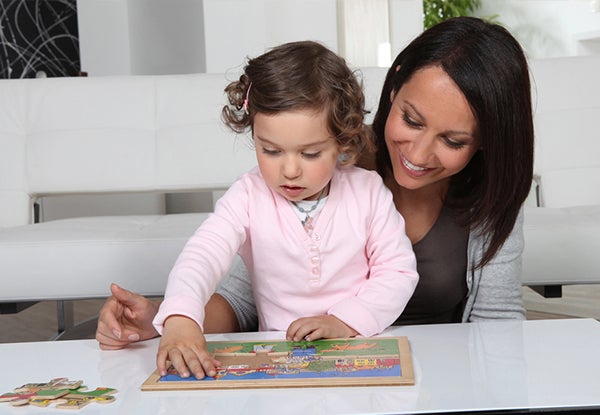
A fun way to practice patience is by engaging in cooperative play activities that have it built right in!
Red Light, Green Light
You’re the traffic light. Stand at one end of the room and have your child stand at the other. Call “green light” when you want them to move forward and “red light” when you want them to stop.
If they move during “red light,” they go back to the start.
Egg and Spoon Walk
Give your child a spoon and then balance an egg on it. Challenge them to walk from your designated start to your designated finish without dropping and breaking the egg.
Catch the Drizzle
The next time it rains, ask your child to get a cup, bowl, or bucket to put outside or on the windowsill. Then ask them to watch and wait until it fills up with rain.
The Silent Game
An oldie but goodie! Turn self-regulation practice into a game. Challenge your child to stay quiet for as long as they can. Time them, and then see if they can beat their time. You can play this with a group of kids, too. Or make it a contest between you and your child!
Jigsaw Puzzle
Invite your child to do a puzzle with you. Give them as much time as possible to find pieces and fit them together on their own.
Baking
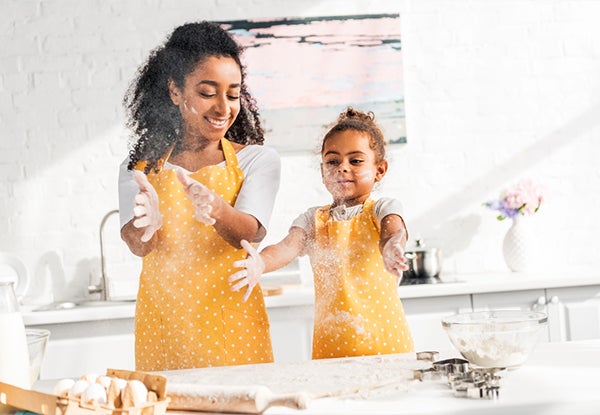
From slowly pouring ingredients into a bowl to mixing to waiting for dough to rise, baking has many built-in opportunities to practice patience.
Gardening
Gardening allows you to teach your kid about patience by taking a long view. The time between planting a seed and eating a vegetable can seem endless to a child, but every stage of the growing process has activity and milestones to note.
Birding
Set up a bird feeder near a window of your home before spring. Then ask your child to check it for birds every day. You can even create a chart or calendar to keep track of the days.
While you wait, read and talk about migration. You can also try some bird-related art projects like drawing birds, making papier-mache eggs, and making nests out of found objects.
Once the birds arrive at the feeder, your child can observe them as they eat. Ask your child to keep track of how many different colored birds they spot. This is especially compelling for kids who love animals and nature!
Painting
Waiting for paint to dry is an inherent part of the painting process. Set up an art station for your child and ask them to create something that has layers of color.
Paint one color, wait, paint another, and so on.
Making Patience Art
Visual cues can be helpful for kids. For instance, having a daily routine chart on the wall gives them a sense of comfort and predictability. If they need to know what’s coming next, they can find the information easily.
Visual cues are especially useful tools as your child learns how to be patient. The bird feeder is a good example of this. It takes time to make the feeder and then more time to wait for the birds to arrive.
Another idea is to ask your child to paint a pot. Then they can plant a seed, take care of it, and watch it grow. Or your child can construct a clock out of paper. Whenever they get impatient, you can remind them to look at their clock!
Basic Turn-taking
Many kinds of play (social play, in particular) include taking turns, which is a tangible way to teach your child patience. Some classic examples that include turn-taking are:
- Board games
- Card games
- Tag
- Hide-and-Seek
- Sharing a toy
Have Patience Teaching Patience!
Try to be patient when you’re trying to teach your kid to be patient!
Learning patience can take time for kids. Remember that it doesn’t have to be learned overnight, and that your child might have situations in which patience is beyond their capability (think when they’re tired or hungry or when the length of time they must wait is simply too much of a challenge for their age).
Of course, when they do demonstrate patience, give them lots of encouragement. They did it!
One fun way to lighten the process and bring you and your child closer together is to tell some stories about your own experiences with impatience from your childhood. You can find points of connection, validate your child’s experiences, and have a laugh, all at the same time.
At Begin, we’re here to support you. Your child can learn social-emotional skills with Learn with Sesame Street, read with HOMER, code with codeSpark, and do activities about world cultures and science with Little Passports.
Our award-winning learning programs can help your child develop the patience they need now for the success they’ll find in the years to come.
Frequently Asked Questions
When will my kid begin to really understand the meaning of patience?
Understanding what patience means takes a long time. Kids learn it at different ages, and your child will have their own skill-building trajectory.
In general, though, infants and toddlers can’t understand patience, but at around age one, you can introduce it by waiting a few seconds between when they ask for something and when you respond.
Between the ages of three and five, kids are still impatient. But they can turn their focus to something new, and they can be distracted. This is the beginning of learning how to self-regulate.
By the time your child is six or seven years old, they can think about their own behavior and its consequences. They’re learning how to take other people’s feelings, actions, and ideas into account. And this is when your child can truly begin to understand patience.
What do I do when I lose my patience?
It happens to all of us. No matter how hard we try, we lose our patience at one point or another. If you feel you’re beginning to lose it, try to slow yourself down. That might look like deep breathing. It might look like stepping away from the situation you’re in.
If you don’t catch it in time, and you do lose your patience, know that you’re not alone. Also know that the most important thing is how you handle the “after.”
Validate your child’s experience of what happened. (“I lost my patience, didn’t I?”) Owning your behavior is vital in reestablishing a connection. Apologize for your behavior, too. (“I’m sorry I raised my voice.”)
You also want to be transparent about needing to do better.
All of these actions are about modeling self-regulation after getting dysregulated. There’s no way to prevent your child (or yourself) from becoming dysregulated, but there’s a lot you can do to come back from it. That’s just as critical a lesson for your child as learning patience.
What are the best games for waiting in public?
What do you do if you’re in a doctor’s waiting room, or you’re in the middle of running errands and your child begins to lose patience?
Try playing simple games that require your child to be present and use their senses. I Spy is a fun one. Or see if your child can find something that begins with each letter of the alphabet.
Ask your child to come up with a category (such as animals or things that are blue) and take turns finding objects that fit. And one other great game is 20 Questions!